

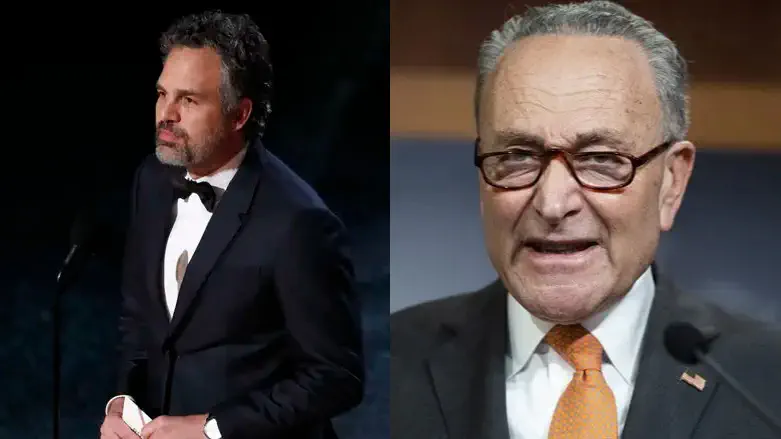
Actor Mark Ruffalo has come under fire over comments targeting Senate Minority Leader Chuck Schumer (D-NY), with critics accusing the Hollywood star of invoking antisemitic stereotypes by suggesting that the Jewish senator's religious beliefs and loyalties make him unfit to lead Senate Democrats.
In a post on X, Ruffalo endorsed Senator Chris Van Hollen (D-MD) to replace Schumer, arguing that the Democratic Party needs leadership free from religious, corporate, and other established interests.
"Israel is just one issue in a whole host of reasons Van Hollen is the right leader for our times," Ruffalo wrote. "We need Justice; we need leadership that follows the will of the people, not entrenched religious beliefs and loyalties."
The four-time Academy Award nominee also accused established political leaders of failing to confront corporate influence and other challenges, arguing that Van Hollen possesses the character and determination needed to address what he described as growing moral and political corruption.
"We have absolutely nothing to lose by replacing Sen. Schumer," Ruffalo declared, urging Americans to pressure their senators to support a leadership change.
His remarks drew criticism from Jewish organizations and political commentators, who questioned whether his reference to religious loyalties was directed at Schumer's Jewish identity.
Anti-Defamation League (ADL) CEO Jonathan Greenblatt challenged Ruffalo to explain his language.
"Entrenched religious beliefs? Entrenched loyalties? Please elaborate, Mark Ruffalo," Greenblatt wrote. "Which religion? Loyal to whom?"
Rabbi Yaakov Menken, executive vice president of the Coalition for Jewish Values, also rejected Ruffalo's characterization of Schumer.
"There are many devout Senators & Congressmen with 'entrenched religious beliefs.' Chuck Schumer is not one of them," Menken wrote, arguing that Van Hollen has closer connections to religious leadership than Schumer does.
Political commentator Meghan McCain similarly asked the actor to clarify what he meant by the reference to religious beliefs and loyalties.
Rather than withdrawing his criticism, Ruffalo defended his position on Sunday by pointing to remarks Schumer delivered at the American Israel Public Affairs Committee (AIPAC) policy conference in 2018.
In those remarks, Schumer discussed Jewish religious claims to the Land of Israel and their role in the Israeli-Palestinian conflict.
"Of course, we say it’s our land, the Torah says it, but they don’t believe in the Torah. So that’s the reason there is not peace," Schumer said at the time.
"These are Senator Schumer’s words, not mine," Ruffalo wrote.
"Schumer is entitled to his religious beliefs, but those beliefs cannot determine the rights of another people. And they certainly cannot substitute for international law," the actor continued.
Ruffalo argued that resolving the Israeli-Palestinian conflict requires addressing territorial rights, security, equality, and self-determination for both sides.
Human rights attorney Brooke Goldstein, executive director of The Lawfare Project and founder of the #EndJewHatred movement, sharply condemned Ruffalo's statements.
Speaking to Fox News, Goldstein accused the actor of using Schumer's Jewish identity to question his political judgment and loyalty.
"And now they’re even turning on one of their own, Senator Chuck Schumer, because apparently even being a loyal Democrat isn’t enough when you’re Jewish," Goldstein said.
She argued that Ruffalo's repeated criticism of Israel raised questions about whether his activism was motivated by political concerns or hostility toward Jews.
The controversy follows earlier accusations of antisemitism against Ruffalo over his opposition to the proposed merger involving Paramount and Warner Bros. During that dispute, the actor criticized Paramount CEO David Ellison and his father, Larry Ellison, over their support for Israel.
Paramount accused Ruffalo of employing antisemitic tropes in his criticism of the company and its leadership.