
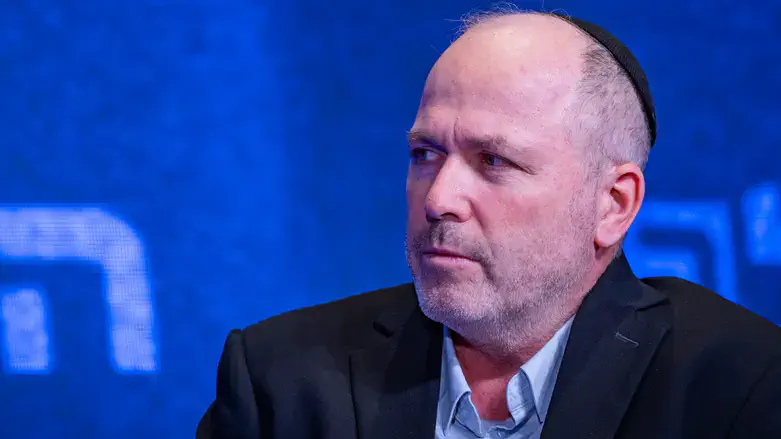
JNS news site editor, journalist and commentator Ariel Kahana is warning of legislation taking shape in the US Congress that could lead to severe personal and financial sanctions against Israeli government ministers, settlement leaders and organizations operating in Judea and Samaria.
In an interview with Arutz Sheva, Kahana reveals details of conversations with American officials who, he says, made clear that Democrats intend to move quickly on legislation targeting what they define as violence in Judea and Samaria. He warns that Israel has only about a month to prepare for the initiative and try to mitigate its consequences.
According to Kahana, Hakeem Jeffries, who is expected to serve as speaker of the House of Representatives, said in an interview with The New York Times that legislation to prevent violence in Judea and Samaria would be among the first bills advanced.
Kahana says, "My sources tell me this is a bill being drafted by the J Street lobby, and its implications are severe personal sanctions against individuals and organizations leading and associated with construction in Judea and Samaria".
He says the messages conveyed to him leave little room for optimism, "This is not the time to argue about who is right. We are right, but we will not convince them. I agree that this is entirely political. I was explicitly told that if we do not build in E1, or if we give up Netanyahu as prime minister, the law will be more moderate".
Kahana stresses that even if the American demands are viewed as unacceptable interference in Israel's internal affairs, the threat must be taken seriously, "The information indicates that they intend to bring a hundred-ton hammer down on our heads, and whether we are right or not, we should take steps to make that hammer smaller".
To illustrate the severity of the potential sanctions, Kahana describes a scenario in which Finance Minister Bezalel Smotrich discovers that his bank account and credit card have been blocked, leaving him unable even to buy groceries or fill his car with fuel. He says similar restrictions could also apply to prominent settlement figures, including Israel Ganz and Ze'ev Hever, known as Zambish.
Kahana clarifies that this is not merely a political threat from the Democrats. In his assessment, the legislation could gain broader support, and President Donald Trump would not necessarily rush to veto it.
He says Trump is already expected to face a series of bills he will want to veto, while members of his own circle have also sharply criticized incidents of violence in Judea and Samaria.
In this context, Kahana points to the response of US Ambassador to Israel Mike Huckabee, considered a staunch supporter of the settlement movement, to incidents in which American citizens of Palestinian origin were harmed. He says the issue also arose in tense conversations that Huckabee, Secretary of State Marco Rubio and Vice President JD Vance held with Prime Minister Benjamin Netanyahu and Israeli Ambassador Yechiel Leiter.
He says, "The United States cannot tolerate harm to Palestinian-American citizens". He adds, "I may be proven wrong, and Trump may veto it, but no one can be certain that will happen".
Later in the interview, Kahana details the demands he says were presented to him in conversations with American officials as possible ways to soften the bill. The list includes refraining from construction in the E1 area, ending Jewish violence, curbing the establishment of farms, allowing supplies into Gaza, and political demands concerning Netanyahu's continued tenure as prime minister and Itamar Ben-Gvir's continued service as a government minister.
According to Kahana, he was told that Israeli compliance with some of the demands could lead to the removal of some sanctions from the emerging legislation.
He says, "We do not like it, but they have an overwhelming majority in the House of Representatives, and that is something we have to deal with, even if it is unjust".
Kahana recounts another conversation in which he sought to understand how far the sanctions might go. He told one American official that he, too, lives in a settlement, and asked whether all residents of Judea and Samaria might eventually be barred from entering the United States if a right-wing government with the same composition as the current one were formed again.
He says the answer he received was yes. Kahana stresses that the person he spoke with is not part of the far left, but rather among those in the Democratic Party who want to maintain dialogue with Israel.
Against this backdrop, he calls on Israeli decision-makers to recognize that relations with the Democratic Party require urgent attention. He says the Democratic victory in the midterm elections and the possibility of a Democratic president being elected in the future require Israel to prepare for a shift in its relationship with Washington.
He says, "Israel needs to repair its relations with the Democrats, which are in a terrible state, and that is also one of the reasons a bill like this is being introduced".
Asked whether Israel should instead focus on diplomatic efforts with Trump to ensure that he vetoes the bill rather than comply with the Democrats' demands, Kahana replies that this is certainly an option. However, he reiterates that members of the president's circle have also criticized incidents of violence in Judea and Samaria, so Israel should not assume the president will automatically block the initiative.
Toward the end of the interview, Kahana sharply criticizes those involved in incidents of violence in Judea and Samaria. He says that beyond the direct harm caused by their actions, they provide opponents of the settlement movement with political and legal tools that could harm the entire settlement enterprise.
He states, "The people who beat others, spray and burn things are endangering the settlement enterprise in Judea and Samaria".
Kahana warns that if Democrats conclude that sanctions are achieving their objectives, they could become a permanent tool for pressuring Israel. He says that in such a situation, the demands would not stop at addressing incidents of violence but could expand to restrictions on construction in cities such as Ariel and Ma'ale Adumim.
He rejects claims that his criticism of the violence stems from a left-wing political position, making clear that he sees it as a warning intended to protect the settlement movement itself. He concludes, "They are drilling a hole in the ship, and water is coming in. As long as the government does not stop this, the ship will sink".