
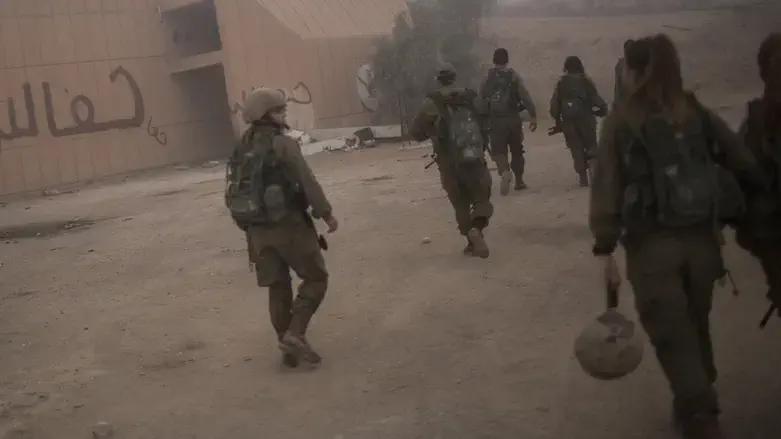
A report by the Choosing Family organization examined differences in the extent of reserve service between male and female combat soldiers, demanding transparency and disclosure of the findings to the public.
Speaking in an interview with Arutz Sheva - Israel National News, Choosing Family chairman Michael Puah said that obtaining the research data was not straightforward.
Instead, a request was submitted to the IDF under the Freedom of Information Law, followed by several months of waiting for answers, after which the organization "had to file two court petitions. We received contradictory answers, and after we confronted the IDF Spokesperson's Unit with the figures it had provided, we received a final, updated response. We hope it is accurate, because the figures we received earlier were less clear-cut."
"The IDF is making a great effort to put a positive spin on the integration of women into combat roles," Puah stressed. Presenting some of the report's findings, he noted that a female combat soldier serves an average of 8.19 years in the reserves, compared with 14.93 years for a male combat soldier. That is a gap of 6.74 years, with female combat soldiers' reserve service lasting approximately 45% less than that of their male counterparts. A significant gap was also recorded in the number of reserve duty days actually served: Between 2013 and 2026, excluding the COVID-19 pandemic years, female combat soldiers served, on average, only about 75% of the reserve duty days served by male combat soldiers.
Choosing Family emphasized that the figures take on particular significance against the backdrop of the past three years of war, during which the reserves have become a central component of the IDF's operational capabilities. In 2024, for example, male combat soldiers served an average of 257 reserve duty days, compared with 196 for female combat soldiers. In 2025, the figures were an average of 211 reserve duty days for male combat soldiers, compared with 180 for female combat soldiers.
One of the report's central findings combines two measures: the length of reserve service and the number of reserve duty days actually served. According to the report's calculation, even assuming that all male and female combat soldiers who complete regular service continue into the reserves, a female combat soldier's cumulative service amounts to only about 41% of that of a male combat soldier.
To illustrate this, the report compares 1,000 male combat soldiers with 1,000 female combat soldiers, assuming they all continue into the reserves. Under this scenario, the men would be expected to accumulate 597,200 reserve duty days, compared with 245,700 for the women. The cumulative gap is 351,500 reserve duty days.
Beyond these figures, Puah said, another question was submitted in recent days that also requires an answer: When comparing 100 male combat soldiers with 100 female combat soldiers, how many actually complete their service in combat roles, and how many transfer during their service to other units in more rear-echelon roles?
"The IDF should be asking these questions itself," Puah said. "The IDF is strongly promoting the integration of female combat soldiers into the military, and this comes at a heavy cost. We know there has been a huge drop in reserve service in the Artillery Corps, and the entire corps is in trouble. Every female combat soldier who joins leads to the departure of several religious and traditional male combat soldiers. Not long ago, the IDF proudly announced that a female combat soldier had joined Sayeret Matkal, but a review of the data showed that she had not completed the unit's training program. Instead, she had completed a special program and was integrated toward the end. The price of admitting a female combat soldier who had not completed the same training as everyone else was that two or three male combat soldiers left the unit. That is in addition to those combat soldiers who will consider whether to join the unit at all, because they do not want to serve in close quarters with female combat soldiers."
Puah emphasized, "We have no criticism of the wonderful, courageous young women who come to serve the people of Israel. We have only good things to say about them. Our criticism is directed at the IDF's senior command, which uses their motivation and willingness to make sacrifices not to achieve victory, but to advance an agenda that is destroying the military."
Arutz Sheva asked Puah how he explained his assertion that senior military officers were promoting an agenda that harms the military, given that they are responsible for the institution and its achievements. Those officers would seemingly have no interest in the failure of the military they command.
Puah responded, "They do not say they want to weaken the military. Rather, they believe there are things more important than victory: issues they view as social and ethical, educating the country, promoting equality, and so on. In recent years, the IDF has become a laboratory for social experiments, and success is measured not by victory but by promoting an LGBT group in Unit 8200, and so on. Throughout this process, the IDF appears before the Supreme Court and commits itself to the values of equality, without presenting the court with the costs of the initiative or the pilot programs that failed, such as the integration of female tank crew members."
Puah added that the number of reserve duty days and years served by female combat soldiers does not stem from their being less capable, but from physical capabilities that he said are naturally lower than those of male combat soldiers. Female combat soldiers marry and become pregnant, and the physical changes they undergo do not allow them to serve as many reserve duty days, he said.
Puah called on the military to present the actual figures on the resources invested in integrating women, the number of religious and traditional soldiers who have left the system, the reduction in reserve duty days resulting from women's service, and the impact on the Artillery Corps and other units, among other issues.
"We are only asking you to present the actual figures, rather than simply showcasing female combat soldiers," he said.
Arutz Sheva also asked Puah whether the report's focus on professional and operational data concealed a religious worldview that opposes the integration of women from the outset, even if it were shown to be operationally feasible.
"In my view, a Jewish army is one that preserves the sanctity of the military camp, and we are putting that on the table. An army that preserves the sanctity of the camp is a victorious army, and integrating women into operational service deals a devastating blow to that," Puah said.
"It is important to understand that beyond this statement of values, there is now a new religion in the IDF: a progressive army versus a Jewish army. The IDF's senior command is heavily influenced by organizations that receive millions and have considerable influence in introducing an ideological-religious agenda that is taking the military in bad directions. That is why I am conducting this research: to bring these things to light."
Concluding his statements, Puah added, "The military's senior command comes with a set of values that does not include a victorious army. This is an army that operates primarily in the social sphere in Israel and focuses less on victory. The public needs to be made aware of this and have its say."