
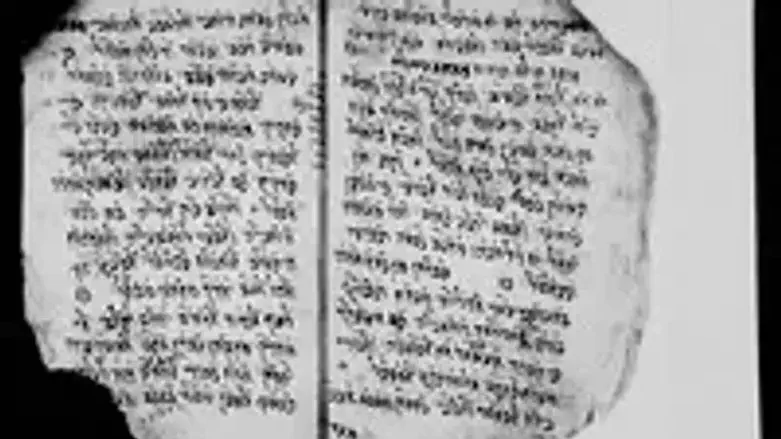
Two rare manuscripts were displayed at the National Library of Israel as part of events marking the immigration of Yemenite Jews to Israel and commemorating those who died on the journey: the Diwan, Rabbi Shalom Shabazi's collection of poetry in his own handwriting, and "Midrash HaGadol," written in Rabbi David Adani's own hand.
Rabbi Shalom Shabazi's manuscript dates to the 17th century, while Rabbi David Adani's dates to the 14th century. Both were donated to the National Library by collectors from the Yemenite Jewish community.
Dr. Yigal Ben-Shalom, president of the Association for Society and Culture, which preserves Yemenite Jewish heritage, discussed the manuscripts and their historical significance in an interview with Arutz Sheva-Israel National News. He previously served as director general of the Labor and Social Affairs Ministry, director general of the National Insurance Institute, and chairman of the Israel Museums Council.
Ben-Shalom began by emphasizing the importance of the national day marking immigration from Yemen, which will be observed this Tuesday for the second time. He views it as a truly historic occasion, and ahead of it, the rare manuscripts were displayed last week at a special symposium attended by dozens of researchers at the National Library.
Describing the texts on old parchment pages, Ben-Shalom said, "We all know Rabbi Shalom Shabazi, but to see the manuscript that survived exile, persecution and pogroms, the expulsion of the Jews to the desert, where two-thirds of them died-and here this original manuscript survived the pogroms." He added, "We were not allowed to turn the pages; only a library specialist could turn them so that we could see the poems. The pages are a little torn around the edges, but the handwriting is very clear. Rabbi Shalom Shabazi wrote in Hebrew, Arabic and Aramaic."
Ben-Shalom added that the Tiklal, the Yemenite Jewish prayer book, was also displayed in Rabbi Shalom Shabazi's own handwriting. He said, "You see an original prayer book containing prayers from before the time of Maimonides, with additions of liturgical poems, songs, prayers, hoshanot and maranot that had not previously been included, which he added from Rabbi Saadia Gaon and his own sources. Seeing this in his own handwriting is very moving."
The manuscript is believed to have been preserved by Yemenite Jews who, out of reverence for Rabbi Shalom Shabazi, copied his manuscript and kept the original inside the walls of homes and in hiding places, ensuring its survival even when synagogues were burned. The original reached the National Library after being purchased in the 1940s from the Habshush family, a prominent rabbinical family that had held the manuscript.
The other manuscript is Rabbi David Adani's Midrash HaGadol. Ben-Shalom described it as, "Five volumes containing all the midrashim we know, and many more that we do not. Rabbi David Adani was the leader of the Jewish community in Aden and was in contact with Maimonides' descendants. He had access to midrashim that disappeared over the years, and this is the only source for those midrashim. It is astonishing to see it in his own handwriting, including liturgical poems, aggadic narratives and commentaries on the Five Books of Moses."
In response to our question, Ben-Shalom explained that the manuscripts were known to be held at the National Library, but had not been publicly displayed, instead remaining under strict preservation conditions with controlled lighting and temperature. Ahead of the special day, a request was submitted to move the manuscripts to a room with slightly less stringent preservation requirements so that visitors could see the originals, and permission was granted for several hours.
Ben-Shalom said the intention now is to offer special tours for groups of younger visitors, who would be shown the original manuscripts under the same slightly relaxed preservation conditions. This would allow them to connect contemporary performances of "Im Nin'alu" with the moving original manuscript containing the text itself.