

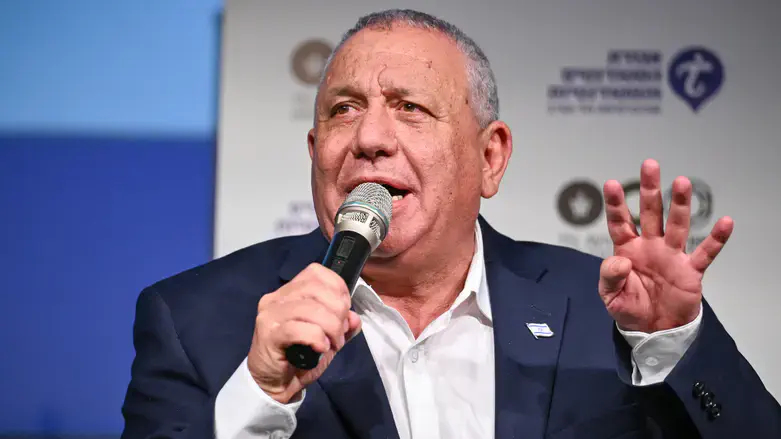
Yashar party chairman MK Gadi Eisenkot sent a firm message to his political partners on Friday, making clear that he is preparing to make critical decisions on forming Israel's next government. In a lengthy post ahead of Shabbat, Eisenkot said he intended to exhaust efforts to form a broad coalition but warned that he would not allow negotiations to continue indefinitely.
Eisenkot wrote, "All sides must understand that I have no intention of dragging things out. They must understand that, at the right time, I will bring a new and good government under my leadership to the Knesset for approval". He stressed that this was not a tactic intended to pressure his negotiating partners, "This is not a threat for negotiating purposes. This is the decision I have made out of an understanding of the responsibility and role entrusted to me at this time of emergency".
The remarks come amid ongoing talks among the parties seeking change and reform to establish a new government. Eisenkot revealed that he had met with party leaders during the week, both together and separately, to advance the talks and examine the available options.
According to Eisenkot, the efforts to form a government are focused on three main tracks. One involves negotiations with the haredi parties, examining formulas that would strengthen the IDF and meet security needs while preserving the status of Torah students.
Eisenkot rejected the suggestion that this amounted to abandoning his principles on military conscription. He clarified, "This is not about 'squaring the circle' or 'lowering the flag' on the issue of service", adding that the emerging framework was based on the principles his party presented during the election campaign.
He also addressed the talks with Likud, expressing disappointment at the gap between its public statements and its conduct in practice. He wrote, "We are making sincere and genuine efforts, but unfortunately there is a great distance between Likud's rhetoric and its actions and actual willingness".
Despite the criticism, Eisenkot made clear that he was not yet abandoning the possibility of forming a broad government with Likud. He noted, "I intend to give this track another chance. We must try to persuade Likud members to rise to the occasion".
However, the central message of his remarks was clear: If efforts to form a broad government fail, he will move to establish a national emergency government, which he will seek to expand either before or after it is sworn in.
Eisenkot also placed responsibility for the decision on Knesset members, "All members of the Knesset will have to follow their conscience and decide whether a new government will be formed, or whether they are prepared to drag the State of Israel and its citizens into another election while Netanyahu remains caretaker prime minister".
Alongside his messages to his partners, Eisenkot devoted a substantial portion of his remarks to sharply criticizing outgoing Prime Minister Benjamin Netanyahu. He warned of the consequences of Netanyahu's conduct for Israeli society and democracy.
He wrote, "We are in very dangerous territory. Territory in which the outgoing prime minister is acting in ways we have not seen before. This is not scaremongering, but a description of reality. A great deal of caution and responsibility is required of us".
Eisenkot argued that Israeli society was approaching a point of no return, warning in particular about public discourse toward the Arab population. He said the distance between a campaign to delegitimize 21 percent of the population by labeling them "supporters of terrorism" and actual violence could be short. He warned, "The writing is on the wall".
He also criticized what he described as the mixing of operational and political considerations. He wrote, "The fact that operational interests and operational timetables are mixed with political interests and political timetables, and that this has become completely normalized, is unacceptable - madness and a danger".
Eisenkot opened the post on a painful personal note after attending a memorial service that morning for his nephew, Capt. Yogev Pazy, who was killed in battle in Jabaliya two years ago. Pazy fell about 700 meters from where Eisenkot's son Gal was killed.
Against the backdrop of the memorial service, he addressed the abusive messages directed that week at elected officials from bereaved families. He condemned the use of fallen soldiers' memory as a means of applying political pressure.
He wrote, "I am not asking for any special treatment. It is legitimate to criticize me and my approach, as it is with any elected official. But there is a clear line between legitimate criticism and desecrating the memory of the fallen and using them as leverage for emotional and political pressure".
Eisenkot called on Netanyahu to intervene and condemn the phenomenon. He stressed that statements such as "Your son would be ashamed of you" go beyond the bounds of acceptable discourse.
Toward the end of his remarks, Eisenkot returned to the issue of forming a government. He made clear that, in his view, the political window of opportunity required action rather than a prolonged wait.
He wrote, "It would be folly to think we have the privilege of delaying and losing the window of opportunity that has opened, a window of opportunity that may never come again".
He concluded with a personal commitment that left little doubt about his intentions, "I do not intend to blink and fail to rise to the occasion. I give my commitment".