
Suppose three neighbors knock on your door. Each holds a can of gasoline in one hand and a lighter in the other. They smile, pose for a photograph, and announce solemnly: a fire in this building cannot be won and must never be started. Then each goes back to his apartment. With the can.
Did you sleep better that night?
On Thursday it happened, minus the parable. In a villa in Shenzhen, in southern China, the presidents of the United States, Russia and China sat together for eighty minutes, the first time the three have ever shared one room. Between them, they hold the overwhelming majority of the nuclear warheads on Earth. When they came out, a document appeared, and in it this sentence: a nuclear war cannot be won and must never be fought.
Who would argue? And still, one question, almost a child's question: they promised to whom?
Each other? Each of the three knows exactly what the other two men's word is worth, because he knows what his own is worth. It is worth as much as it pays.
We, the eight billion who were not invited into the room? We have nowhere to file a claim.
They themselves? Who holds a man to a promise he made to himself, on the morning it stops being convenient?
Clause Three: No One Judges Us
The declaration has four clauses. Reform of the United Nations. Which reform? It does not say. More oil. How much, by when? It does not say. A dialogue on reducing nuclear risk, which is a promise to talk: not one warhead will be dismantled, and the text contains no number anyone could measure. The war in Ukraine? Not a word. A joint press conference? There was none.
Then the third clause. Read it slowly. The immunity of state officials is a fundamental principle, and international courts must not overstep their jurisdiction. In Jerusalem, where I live, many will nod: Israel has its own open account with those courts. But look at what is lying on the page. The same document that promises the world peace promises its signers that no one will judge them.
China's president went further on his own. He called for banning nuclear weapons outright and destroying every last one. A fine sentence. It did not make it into the joint text.
I do not suspect them of lying, and that is the troubling part. Suppose every word was spoken wholeheartedly. What does it rest on? On the will of three men. And will, as we know, changes.
A Refugee's Question at a Well
This Shabbat, in synagogues around the world, the weekly Torah reading tells of a young man running from a brother who wants him dead. He arrives with nothing in a foreign land and meets shepherds at a well. His first words to them:
"My brothers, where are you from?" And they said, "We are from Haran." (Genesis 29:4)
וַיֹּאמֶר לָהֶם יַעֲקֹב אַחַי מֵאַיִן אַתֶּם וַיֹּאמְרוּ מֵחָרָן אֲנָחְנוּ
A request for an address, on first reading. But listen to how he opens: "my brothers," to men he has never seen. And listen to the next word as Manitou (Rabbi Yehuda Léon Ashkenazi) taught us to hear it. In Hebrew, "from where" is me'ayin, and ayin is also the Nothing that precedes everything, the Infinite. It is less a question than a statement. We all come from one source, and every one of us carries the same image. That is why "brothers."
And their answer? "From Haran." The Midrash hears in the town's name the Hebrew word haron, wrath. We come from wrath. In today's language: in the beginning there was chaos, no one intended us, no one cares, and the strong prevail.
It is an entire worldview in two words, and it is the ground on which the Shenzhen declaration stands. Whoever comes from Haran can offer the world only one thing: a ceasefire, until further notice.
Jacob does not argue. He asks two more questions:
"Do you know Laban, son of Nahor?" They said, "We know him." "Is there peace with him?" They said, "Peace." (Genesis 29:5, 6)
וַיֹּאמֶר לָהֶם הַיְדַעְתֶּם אֶת לָבָן בֶּן נָחוֹר וַיֹּאמְרוּ יָדָעְנוּ. וַיֹּאמֶר לָהֶם הֲשָׁלוֹם לוֹ וַיֹּאמְרוּ שָׁלוֹם
Laban, son of Nahor, belongs to the family of Eber, the family from which Abraham the Hebrew came. In Manitou's reading, Jacob is asking the men of Haran: Have you heard of this family? Did you know there is someone in the world who has taken on a real project, to bring it peace? And that peace, is it even possible?
And the shepherds, the men of wrath, answer with one word: shalom.
Today's world knows the word too. The proof: three men in Shenzhen took the trouble to write it at the top of a document. They are not missing the word. They are missing the "from where."
Sixty Signatures, One Dance
Two weeks ago, on November 4, in a hotel on the Mount of Olives in Jerusalem, some sixty men and women from twenty-two countries signed a scroll. The Noahide Scroll. They have no army. They have no oil. Most are unknown beyond their own communities. The President of Israel received them at his residence, and the Mayor of Jerusalem welcomed them.
Who are they? People who, each in their own country and language, went looking for where they come from and found an answer older than any framework they grew up in: the covenant made with Noah, that is, with every human being. None of them asked to become a Jew. No one asked them to leave their nation. They are called Noahides, and they came to Jerusalem to stand in that covenant together with the nation of Israel, which has carried the story through every generation.
Then something happened that no one planned. We who organized the Congress did not see it coming either. Hundreds of Israelis had traveled from across the country to be there that evening. And after the signing, with no signal from anyone, the hall broke into dance. Signers and guests, Noahides and Israelis, dancing together and weeping.
The feeling in the room was that something had opened that has had no equal since the days of King Solomon, when, as the Hebrew Bible tells it, there was peace, and the nations came up to Jerusalem to listen. Rabbi Yehuda Halevi, the twelfth-century poet and thinker, described Israel among the nations as a heart among the limbs: one body, in which a heart is nothing without limbs and limbs are nothing without a heart. For years I taught that sentence as a metaphor. That night I watched it dance.
How much does such an evening weigh in history? I do not know, and I am careful not to rule. I know what I saw: people who signed with no one forcing them and nothing to gain, and who cried for joy.
In Shenzhen, no one cried.
The Weapon Hung in the Sky
What did they sign, in the end? A return to the first "never again" in human memory. It was spoken after the Flood, by the One who holds the power to destroy everything: Hashem, the World Creator. And He does not settle for a declaration. He binds Himself in a covenant and gives it a sign:
"I have set My bow in the cloud, and it shall be a sign of the covenant between Me and the earth." (Genesis 9:13)
אֶת קַשְׁתִּי נָתַתִּי בֶּעָנָן וְהָיְתָה לְאוֹת בְּרִית בֵּינִי וּבֵין הָאָרֶץ
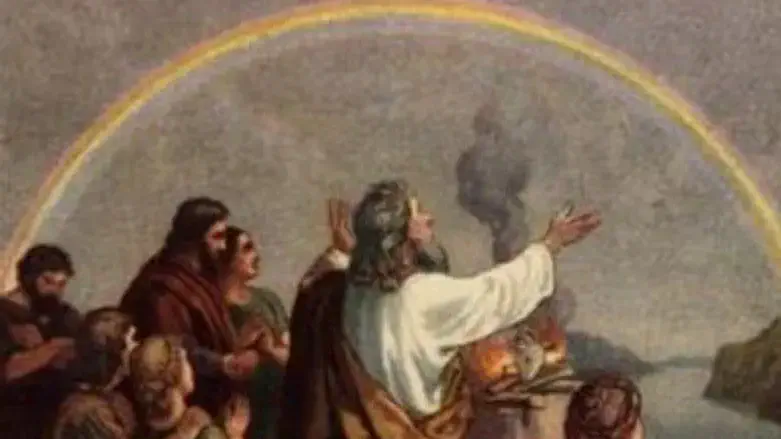
If you grew up with this story, you probably met the rainbow as a picture on a nursery wall. In Hebrew, the word is keshet, and a keshet is a weapon, a war bow. Nachmanides, the great thirteenth-century commentator, notes that it hangs in the sky turned away from the earth, with no string, the way warriors reverse the bow in their hands when they call for peace.
Set that beside the picture from Shenzhen. There the weapons stayed in their silos, and a page was laid on the table. Here the weapon itself hangs in plain sight, and it is the signature.
The covenant has a second side, ours. In the same breath, man is called to account for his brother's blood:
"Whoever sheds the blood of man, by man shall his blood be shed, for in the Divine image He made man." (Genesis 9:6)
שֹׁפֵךְ דַּם הָאָדָם בָּאָדָם דָּמוֹ יִשָּׁפֵךְ כִּי בְּצֶלֶם אֱלֹהִים עָשָׂה אֶת הָאָדָם
Tradition ties to this covenant the Seven Commandments given to all humanity, and one of the seven is the duty to establish courts of justice. Now go back to clause three. In the ancient covenant, there is no immunity. There is justice, and it applies to the one who holds power as well. Perhaps to him first.
The difference between the two signings is not size, and there is no point pretending: in Shenzhen sat the power that runs the world, and in Jerusalem sat private people. The difference is direction. One signature faces sideways, toward the partner and the rival, and holds for as long as the balance of power does not move. The other faces upward, toward the One who is not part of the balance.
He who signs sideways says: it is forbidden, because I too would be hurt. He who signs upward says: it is forbidden, even if I could.
Now the Uncomfortable Part
It would be comfortable to end here. But whoever asks what stands behind other people's declaration owes the same question to his own scroll. So here it is, four times.
Our scroll has no enforcement mechanism either. Sixty signatures and one dance do not stop a missile. A direction is not yet a road, and the road will have to be shown in deeds, not in articles: what a community looks like, and later a whole society, whose commitment does not depend on what pays.
People from twenty-two countries are not twenty-two countries. Since the Congress, I am asked again and again what the next step is, and the honest answer is that it is still being built. For now it is very modest: an open home, a table, shared learning. Anyone waiting for international institutions will be disappointed. We are starting where Abraham started, with an open tent.
The hardest: ourselves. The nation of Israel does not sit in the stands of the power game. We have an army, we have enemies who seek to destroy us, and according to foreign reports we hold a membership card in the very club that met in Shenzhen. A nation that wants to remind the world there is Someone above power will be tested first on how it carries power itself: in its courts, in the way its own parts treat one another, in how it fights when it has no choice.
The sixty who came to Jerusalem did not come for a lecture from above. They came because they believed this story is alive here. That trust is a debt.
And justice. I pointed at the immunity clause, and in the same breath I must admit we hold no ready answer. What does a court look like that nations can trust, one that does not itself become another piece in the game? The commandment to establish justice is one of the seven, and it still lies before us as a question.
The project Jacob asked about at the well, the project of the family of Eber, is not finished. We stand at the beginning of rebuilding it, and we no longer stand in it alone.
China's president is right: a nuclear war must never be fought. The question left open in Shenzhen is who forbids it. It is the same question a refugee once asked at a well, and it is asked this Shabbat:
My brothers, where are you from?
Rabbi Chaim Goldberg is CEO of the Noahide World Center in Jerusalem.