
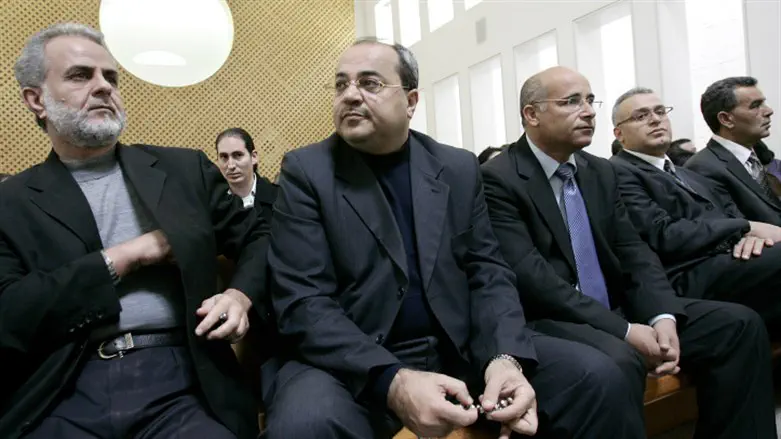
Arab MKs (Members of Knesset) have frequently walked out or declined to participate during the national anthem, Hatikvah, at Knesset ceremonies and other events. They did it again at the opening of the new Knesset, except for one who did not sing.This is an overt symbolic act of nonparticipation during the national anthem, which clearly signals that the person or group does not identify with the State of Israel.
This raises the obvious question on how specifically, these two Arab parties (Ra’am and The Joint List) with their anti-Israeli governmental positions, are allowed to be part of the political process, let alone the Knesset.
Like the other democracies of the world, Israel has fundamental laws that express equality regardless of race, religion, or sex. Therefore, there can and should be political parties that represent every segment of the population. But that does not include avowed enemies of the state.
Yashar (Gadi Eisenkot’s party) recently put this democratic concept into actionable words by stating the obvious and declaring that any party or Knesset member may join its coalition only by accepting four key principles:
- Recognize Israel as a Jewish and democratic state. Accepting Israel as the national home of the Jewish people while upholding democratic institutions and equal rights.
- Accept the values of Israel’s Declaration of Independence. See paragraph 13, which includes full and equal citizenship and the rule of law to all.
- Support universal service. Mandatory military, national, or civilian service for all Israeli citizens, including communities currently exempt.
- Recognize Hamas as a terrorist organization and commit to dismantling its military and governing capabilities in Gaza. (Hamas is designated a terrorist organization by the European Union, United Kingdom, United States, Canada, Australia, and Israel.)
The two Arab parties’ responses to these four coalition principles differ. Ra’am leader Mansour Abbas has accepted Israel as a Jewish and democratic state, and the party has said it supports Hamas’s full disarmament. But Abbas has not publicly declared Hamas a terrorist organization, whose goal is the destruction of the State of Israel. Therefore, Ra’am has not met all four principles.
Not surprisingly, the Joint List party has flat out rejected all of Eisenkot’s basic principles.
The avowed positioning of these Arab parties confirms the presence of a ‘fifth column’ in Israel, which is defined as a “a group inside a country or organization that secretly helps an external enemy undermine it - through espionage, sabotage, propaganda, or disinformation. It is a serious accusation of internal betrayal, not merely political disagreement." While there are loyal Israeli non-Jewish citizens, unfortunately the events, actions, and many declarations of these Arab parties, prove this subversive belief exists in Israel.
Legal support for Yashar’s position can be found in two important key foundational principles:
1. Under Israel’s Parties Law, 1992, a political party cannot be registered if its objectives or activities, explicitly or implicitly, reject Israel’s existence as a Jewish and democratic state, incite racism, or camouflage illegal activity.
2. According to the Israel Basic Law: The Knesset similarly bars a candidate list or candidate from running if its goals, actions, or expressions negate Israel’s existence as a Jewish and democratic state, negate its democratic character, incite racism, or support an enemy state or terrorist organization’s armed struggle against Israel.
Using Israel’s democratic governmental structure, on 23 Sept 2026, the Central Elections Committee (CEC), which is Israel’s statutory body for administering Knesset elections, voted to bar Israel’s two main Arab-majority electoral lists - the Joint List and Ra’am - from running in the October 2026 Knesset election, invoking existing disqualification law Section 7A of the Basic Law: The Knesset.
To disqualify a list or candidate under section 7A, the CEC must establish all of the following:
- A prohibited objective or action exists: The negation of Israel’s existence as a Jewish and democratic state, incitement to racism, or support for armed struggle by an enemy state or terror organization against Israel.
- That objective is dominant and central, not marginal: It must be among the dominant characteristics of the list’s aspirations or activities, and the list must be seeking election in order to advance it.
- The objective is shown by express declarations or unambiguous inferences from the list’s activities and course of conduct; theoretical or abstract goals are insufficient.
- There is actual, systematic, repeated conduct advancing the objective; sporadic acts do not suffice, and the conduct must be severe and extreme in intensity.
- The evidence must be “convincing, clear and unequivocal"-the “critical mass" formulation.
Regarding the two Arab parties, these conditions were clearly met. Yet, on 02 October, the Supreme Court unanimously overturned the ban, holding that the materials submitted by the CEC record did not satisfy elements 2 through 5 in that it did not establish them (as proven under a settled precedent). It added that “disqualification is reserved for extreme cases, the statutory grounds must be construed narrowly, the burden rests on those seeking disqualification, and the prohibited objective must be shown by clear and convincing evidence to be a dominant or controlling goal, supported by systematic, repeated, and significant conduct rather than isolated acts."
That the Supreme Court could unanimously rule this way disregarding that the evidence submitted by the CEC was supported by the Arab parties’ own words as reported in the press, is incredibly and blindly destructive to the country they are supposed to be protecting.
To that point, as of 18 November, the Knesset advanced a bill to repeal the judicial selection committee overhaul in preliminary reading. The new Supreme Court selection committee would have had more representatives that were voted into office than legal professionals choosing their own and less control of the selection process by the courts' justices themselves. It was 4 of 9. It would now be 6 of 9 not under the judiciary's control.
The Supreme Court and the Knesset must fully Enforce the Parties Law and Basic Laws already on the books. That is what they are sworn to do. If not, this could strengthen the fifth column and be the start of the downfall of the one Jewish state.
David S. Levine (MBA) is a retired NYC corporate Marketing and Finance executive, and university instructor. He has authored many articles and four books, including the “In Their Own Words" series RevolutionsandWhat Do They Pray For, and “Hey Israel - You’re Perfect. Now Change!" Read more and follow him on theRealDavidLevine.Substack.com and X (Twitter): @DavidsLevine