
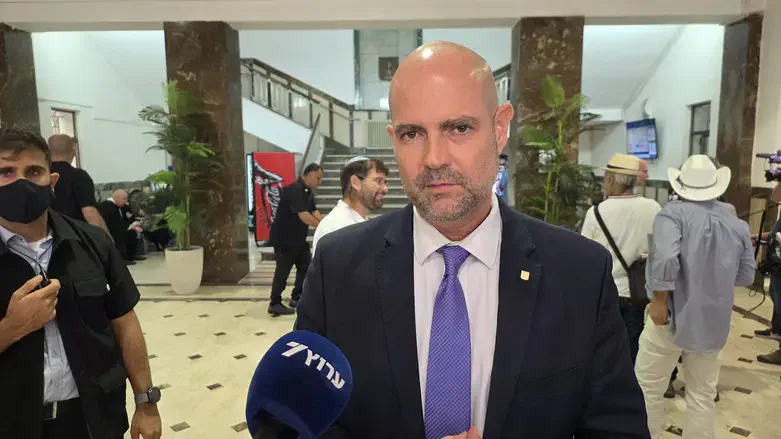
There are politicians who occupy positions of power, and there are leaders who elevate the institutions they serve. Amir Ohana belongs firmly in the second category.
As he concludes his historic tenure as Speaker of the Israeli Knesset, I want to say something that goes beyond political admiration or professional respect: Amir Ohana is a friend who I admire as a leade,and cherish as a Jewish patriot who has brought extraordinary dignity and honor to Israel and the Jewish people.
Few Israeli public servants have represented the Jewish state with such eloquence, conviction, intelligence, and moral clarity during such extraordinarily difficult years.
And few have done so while remaining so profoundly decent, accessible, and personally loyal.
Amir’s nearly four years as Speaker, beginning December 29, 2022, encompassed some of the most traumatic and consequential events in modern Israeli history. Yet through war, international condemnation, political division, and an unprecedented eruption of global antisemitism, he remained an articulate, fearless, and dignified defender of his country.
He did not merely preside over Israel’s parliament. He became one of Israel’s most formidable ambassadors to the world.
Amir Ohana did not merely preside over Israel’s parliament. He became one of the Jewish state’s most courageous and eloquent defenders before the world.
Consider his extraordinary diplomatic achievements.
In June 2023, Amir made history by becoming the first Speaker of the Knesset to receive an official invitation to visit the parliament of a Muslim-majority country, Morocco.
As Israel’s first Knesset Speaker of Moroccan descent, his visit represented something profoundly moving: a Jewish son of Moroccan heritage returning as the representative of the sovereign parliament of the Jewish state.
It was the Abraham Accords translated into human dignity and personal history. It demonstrated that peace between Israel and the Muslim world is not a fantasy but possibly an achievable reality.
And then came October 7, 2023.
The worst massacre of Jews since the Holocaust transformed the responsibilities of every Israeli leader. Suddenly, the Speaker of the Knesset was required not merely to manage parliamentary proceedings but to help defend Israel’s very legitimacy before a frequently hostile international community.
Amir rose magnificently to the challenge.
He mobilized parliamentary diplomacy across continents, challenging the lies told about Israel, exposing Hamas’s barbarism, advocating for the hostages, and insisting that the Jewish people possessed the same fundamental right of self-defense as every other nation.
In January 2024, he wrote to 155 parliamentary counterparts across six continents, urging action against Hamas and Hezbollah, the strengthening of security for Jewish communities, and the adoption of the International Holocaust Remembrance Alliance’s working definition of antisemitism.
This was leadership translated into action.
While too many international leaders discovered their voices only to condemn Israel, Amir Ohana used his to defend Jewish lives.
But what impressed me most was that Amir never allowed the hostages to become abstractions or diplomatic talking points.
In November 2023, he helped convene a special Knesset conference with hostage families and representatives from across the political spectrum.
In February 2024, he traveled to Washington with relatives of hostages, bringing their anguish directly into discussions with senior American officials.
In 2025, he led a parliamentary delegation to Japan that included the father and brother of hostage Guy Gilboa-Dalal, carrying their family’s plea into Japan’s parliament and international media.
For Amir, the hostages were not statistics. They were members of the Jewish family whose suffering demanded the world’s attention.
His international speeches were equally remarkable.
In Austria, he confronted the resurgence of antisemitism with historical seriousness and moral urgency.
At the 2025 Inter-Parliamentary Union assembly in Uzbekistan, he addressed an international parliamentary gathering in a Muslim-majority country, opening with an Arabic greeting of peace while forcefully defending Israel.
At the World Conference of Speakers of Parliament in Geneva, he refused to surrender to diplomatic intimidation, confronting anti-Israel delegations so directly that representatives of Iran, Yemen, and the Palestinian Authority walked out during his address.
That is courage.
Not the artificial courage of politicians who applaud themselves before sympathetic audiences, but the courage of a Jewish leader who will defend his country even in a room filled with hostility.
And in January 2026, when Albanian Prime Minister Edi Rama addressed the Knesset, Amir celebrated the historic friendship between Israel and a Muslim-majority democracy, reminding the world that the conflict was not between Judaism and Islam but between those who cherish life and those who glorify destruction.
His was a vision of Jewish strength without Jewish isolation.
Amir understood something essential: Israel must never apologize for existing, never beg for the world’s permission to defend itself, and never abandon the possibility of peace.
There were important domestic achievements as well.
At a time when Israelis were sacrificing enormously for their country, Amir repeatedly reduced the Knesset’s budget, with announced reductions reaching NIS 376 million by July 2026.
He demonstrated that parliamentarians should demand sacrifice not only from citizens, but from their own institutions.
Here was a proud Jewish patriot and a committed representative of the Israeli Right, demonstrating that love of country transcends simplistic ideological categories.
My admiration for Amir is also deeply personal.
My son Mendy, an IDF combat veteran, has had the privilege of serving as an advisor and aide. I disclose that connection with great pride.
But my love for Amir is not dependent upon political office or family connections.
I cherish his friendship because beneath his formidable public presence stands a man of tremendous heart.
He is principled without being pompous, patriotic without being performative, and strong without surrendering his humanity.
Of course, Israeli politics has been bitterly divided. Not everyone agreed with Amir’s political positions or his handling of contentious parliamentary disputes. Democracy permits, indeed requires, vigorous disagreement.
But political disagreements should not prevent us from recognizing extraordinary public service.
On November 10, as the 26th Knesset convened, Amir called for unity and a renewed sense of national purpose. Seven days later, Matan Kahana succeeded him as Speaker.
Titles change. Elections are won and lost. Political fortunes rise and fall.
But character and achievement endure.
The gavel may pass to another hand, but the dignity, courage, and Jewish pride Amir Ohana brought to the Speaker’s chair cannot be erased.
At a moment when the Jewish people have endured unspeakable tragedy, unprecedented hatred, and relentless international pressure, Amir gave us something priceless: the confidence to stand tall.
He showed the world a Jewish nation that would not be intimidated, a democracy that would not apologize for its existence, and a people determined to survive and flourish.
Amir, I am immensely proud of you.
Thank you for the honor you brought to the Knesset, for the courage with which you defended Israel, for your unwavering commitment to our people, and for the light you brought to the Jewish world.
The Jewish people are blessed to have you among their defenders.
Your tenure as Speaker has ended. Your contribution to Israel’s future has only begun.
Am Yisrael Chai.
Rabbi Shmuley Boteach is the author of numerous international bestsellers and a prominent advocate for Israel and the Jewish people.