
(JTA) - Several years before the American Revolution secured independence, a vibrant and influential Jewish community in the Caribbean played a vital role in the Patriots’ fight for freedom.
“The First Salute," an exhibit at Philadelphia’s Weitzman National Museum of American Jewish History marking the United States’ 250th anniversary, explores this nearly vanished world of Caribbean Jewry, placing this diverse community at the center of an era defined by commerce, courage and geopolitical risk.
The exhibit’s name refers to an event that happened on Nov. 16, 1776, when a brig flying an early version of the American flag sailed into the harbor at the tiny, Dutch-controlled island of St. Eustatius to deliver a copy of the Declaration of Independence and purchase weapons and ammunition. Announcing its arrival, the American ship fired a 13-gun salute, representing the first 13 American states. The island’s Dutch governor returned the salute - the fledgling nation’s first formal recognition by a foreign power.
This largely symbolic event is just one episode in a larger, dramatic story about Jews on both sides of the Atlantic who played crucial roles in securing American independence. Using historical artifacts from the islands as well as state-of-the art technology, the exhibit examines how Jewish merchants in St. Eustatius played a vital role in supplying the Continental Army in its fight against the British.
At the same time, “The First Salute" also introduces museumgoers to a largely forgotten Jewish community that was, at the time, larger than the Jewish population of New York City.
“Some people might know that some Caribbean Jews were pirates, but Caribbean Jews actually played an important role in the Revolutionary War," said Laura Arnold Leibman, a professor of Jewish studies at Princeton University and one of the exhibit’s historical advisers.
Learning more about the Caribbean Jewish experience during the era is, she added, “important to understanding early American history and early American Jewish history."
“This is an important, largely overlooked, story that broadens our understanding of the Revolution itself and those who participated in the struggle for American Independence," said Josh Perelman, the museum’s senior advisor for content and strategic projects and the exhibition’s curator. “Introducing Jewish merchants operating in the Caribbean to that history offers new insight into the meaning of our nation’s founding ideals."
Keep reading for eight things to know about this unique Jewish community.
1. Dutch Jews played a foundational role in establishingCaribbean Jewish communities.
Many of the Jews who came to the Caribbean in the 17th and 18th centuries were from Amsterdam, including Sephardic Jews who traced their backgrounds to Spain and Portugal. After Jews were exiled from the Iberian Peninsula in 1492, they and their descendants eventually made their way to Amsterdam, a Dutch city known for its religious tolerance.
As the Colonial era unfolded, Amsterdam’s Jewish community, which was responsible for its indigent Jews, known then as “despachos," sent Jews to the Caribbean to start new lives and lessen their burden on the community. London’s Jewish community did the same - particularly in the 1730s, when some of these impoverished Jews got small travel stipends to make the journey. Jews arriving on the islands “were disproportionately from their communities’ poor rolls," Leibman said.
While this might seem cruel, in a way Jewish leaders were “giving these unfortunate Jews a fresh start," according to Jonathan Sarna, professor of Jewish history at Brandeis University and The Weitzman Museum’s chief historian.
2.Jewish communities in the Caribbean were the largest in the Western Hemisphere.
The Dutch-controlled islands of Suriname and Curaçao were home to 1,200 to 1,500 Jews. On St. Eustatius, where the European population numbered approximately 2,000, Jews comprised at least 30 percent - a number that varied according to the arrival and departure of transient sailors.
By contrast, in 1776, the entire North American Jewish population was estimated to be 2,000 to 2,500.
“There was more Jewish life in the Caribbean than in the Colonies," Leibman said, adding that there were Jewish schools in Curaçao and Suriname.
The reasons for Jewish migration to the Caribbean were both financial and intellectual, according to professor Stanley Mirvis, the Grossman Chair of Jewish Studies at Arizona State University.
“The center of economic gravity in the New World was the Caribbean," Mirvis said, noting that the Caribbean’s geographic location, sugar plantations and vibrant ports made it an ideal place for Jewish merchants to ply their trade.
Culturally, intellectual life in the Caribbean was more advanced than in the Colonies. “Learning societies," where Enlightenment ideas were promoted and discussed, were established on several islands, he said.
3. The Jews on St. Eustatius played a vital role in supplying the Continental Army during the Revolutionary War.
The inhabitants of St. Eustatius played an essential role in the American Revolution by smuggling supplies to the Continental Army.
About one-third the size of Manhattan, St. Eustatius, nicknamed the “Golden Rock," boasted one of the busiest ports of the 18th century - an international thoroughfare for sugar, coffee, tobacco, rum, hides and textiles, as well as enslaved Africans.
When the Revolution broke out in 1775, new cargo began flowing through St. Eustatius: secret shipments of gunpowder, weapons and other supplies passing from European allies like Holland to American Patriots - often on ships owned or operated by Jews with robust trade connections in Europe and North America.
“These were people who understood statelessness, vulnerability and opportunity all at once," Sarna said during the exhibit’s media opening. “They leveraged those networks not only to survive, but to participate in what they recognized as a revolutionary moment."
Whether motivated by economic opportunity or ideological sympathy, many of these merchants supported the American revolutionaries at huge personal risk, Leibman noted. Indeed, in 1781, British invaders specifically targeted the St. Eustatius Jewish community for harsh treatment and expulsion due to their support of the Patriots.
4. Jewish women played a key role in business and community life.
The exhibit also centers the experiences of Jewish women. “One of the things we are trying to do is to change the story that was told during the Bicentennial about the American Revolution in 1976," Leibman said. “We’re trying to include a more diverse cast of people."
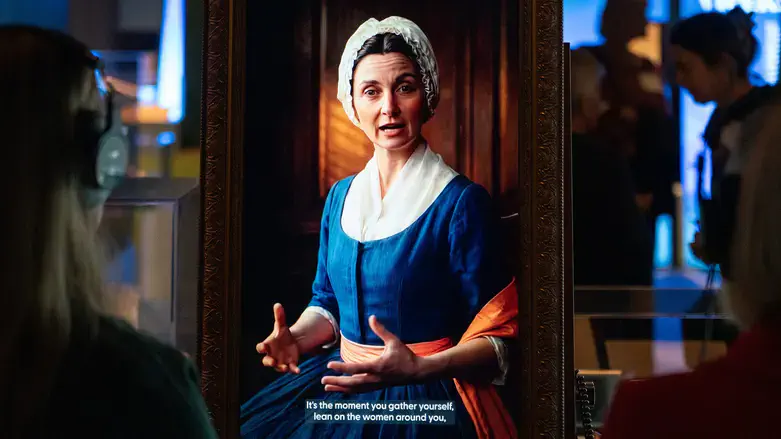
For example, a video in the exhibit spotlights Hannah de Leon Benjamin, a real-life Jewish medical practitioner and midwife on St. Eustatius. In the video, she discusses the central role Jewish traditions and Honen Dalim - the island’s synagogue, founded in 1739 - play the in the community’s life. She also explains how she uses herbs and oils to attend to births, and how she learned to “heal when I can and comfort when I cannot." Her grave can be found today in the island’s Jewish cemetery.
Benjamin’s career was not uncommon. In Suriname there were about two dozen female midwives, according to Leibman. Though Jewish communal records are spotty across the Caribbean, it’s likely other Jewish women worked in this profession as well.
5. The Caribbean Jewish community was diverse.
“Racial identities were more fluid than they were in the Colonies or in later years in the Caribbean," Leibman said.
On Suriname, for example, there were many intermarriages between Jewish men and women of African or mixed heritage. Some Jewish men petitioned to have their mixed-race wives and children considered Jewish, Leibman said, adding that this petitioning wasn’t possible on every island.
There was also a community made up of Jews of color on Suriname. Until around 1800, Free Black and Creole Jews maintained a separate synagogue in the capital city of Paramaribo, as well as designated burial grounds.
6. Jewish life was robust and varied.
Jewish life flourished on Caribbean islands that were colonized by the British or Dutch, who adopted relatively lenient policies toward Jews. Synagogues were the centers of life, and some had ordained rabbis. Mikvehs, or ritual baths, schools and sometimes housing for those working in the synagogues were located nearby.
Because many Caribbean Jews traced their roots to the Iberian Peninsula, translations of the Torah and prayer books were sometimes written in Spanish or Portuguese - especially in the Sephardic diaspora - and some prayers were also occasionally chanted in Spanish or Portuguese.
7. Some Jews participated in, but had little impact on, the trafficking and enslavement of Africans.
Slavery fueled Europe’s colonial empires. The locations where Jews lived during the 18th century, whether in North America or the Caribbean, actively took part in the abducting, purchasing, selling and owning of African people. At least one-fifth of New Yorkers owned slaves, and plantations existed across the American South as well as on Jamaica and Barbados. The presence of Jews in these locations had little impact on the overall systems of enslavement, but it is undeniable that Jews participated.
St. Eustatius’ role as a commercial hub included buying, selling and owning people. Enslaved Africans - a significant part of the island’s population and economy - labored in households, warehouses and maritime commerce. Numbers varied over time, but the 1781 census recorded that Jews on St. Eustatius owned 86 people, or 6.4 percent of the island’s total enslaved population.
In total, about 2,500 enslaved Africans and a few free Blacks also lived on St. Eustatius.
8. After the Revolution, the Caribbean ceded its spot as the focal point for Jewish life in the Western Hemisphere.
The Caribbean Jewish population declined in the 19th century due to a confluence of factors, including the decline of the sugar trade, natural disasters and migration to the United States.
“America emerges as a new economic powerhouse that fills the space that the Caribbean played before," Mirvis said. This was especially true after a large influx of Jews from Central Europe to the U.S. in the early-to-mid 1800s.
On St. Eustatius specifically, the Jewish community never recovered after the British expelled many of the island’s Jewish men due to their support of the Revolution. In addition, the island’s economy declined significantly. By the early 19th century, no Jews lived on the island, and Honen Dalim fell into disrepair. Today, the synagogue’s remains include an intact mikveh, and its walls were restored by the government of St. Eustatius in 2001.
Exiting “The First Salute," visitors can watch a video tribute to Honen Dalim, featuring Israeli musicians performing Leonard Cohen’s “If It Be Your Will" amid the synagogue’s ruins. Their presence carries a powerful message of Jewish continuity and resilience, one that the museum emphasizes when leading groups.
“The First Salute" is on display through the summer of 2027 at theWeitzman National Museum of American Jewish Historyin Philadelphia.
This article was sponsored by and produced in partnership with the Weitzman National Museum of American Jewish History, the nation’s only museum dedicated to telling the full story of Jewish life in America and its enduring impact on the American experience. This article was produced by JTA’s native content team.