
Reflections on Parashat Vayetze
In Parashat Vayetze, we read how Yaakov Avinu leaves Be'er Sheva and sets out for Charan. On his journey, he dreams of a ladder reaching from earth to heaven, and Hashem promises him that the Land upon which he lies will be given to him and his descendants. Hashem further assures him: "I am with you; I will protect you wherever you go, and I will bring you back to this Land."
This promise is about much more than a place to live. It brings together
1.the future of Yaakov's descendants
2. their relationship with Hashem and
3. their inheritance of Eretz Yisrael.
These are not separate matters. They are bound together as part of one enduring promise.
Yaakov understands that this promise carries a responsibility. In response, he makes a neder, declaring: "And this stone, which I have set up as a pillar, shall be a house of G-D." He recognises that his life and the future of his family must be built around Hashem and His service.
This is a lesson that remains particularly relevant to us today.
When a government is formed in Israel, political parties naturally negotiate over budgets, ministries and policies. Such negotiations are part of democratic life. But there are foundations of Jewish life that cannot be treated as bargaining chips. Our existence in Eretz Yisrael carries with it a responsibility that goes far beyond the formation of any government. We are Am Yisrael, a people whose identity, history and future are bound up with Torat Yisrael and Eretz Yisrael.
These are not separate interests to be negotiated independently. They belong together.
For many years, the expression "preserving the status quo" has been part of Israeli political language. But what does it really mean? Over time, it has become a convenient expression behind which very different positions can be hidden. One party may be concerned with yeshivot, another with Shabbat, another with conversion, and another with kashrut. Each may seek to protect the particular matter closest to its heart. But Jewish life cannot be divided into separate compartments.
We cannot preserve one part of Jewish life while allowing another to become weakened.
I write as a practising rabbi and as a member of the Council of the Chief Rabbinate of Israel. These are my personal views and do not represent the position of any institution or political party. The responsibility for forming a government rests with our elected representatives. My concern is with the principles that should guide them, and with the responsibility we all bear for the spiritual future of Am Yisrael.
The Torah places upon us a responsibility for one another. This responsibility does not end at the boundaries of our own community or with the institutions that serve us. It extends to every Jew. Protecting yeshivot and institutions of Torah is essential, but our responsibility is much wider:
-Every Jewish child growing up in Eretz Yisrael, including those attending the general school system, should have the opportunity to learn Torah, Tanakh and the history of our people.
-A child born in the Land of Israel should know the heritage of the people to whom he or she belongs.
We cannot be satisfied with preserving Torah within our own communities while generations of Jewish children grow up without a meaningful knowledge of their own heritage. Our responsibility is not only to maintain what we have, but also to bring the next generation closer to the Torah of its people.
The question of who is a Jew is another matter that cannot be left to political convenience. It is not merely a question of legal definitions or administrative arrangements. It touches the very unity of Am Yisrael and the future of our people. The distinction between eligibility under the Law of Return and Halakhic Jewish status must remain clear. Conversion must be according to Halakha.
The standards of conversion cannot be adjusted to suit changing political circumstances. The standards of Halakha that have guided our people throughout the generations must be maintained. If we weaken the common Halakhic standard for joining the Jewish people, we risk creating divisions that future generations will find extremely difficult to overcome. The consequences may become painfully apparent when young Jews wish to marry and discover that, according to Halakha, they cannot marry one another.
This is not a problem belonging to one community or another. It concerns the unity of the entire Jewish people. We must consider not only the immediate consequences of decisions made today, but also what they will mean for our children and grandchildren.
The same responsibility applies to Shabbat, kashrut, and marriage and divorce. These are not private demands made by one sector of society. They are part of the Torah framework of Jewish public life. Shabbat is not simply a day of rest; it is a testimony to the creation of the world and to the special relationship between Hashem and Am Yisrael. Kashrut brings the discipline of Torah into our homes and daily lives. Marriage and divorce according to Halakha preserve the framework of Jewish family life and the continuity of our people. These matters must be treated as parts of one Torah responsibility, not as separate political demands, each competing for attention.
Torah study stands at the very foundation of this responsibility. It cannot be reduced to a budgetary question or treated as a temporary solution to a coalition difficulty. It is Torah that has sustained the Jewish people through generations of exile, persecution and hardship. Wherever Jews were scattered, Torah remained the bond connecting one generation to the next. Those who dedicate their lives to Torah study are continuing that great tradition.
Supporting yeshivot and those who study Torah is therefore not simply assistance to one sector of society. It reflects an understanding that Torah is the foundation upon which Jewish existence rests. A Jewish society must understand that its relationship with Torah cannot be measured solely in financial terms.
There is also a responsibility to preserve the Jewish identity of the State of Israel. Protecting the civil rights of every citizen, Jewish and non-Jewish alike, is essential. At the same time, the national identity of the state must remain clear. Israel is the national home of the Jewish people, and the Jewish people's right to national self-determination in Eretz Yisrael is an essential part of that identity.
Respect for every citizen and loyalty to the Jewish character of the state are not contradictory. We can respect all those who live here while remaining faithful to the purpose for which the Jewish people returned to their Land.
None of these responsibilities should be set against another. It is not enough to defend Torah institutions while neglecting the Jewish education of the wider public. It is not enough to protect Shabbat while weakening the Halakhic standards that safeguard the unity of Am Yisrael. Nor can the Jewish character of the state be separated from the Torah values that have shaped our people throughout history. We must look at the whole picture and recognise that each of these matters contributes to the spiritual and national future of our people.
Parashat Vayetze reminds us that the connection between the Jewish people, the Torah and Eretz Yisrael is rooted in the very foundations of our history. Yaakov Avinu leaves the Land, builds his family and establishes himself in Charan, but the promise of Eretz Yisrael remains with him. Eventually, he returns with his family, and the foundations of the nation of Israel are established. The promise given to him at Beit El continues to shape the destiny of his descendants.
We, too, must recognise the privilege and responsibility of living in Eretz Yisrael. Our return to the Land is not simply a return to a geographical home. It brings with it the obligation to build a society faithful to the Torah and heritage we have inherited. Our ancestors preserved the connection between Torah, Am Yisrael and Eretz Yisrael through generations of hardship. We must ensure that this connection remains strong and is passed faithfully to those who come after us.
Our elected representatives must conduct negotiations and address the practical needs of the public. That is their responsibility. But no political agreement should come at the expense of the foundations of Jewish life. Governments change, coalitions come and go, and political agreements are temporary. Our responsibility to Torah, to Am Yisrael and to Eretz Yisrael remains.
Jewish life cannot be subject to political bargaining. As Yaakov Avinu understood at Beit El, the Land, the people and our relationship with Hashem belong together. We have inherited all three, and we have a duty to preserve that inheritance and pass it on faithfully to our children and grandchildren.
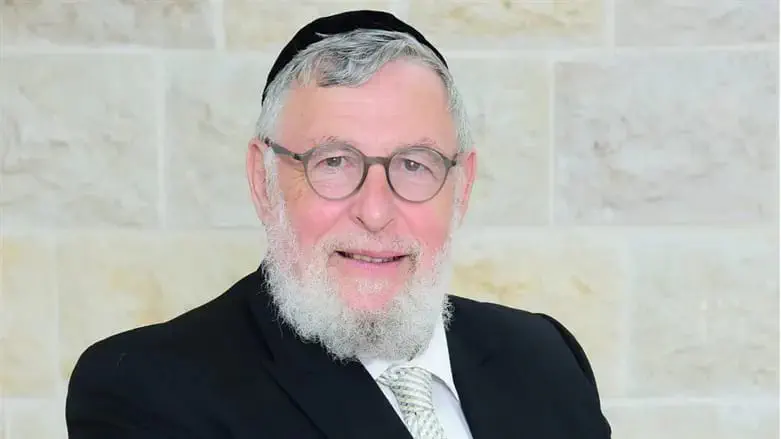
Rabbi Eliezer Simcha Weiss is a member of Israel's Chief Rabbinate Council