

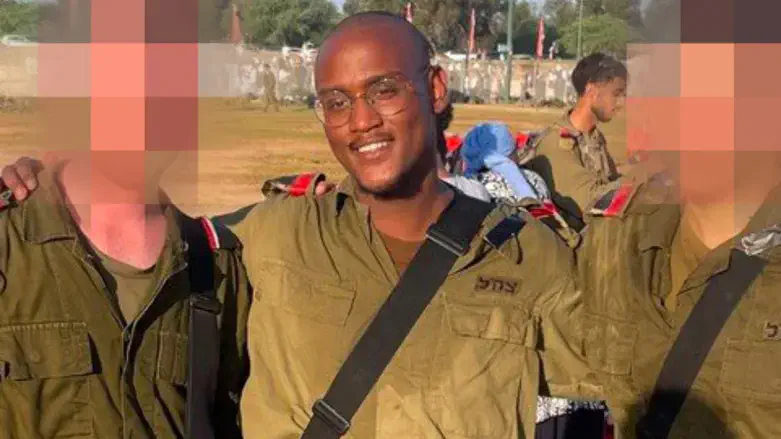
Combat engineering soldier Osher Avraham, 19 and a half, from Rehovot, was found dead in his room at an IDF base in northern Israel last Friday.
Nearly a week after his death, he has yet to be laid to rest amid a dispute between his family and the Institute of Forensic Medicine over whether an autopsy should be performed.
According to information provided to the family, a gunshot was heard at the base shortly after the start of Shabbat. Officers and soldiers who entered Avraham's room found him wounded and bleeding, with his personal weapon lying nearby. Medical personnel called to the scene pronounced him dead.
Investigators from the Military Police Criminal Investigation Division arrived at the base and opened an investigation into the circumstances. The IDF informed the family that the preliminary findings raised suspicions that Avraham had taken his own life, but his relatives reject that possibility and are demanding an autopsy to clarify the circumstances of his death.
Following the family's demand, and with the support of military police investigators, a request was submitted to the court for an order to conduct an autopsy on Avraham's body, which is being held at the Institute of Forensic Medicine in Abu Kabir.
The court initially granted the request and issued an order authorizing the autopsy. However, institute officials subsequently said that a CT scan and an external examination had been conducted after the body arrived, and that the findings established a gunshot wound as the cause of death, without the need for an autopsy.
The institute clarified that determining whether the death was a suicide or involved criminal activity was the responsibility of military investigators, not the institute.
A further hearing was held yesterday (Wednesday) at the Kiryat Shmona Magistrate's Court, where representatives of the institute, military police investigators and family members presented their positions. At the conclusion of the hearing, the court accepted the institute's position and revoked the autopsy order it had previously issued. Because of the dispute, Avraham's funeral has not yet taken place.
In an interview with ynet, the soldier's mother, Esther Avraham, spoke about her son and her difficulty accepting the preliminary conclusion presented to the family. She said, "I don't believe Osher did anything to himself. There is no way". She added, "He was a happy child, true to his name - Osher [happiness]. He postponed his enlistment so he could raise his medical profile and join a combat unit".
She said Osher had been determined to serve as a combat soldier and had completed his combat engineering training as a heavy equipment operator with distinction several months earlier.
Esther recalled her last exchange of messages with her eldest son, who is survived by two sisters, Elior, 17, and Romi, 7. She said, "He wrote to me, 'Mom, I love you,' with a heart. I replied, 'I love you too.' And there was no reply from Osher, which was very unusual. I called him and he didn't answer".
She continued, "I wrote to him that we would talk after Shabbat because I observe Shabbat. Suddenly, while we were making Kiddush, we received a call at home saying something had happened to Osher, and a few minutes later military personnel arrived and told us he had been found dead in his room".
Later in the week, she spoke with a pathologist and a social worker from the Institute of Forensic Medicine, who explained the examinations that had been performed and the decision not to conduct an autopsy.
But the explanations did not satisfy her. Referring to her dealings with investigators, she said, "They gave us the impression that an autopsy was being performed". She added, "I told them that without an autopsy, without finding out the truth about what happened to Osher, there would be no burial. It is already Thursday, and there is no grave for Osher. Why should they object to performing an autopsy?".
His mother added that the decision not to conduct an autopsy raised serious questions for her, "The insistence on not performing an autopsy raises doubts in my mind. We heard all sorts of accounts during the week. I'm already starting to think they don't want to perform an autopsy because perhaps they are hiding things from me. At least on a human level, they should give me and the family peace of mind, so I know I did everything for the truth, and even if it is painful, I will accept it".
Esther again emphasized that, in her view, the possibility that her son had taken his own life was inconsistent with his character and his plans for the future, "There is no way he died by suicide. This is the heart of a mother who knows her son, who was like a friend to me and told me everything. The first thing I asked when I arrived at the base was, 'Who did this to my son?' He loved the army, he loved being a combat soldier, and he was excited about his upcoming entry into Lebanon and was looking forward to it".
The IDF said, "An IDF combat soldier was found dead last week at a base in northern Israel. Following the incident, the Military Police Criminal Investigation Division opened an investigation. Once it is completed, the findings will be submitted to the Military Advocate General's Corps for review. His family has been notified. The IDF shares in the family's grief and will continue to support them".
Regarding the dispute over the autopsy, the IDF said, "The Military Police Criminal Investigation Division requested an order to perform an autopsy, and the court granted it. The Institute of Forensic Medicine subsequently determined that an autopsy was not necessary to establish the cause of death. At a hearing held yesterday, during which the court heard representatives of the institute, the Military Police Criminal Investigation Division and the deceased's family, the court decided to revoke the autopsy order".
The Institute of Forensic Medicine said, "We share in the Avraham family's grief and understand how difficult the wait for a decision is for the family at this painful time. Out of respect for the privacy of the deceased and his family, we cannot provide further details. The decision on whether to perform an autopsy rests with the court, and the center will act in accordance with its ruling".