

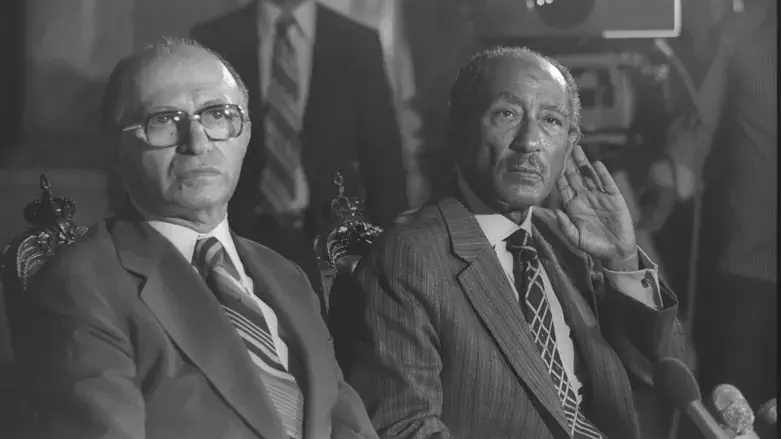
Gamal Sadat, son of former Egyptian President Anwar Sadat, remains convinced that peace in the Middle East is possible, nearly five decades after his father made history by signing a peace agreement with Israel.
Speaking to The Telegraph ahead of a ceremony in Washington honoring his father with the Congressional Gold Medal, Sadat, 70, expressed hope that today's leaders could follow his father's example.
"I think peace can still be achieved. You need two strong leaders to make it happen. It is all a matter of leadership," he said.
Anwar Sadat became the first Arab leader to make peace with Israel after decades of conflict and four wars between the countries. In November 1977, he made a historic visit to Jerusalem, addressing the Israeli Knesset and declaring his commitment to reconciliation.
"I come to you today on solid ground, to shape a new life, to establish peace," he told Israeli lawmakers.
His initiative led to the 1978 Camp David Accords and the peace treaty signed with Israeli Prime Minister Menachem Begin the following year, under US President Jimmy Carter's mediation.
Gamal recalled that negotiations nearly collapsed before the leaders began connecting on a personal level. His father spoke to Begin about his brother, a pilot killed during the 1973 Yom Kippur War.
"They started talking to each other as human beings, not as the president of Egypt and the prime minister of Israel. And things started to change."
Despite fierce opposition across the Arab world, Sadat remained determined to pursue peace, believing that continued warfare could never secure a better future.
"You can't reach your ambition for prosperity and betterment for your country with war," he told his son. "War doesn't get you anywhere. It is terrible for all parties, all sides. Violence begets violence."
Sadat also believed that reconciliation required setting aside historical grievances for the sake of future generations.
"Just draw a line, and forget about the past," he advised. "I want a better future for my sons, my grandchildren and the generations to come."
His commitment came at a devastating personal cost. In October 1981, Sadat was assassinated during a military parade in Cairo.
"He knew it was going to come at a cost," Gamal recalled. "It is true that he did die for peace and he knew it could come."
Nevertheless, Gamal continues to believe that his father's achievement can inspire another generation of Middle Eastern leaders.
"It's never impossible. Although at times it seems so dark, there is always a chance."
"Yes, peace can be achieved. I cannot for one second say peace is not possible because then I can just throw my life away."