
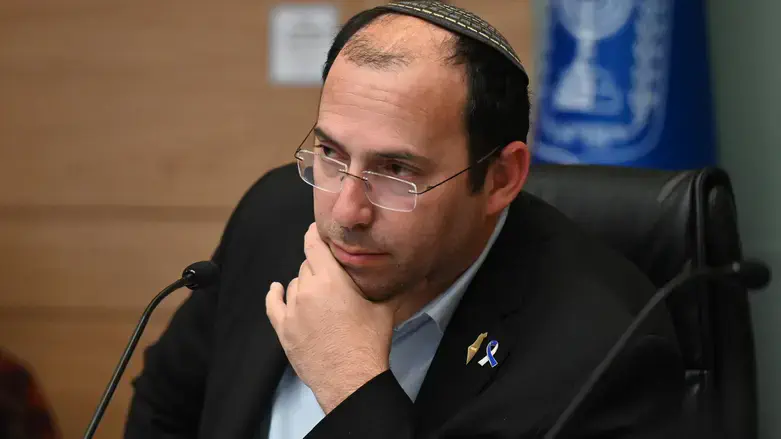
Opposition parties are not waiting for the next government to be formed and are already setting up committees to dismantle and repeal judicial reform legislation. In an interview with Arutz Sheva, former Knesset Constitution, Law and Justice Committee chairman MK Simcha Rothman addressed this legislative offensive.
"It is not easy for them", Rothman said, recalling the first obstacle encountered when a committee chaired by MK Gilad Kariv was established to discuss repealing legislation concerning the attorney general. Following efforts led by Rothman and his colleagues, Kariv was forced to announce that he would not chair the committee's deliberations because an investigation into his conduct remains pending, awaiting the attorney general's decision.
"We will not give them an inch. We are experienced in working both in the opposition and in the coalition", Rothman said. He noted that the law governing the attorney general's powers, which Kariv will not chair discussions on, is the most urgent issue because it is due to take effect in less than a month.
Rothman believes the flurry of committee activity aimed at repealing judicial reform legislation is intended solely to serve the next election campaign. He views it as an encouraging sign that the opposition, too, senses that another election is inevitable in the near future, and that it is therefore advancing these committees as nothing more than a campaign initiative.
Rothman said that while he hopes a unity government will be formed, the Democrats party understands that it would not be part of such a government and is therefore working to undermine efforts to establish one. Regardless, he and his colleagues intend to scrutinize every procedural detail in these committees and fight any attempt to circumvent the law when advancing legislation to repeal the reforms.
Nevertheless, we asked Rothman whether repealing the judicial reform legislation would be acceptable to him if the opposition followed the rules and the law. He replied that the Knesset is the place to enact and repeal laws, and that if a majority in Israel chooses to do so, that is its right.
He noted, however, that he had succeeded in passing 120 laws during the most recent Knesset term, a volume he said exceeded that of all Knesset committees combined during the term of the Bennett-Lapid "government of change". He is convinced that an attempt by the "change bloc" to repeal all this legislation would end in disappointment.
"In principle, a Knesset majority-a majority that does not rely on supporters of terrorism-certainly has the right to repeal laws I passed. I accept the voters' verdict, but I do not accept a situation in which laws are struck down both when the right wins and when the left wins. That is what we are working, and have worked, to change. Of the 120 laws I passed, only one was struck down by the High Court of Justice, the reasonableness law, and the court paid a very heavy price for that decision because from that moment it was clear to everyone that the High Court was not interested in the law. Since then, no one has taken the High Court seriously as a court, but rather as a political party".
"As someone who believes in democracy, my aim, including in changing the Judicial Selection Committee, was to 'level the playing field.' For many years, even when right-wing voters voted for the right, they got the left. We leveled the playing field so that when the public votes for the right, it gets the right, and when it votes for the left, it gets the left. That is what voters will get in the next election, and when they vote for the right, they will get four stable years with a strong economy, a determined fight against terrorism, construction in Judea and Samaria, and reform of the judicial system. If you do not vote for the right and, God forbid, choose the left, you get destruction and devastation. That is the overarching goal of judicial reform. In fact, these days mark the realization of the reform, because the debate over the laws is taking place in the Knesset rather than in the High Court", Rothman said.
Asked whether he was prepared for the possibility that forming a unity government would require scaling back aspects of the reform, Rothman replied, "You are pushing at an open door. Throughout the judicial reform process during the most recent term, we never stopped trying to reach agreements with the other side. That is how we acted when we held power. We did not wait until we were in the opposition to do so".
He continued, "The law that will be discussed on Monday, the Judicial Selection Committee law, is the product of compromise and agreement. It differs significantly from what Minister Yariv Levin proposed, from what I wrote in my book, and from what Yizhar Shai and Dedi Simchi proposed, and we advanced that compromise in the Knesset. The fact that the other side rejects our outstretched hand is regrettable, but nothing new".