
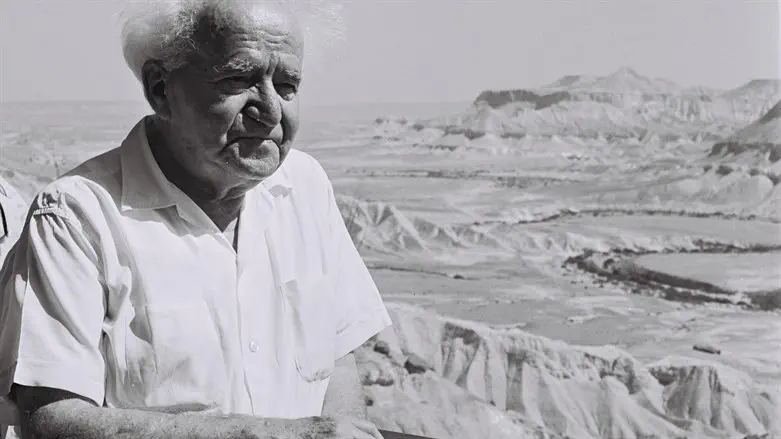
1. The Messiah from Sde Boker
A Messiah in Sde Boker: Rediscovering Ben-Gurion is the title Hagai Segal chose for his book, in which he examines the life and work of Israel’s founding father with deep appreciation. Ben-Gurion is described in the book as a man on whose head “the spirit of history placed the laurel of the privilege of proclaiming Israel’s rebirth, 1,878 years after Jerusalem fell to Titus".
Segal, a former editor of Makor Rishon and Nekuda and director of the news department at Arutz Sheva - Israel National News, presents lesser-known aspects of Israel’s first prime minister.
This week marked the 53rd anniversary of the death of David Ben-Gurion, Israel’s first prime minister and defense minister, who died on 6 Kislev 5734, in 1973.
Ben-Gurion, too, the man who reestablished Jewish sovereignty and of whom it could be said, borrowing Maimonides’ words, that thanks to his vision “sovereignty returned to Israel," was not granted eternal life. Yet the question of how he would be remembered in the history books does not appear to have particularly occupied him.
In a conversation with intellectuals in 1949, which Segal located among the many accounts and documents in the Ben-Gurion Archives, Israel’s first prime minister said, “I want to tell you at the outset: I am not speaking out of modesty. I am not a modest man. But this thought never crossed my mind, what my historical image would be. What has driven and continues to drive my entire life is this: What is the character of the Hebrew nation, will the Hebrew nation survive, and what will its character be."
Even before the establishment of the state, and for many years afterward, Ben-Gurion was not a popular leader in right-wing circles, to put it mildly. Yet roughly half a century after his death, Hagai Segal embarked on a fascinating archival journey, uncovering lesser-known aspects of “the Old Man."
Among other subjects, he examines Ben-Gurion’s messianic branding during the election campaign for the Second Knesset, his complex relationship with Diaspora Jewry, and his surprising closeness to figures such as the poet Uri Zvi Greenberg and even Menachem Begin.
Segal raises the possibility that Ben-Gurion would be considered a far-right figure today. Among the evidence he cites is a passage Ben-Gurion wrote in a Passover Haggadah he compiled for the Seder at his kibbutz, Sde Boker, “Pour out Your wrath upon the Ishmaelites, for they sought to devour Jacob and lay waste his habitation. We shall pour out our fury upon them, and our fierce anger shall overtake them. The IDF shall pursue them in anger and destroy our enemies from beneath the skies of the East."
Incidentally, the Haggadah Ben-Gurion compiled made no mention of God.
2. From Messiah to Prophet
Segal’s book reveals a different Ben-Gurion: a prime minister for whom the Bible was his avowed operating code; a leader who enjoyed sparring with religious Knesset members but held Torah scholars in deep respect; and a man regarded as combative who nevertheless knew how to forge surprising ties with his greatest political rivals.
From the standpoint of an “enthusiastic critic," as he describes himself, Segal draws a fresh portrait of the leader who shaped the state. He sheds light on fascinating archival documents and offers an original interpretation of Ben-Gurion and his legacy.
If Segal’s book presents Ben-Gurion as a kind of “Messiah from Sde Boker," the documents released by the Ben-Gurion Archives to mark the anniversary of his death instead portray him as “the prophet from Sde Boker": a leader who identified in advance dangers and challenges that still lay ahead for the Jewish people and their state. As the biblical verse puts it, “I see him, but not now; I behold him, but not near."
In a letter sent in January 1934 to the American Jewish justice Louis Brandeis, more than 90 years ago, Ben-Gurion warned of the spread of antisemitism in Europe. He wrote, “During my brief visit to England and France, I saw the seeds of the Nazis’ poisonous propaganda against the Jews spreading slowly, almost imperceptibly, but present in both these countries."
Ben-Gurion warned that antisemitism could force Jews to leave their countries. Concerned about the future of the Jewish people, he stressed the need to prepare the Negev to absorb large numbers of immigrants.
In his view, the Negev was the main land reserve that could enable the expansion of Jewish settlement in the Land of Israel.
In another letter to Brandeis, dated June 1935, he wrote, “The areas available for settlement in the country have recently come close to being filled to capacity."
Ben-Gurion explained that without expanding the areas available for settlement, it would be impossible to absorb all the Jews who would be forced, or might choose, to leave their countries.
The solution he identified was settlement in the Negev: a vast, largely uninhabited region that he believed held enormous potential for the future of the Jewish people.
Ben-Gurion wrote, “The Negev’s chief importance lies in the fact that large areas are empty of inhabitants, quite literally." He added that drilling wells would make it possible to “create dense settlement on a mass scale that would not be possible anywhere else in the Land of Israel west of the Jordan."
Thus, even before the state’s establishment, “the Old Man" recognized the Negev’s importance as a land reserve for settlement and a vital region for absorbing future immigration.
3. The Warning About the Gaza Strip
Another of Ben-Gurion’s warnings concerned the security threat posed by the Gaza Strip, decades before Hamas took control of it.
During a visit to Kibbutzim Nahal Oz and Nirim, near the Strip, Ben-Gurion addressed the security dangers in the area and explained why he opposed annexing Gaza to Israel. He said, “I did not need to come to Nahal Oz and Nirim to be told about the dangers that have now emerged. I knew about them, but there are greater considerations. That is why, from the very outset, I firmly opposed those who demanded the annexation of Gaza. That is not what Israel is lacking, another 300,000 Arabs, and ones like these at that. If I believed in a miracle, I would want it to be swallowed by the sea. The Gaza Strip is a malignant danger".
These remarks take on renewed significance in light of the October 7th massacre and the security situation that developed over the years along the Gaza border.
Maj. Gen. Yeshayahu Gavish, who served as head of the Southern Command during the Six Day War, also addressed the issue in his book “Red Sheet."
According to Gavish, even before becoming defense minister, Moshe Dayan argued that there was no point in conquering and taking control of the Gaza Strip. According to Gavish’s account, Dayan said, “Nasser will be happy to leave it to us so that we choke on it."
Later, during peace talks with Egypt, Dayan tried to raise the idea with Egyptian President Anwar Sadat as well, but the Egyptian president refused to accept it.
4. The Decision on Drafting Yeshiva Students
Yet even “the prophet from Sde Boker" did not foresee the full consequences of one of the decisions he made in the state’s early years: the exemption from military service granted to some 400 outstanding yeshiva students at the request of the haredi leadership.
As the years passed and the number of yeshiva students grew, Ben-Gurion reconsidered the decision.
In a letter he sent to Prime Minister Levi Eshkol in the 1960s, he wrote, “I exempted yeshiva students from military service. Admittedly, I did so when their numbers were small, but they are growing. In general, perhaps the entire question of yeshiva students should be examined, and whether they should be exempt from compulsory military service."
As early as 1958, Ben-Gurion raised the moral aspect of the issue in a letter to Israel’s chief rabbi, Rabbi Yitzhak Isaac Halevi Herzog. He wrote, “This is, first and foremost, a profound moral question: Is it right that one mother’s son should be killed defending the homeland, while another mother’s son sits in his room studying in safety, as most of Israel’s young people risk their lives."
Ben-Gurion’s words, written decades ago, also resonate amid the continuing public debate over drafting yeshiva students.
More than five decades after his death, the documents and letters Ben-Gurion left behind are a reminder of how the questions that occupied him continue to accompany the State of Israel.
Antisemitism, settlement in the Negev, the danger from the Gaza Strip and the obligation of military service, all were on “the Old Man’s" agenda and remained part of the national debate in the generations that followed.
It was not for nothing that “the prophet from Sde Boker" yearned for the Jewish people’s return to their land, and their return to the ethics of the prophets.