
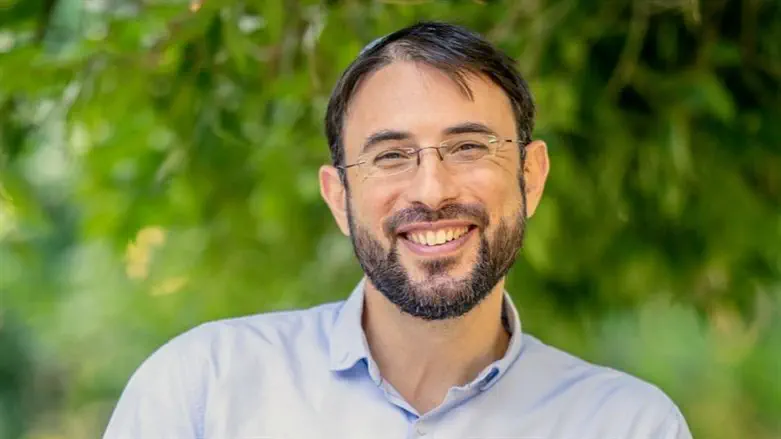
There were several defining moments for me in Oded Harush's compelling interview with journalist Benny Ziffer, who was recently dismissed from Haaretz.
The journalist, author and cultural supplement editor, who worked at Haaretz for 50 years, describes his growing affinity with the right and with religious faith. Along the way, he also discusses his daughter's return to religious observance, after she had once nearly married an Arab man. He also offers his perspective on the resurgence of Jewish consciousness in recent years:
"I think this is the Jewish story. The Jewish story is that there was a period in the 20th century when there was this general pretension in the orld that you could engineer people in all sorts of directions. It worked for ten, twenty, thirty, forty, fifty, sixty, seventy years, and then enough, it was over. You cannot engineer people, quite simply. In the end, they return to who they originally were."
In his view, the Zionist and secular establishment's attempt to create a "new Israeli" and erase Jewish tradition lasted for a certain period, but ultimately collapsed. Today, he sees young people returning to their roots and the first stirrings of religious faith as an "explosion" of a return to a natural Jewish identity that could not be erased.
About a decade ago, in a Facebook post ahead of Yom Kippur, he expressed regret and sorrow over his attitude toward the Land of Israel as a man of the left, "This Yom Kippur, my greatest regret is that I did not love the Land of Israel enough. For too long, I was like a Jewish child taken captive among the nations: held captive by the false slogans of the settlement-hating left. I looked down on those whom the left calls 'settlers' and saw Jewish settlement in Judea and Samaria as something diabolical and monstrous, because that was how I had been brainwashed for years."
"Until my eyes were opened to see. And thank You, God, for opening my eyes to see that this beautiful land is ours, this vast land stretching from the sea to the Jordan, and that it is our duty to conquer it."
He concluded with a prayer, "Forgive me, God of abundant kindness, for having been part of this hateful left for so many years. And thank You for opening my eyes to see the light of truth and to distinguish good from evil."
From the Bible to Zionism
This week, Ziffer's moving words brought to my mind another Jewish figure who underwent a similar process of returning from the brink of assimilation to the depths of Jewish identity. I discovered this figure through our teacher, Rabbi Tzvi Yehuda Kook.
In his talk on Parashat Vayetzei in 5740 (1979-80), published in "Mitokh HaTorah HaGo'elet," Volume II, pp. 39-40, Rabbi Tzvi Yehuda describes the unique fortitude of the Jewish people, "We are named after Jacob; we are Jacob and Israel. 'For you have striven with God and with men, and have prevailed.' A unique, divine quality: you have striven with God. This fortitude, this strength of Israel, has existed within us from then until now. The eternity of Israel. The fortitude of Israel. A fact that cannot change. This fact, this power of Judaism, this power of Israel, is a theme of today's Torah portion."
Rabbi Tzvi Yehuda then turns to a book that made a deep impression on him, "There is a book, 'Jacob's Dream.' In 'Jacob's Dream,' the eternity of Israel throughout the generations is revealed. This book came out when I was in Vienna. The author was Jewish, and I met him. The book made an enormous impression. The chief rabbi of Vienna, Rabbi Chajes, was a grandson of the Maharatz Chajes [Rabbi Tzvi Hirsch Chajes, head of the rabbinical courts in Zhovkva and Kalisz and author of glosses on the Talmud]."
"I went to see him, and just then two people were leaving; one of them was the book's author. Rabbi Chajes said of him: He came to Zionism through the Bible. I became interested in him and asked to meet him. He was a great, spiritual man. The book came out in German and caused a sensation in the literary world. The entire book is about the genius of Israel, the eternity of Israel. Jacob's genius in a literary, theatrical form. As we spoke, he became animated and paced around the room. He calls Esau Edom-and there in the book, Edom meets Jacob, recognizes his genius and says to him: Tell me honestly, Jacob, am I not lesser than you? And Jacob says to him: I am not saying that I am greater than you, but God requires this of me and that of you..."
Who was the novelist and playwright whom Rabbi Tzvi Yehuda met?
Suffering and destiny
He was Richard Beer-Hofmann (28 Tammuz 5626, July 11, 1866-19 Tishrei 5706, September 26, 1945), an Austrian Jewish poet, novelist and playwright from Vienna. He belonged to the avant-garde literary circle "Young Vienna," alongside Arthur Schnitzler and Hugo von Hofmannsthal, and also had ties to Herzl, who influenced him. He was born in Vienna to an assimilated Jewish family. In 1939, following Austria's annexation by Nazi Germany, he fled to the United States and settled in New York, where he lived until his death in 1945 at the age of 79.
"Jacob's Dream" is a play that Beer-Hofmann planned as the opening of a major trilogy titled "The Stories of King David," or "The Saga of King David."
As Sharon Gordon wrote in "Richard Beer-Hofmann: Judaism Is Anxiety," published in Haaretz on September 22, 2004, "The play was staged countless times in German and other languages, and was also translated into Hebrew and performed by Habima Theater."
In the play, Jacob flees Esau and sees the ladder and angels in a dream. He accepts Israel's destiny and the suffering that comes with it. In Jacob's dream, which lies at the heart of the play, Jacob falls asleep and sees the angels Gabriel, Uriel, Raphael and Michael. They urge him to accept his mission and describe Israel's future greatness. Only Samael, the spirit of doubt, objects: he describes the suffering the mission will bring and its futility. Jacob hesitates, and then God's voice is heard from within the light, urging him to accept the mission. In this central scene, Jacob freely chooses his people's destiny, even knowing the suffering that awaits him.
Other people's dreams
In the play, Beer-Hofmann brings together two stories that took place at different times and in different locations: the dream of the ladder at Bethel (Genesis 28) and the struggle with the angel at the Jabbok River (Genesis 32). He transforms them into a single dream that Jacob has on the mountain.
The struggle is not merely physical, as the plain meaning of the Torah describes it, but primarily intellectual and spiritual: Jacob grapples with the meaning of being chosen, the right to be free rather than enslaved, the relationship between God and His people, and the willingness to endure suffering.
Here is one of the passages in which Beer-Hofmann expresses the miracle of Israel's eternal chosenness:
"Mighty kings of the lands across the sea will perish! Egypt will perish! Babylon will crumble and fall! Only you, His eternal people, may wander forever. An eternal miracle of His eternal world!"
It seems to me that a direct line connects Ziffer and Beer-Hofmann: Jews who, in many respects, grew up in an assimilated environment alienated from their identity, and continued to live that way for many years. Then, as if by a wonder and a miracle, they suddenly embrace their identity anew, with all the suffering that this destiny entails. For Jacob's dream is the dream of the entire Jewish people throughout the generations. And even if others try to sell us other people's dreams, "You cannot engineer people... In the end, they return to who they originally were."