

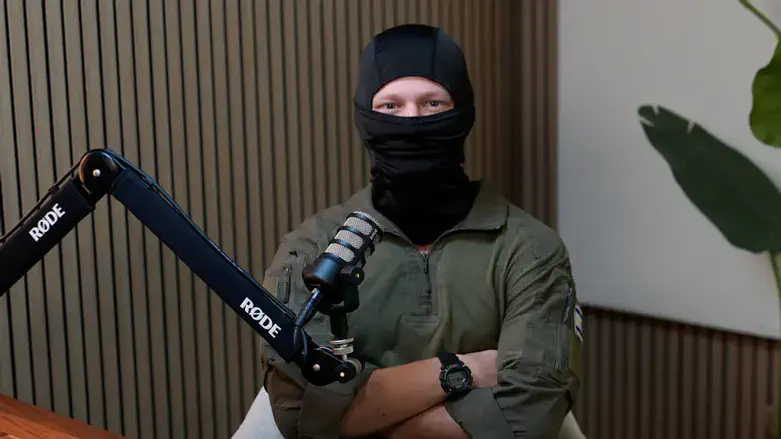
Sergeant Tz., a graduate of the Israeli Navy's submarine training course in Flotilla 7, sums up the gap between what the public knows about submarine service and the reality he and his fellow sailors experience, "Very often, people tell me, 'Oh, you don't do anything.' When the work is quiet, no one hears about it".
In an interview at the Israel National News-Arutz Sheva studio ahead of his graduation ceremony, he discusses the demanding training, the heavy responsibility borne by crew members and his decision to choose a combat role in which most operations take place far from public view.
Sergeant Tz. grew up in the religious-Zionist community, attended a yeshiva high school, was active in the Bnei Akiva youth movement and completed a year of volunteer service. Military service plays a central role in his family: his father and five older brothers served in the infantry. He and his twin brother, however, chose different paths: one in a Navy submarine, the other in the Armored Corps. His choice prompted quite a few questions among his friends, many of whom enlisted in elite units.
He says, "The religious-Zionist community is known for placing importance on combat service. When I decided to go into submarines, a lot of people really did raise an eyebrow. It wasn't clear to me either; I didn't decide right away that this was what I wanted". He says one factor that tipped the balance was the uncompromising nature of the service, "The machine is made of metal, and it cannot deal with you cutting corners. With you doing something only halfway".
Behind that statement lies an exceptional level of responsibility. Aboard a submarine, he explains, every technical action requires absolute precision, and an error in operating a system or changing the sequence of actions could endanger the crew. He explains, "If you do one action too early, one action too late, we will end up in a dangerous situation".
The first time he entered a submarine is etched in his memory. He recalls, "To me, it was like a spaceship. You go inside, climb down a ladder, and it is simply organized chaos". He says the sight of tightly packed pipes, valves and systems was surprising, but he was just as impressed by the crew members' command of every detail.
The training that prepares sailors to serve aboard the vessel begins with a selection process, after which about 50 soldiers enter the course. The basic phase lasts about six months and involves physical exertion, mental challenges and intensive study, with trainees required to absorb large amounts of information quickly and pass tests even under pressure and while fatigued. They later divide into professional tracks, and Sergeant Tz. was assigned to the engineering track.
But the challenge goes beyond studying or physical exertion. Submarine service means coming to terms with being inside a complex vessel, in an environment where any malfunction could have serious consequences. He says, "You learn how to cope with pressure, with the fact that you are both inside a very dangerous machine and in enemy territory, where you could be detected. Just being inside the vessel is dangerous; even training can be very dangerous".
Separation from the outside world is another part of that reality. During the course, the trainees remained on base for 28 consecutive days on more than one occasion, with phone access limited to one hour a week. During voyages themselves, he says, there is no way to speak to family or even send a greeting.
He recalls a period when the trainees learned about major events only after returning home. He says, "It was during the period when hostages were being released, and we would go home after 28 days and find out about it. We wouldn't know anything". Smaller updates also became part of their shared life: a soldier returning from an event brought news from outside, and anyone who heard a new song taught the others the lyrics.
He says those very conditions forged a deep bond among the crew members. He explains, "My friends from the course became like family". After long periods together, without regular contact with the outside world, those friendships became one of the most meaningful things he took away from the training.
Alongside the professional and personal challenges, Sergeant Tz. also describes a religious experience he had not expected. He says submarine service allows religious soldiers to maintain their way of life, with commanders even helping them do so. He recalls, "It got to the point where you forget to pray Mincha, and the commander comes and reminds you".
One particularly special moment for him was his first Shabbat aboard a submarine. Usually, he explains, there are not enough religious soldiers for a minyan, a prayer quorum, but on that voyage, traditional and secular soldiers also joined the prayers. He recalls, "There was a minyan. The traditional soldiers came too, and the secular soldiers also joined". Ahead of Kabbalat Shabbat, the crew sang Shabbat songs and Carlebach melodies together.
Even before enlisting, he was considering a question not heard in every Torah study hall: which direction should one face when praying aboard a submarine underwater? He recalls, "Before my service, I asked myself, which way should I face when praying? Where is Jerusalem?". Ultimately, he decided to choose a fixed direction within the vessel. He says, "I decided I would always pray facing the submarine's bow", explaining that aboard a moving vessel, it is difficult to rely on a fixed direction relative to land.
The personal cost of his service is felt particularly in his relationship with his family. His twin brother serves in the Armored Corps, and at one point, four months passed without the two seeing each other. Sergeant Tz. even missed his brother's enlistment party, but when his brother's beret march approached, he was given special permission to leave and take part.
He recalls, "We had a long stretch of four months. They let me leave especially for the march". The reunion was emotional for both of them and highlighted the similarities between their two service paths. Although one serves beneath the sea and the other inside a tank, both must know their assigned vehicles thoroughly, maintain them and operate in full coordination with their fellow crew members.
There is another side to life aboard a submarine: missing nature. Sergeant Tz., who often hiked in the desert before enlisting, discovered a new world during his service. He says dolphins, birds and other wildlife can be seen while sailing on the surface before a dive, but once the submarine descends beneath the sea, the view disappears.
Smiling at one of the questions he is asked repeatedly, he says, "There are no windows in a submarine". He says it is possible to spend weeks without seeing the sky, and it is then that he draws strength from memories of hikes and open spaces. He explains, "You learn to connect with the outside through what is inside, to think of the scenery from your memories, to recall landscapes you saw on hikes, and that gives you the strength to keep going".
Toward the end of the conversation, he asks to address young people considering whether to enlist in Flotilla 7. He understands their concerns, particularly the desire among young people in the religious-Zionist community to serve in combat roles that involve carrying weapons and running in the field. He says some pass up submarine service because it does not match their image of meaningful service.
Of his decision to serve in submarines, he says, "I think it is one of the best decisions I have made in my life. People think that anything outside the infantry isn't hard. It is hard, and you work at it and cope with it". Asked what he wants Israel's enemies to know about Flotilla 7, he does not go into detail about the submarines' capabilities or missions, giving a brief answer, "That we are ready".