
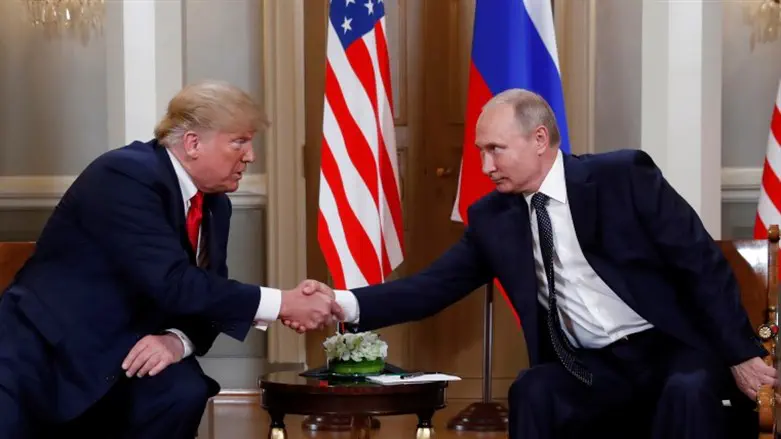
Ahead of the US-Russia-China summit, where Presidents Trump, Putin and Xi Jinping are expected to meet tomorrow, Arutz Sheva spoke with Prof. Mordechai Chaziza, a fellow at the Misgav Institute for National Security and an expert on China's relations with the Middle East and North Africa. Unlike some other observers, he does not have particularly high hopes for the meeting.
He said, "This is a very interesting and unique summit. For the first time, there is a meeting here between three important powers. There are three very interesting presidents, each arriving with his own personality, wishes and ambitions. Bringing all three into one room is very interesting, and that is what is drawing everyone's attention. Here are the three big bosses meeting to discuss the world's most pressing problems: Ukraine, the nuclear issue, Iran and perhaps other subjects. There are many expectations for this meeting".
However, Prof. Chaziza noted that the meeting is part of a larger event hosted by China and attended by many leaders. For Putin, this is a special occasion, as he has avoided traveling to international events for fear of enforcement of the arrest warrant issued against him over the war in Ukraine. Now, under China's protective umbrella, he is allowing himself to attend a meeting with world leaders.
While the Trump-Putin-Xi triangle may appear to pit Trump against two allied adversaries, Prof. Chaziza believes the picture is different. He said, "China and Russia are not such good friends as some try to portray them. They have a partnership, but the presidents do not see eye to eye on many things. The Chinese are unhappy with Russia's conduct in Ukraine and with the Russian-American initiative for talks on reducing nuclear weapons".
Chaziza said, "This is, in fact, a meeting of three presidents of major powers. What connects them, first and foremost, is the very fact that the meeting is taking place. They may shake hands and smile for the cameras, but not much may come of it, and everyone will be disappointed". Prof. Chaziza also sees the lack of substantive preparations and the absence of any leaked information about preliminary agreements as indications that the meeting may produce little of substance.
He added, "So this is primarily a diplomatic meeting with plenty of smiles that suits everyone: Trump will divert attention from his election failure, Putin gets his first opportunity to attend an international meeting, and Xi will be seen as an international leader. If they manage to reach agreements, that would be wonderful, but that does not appear to be the direction things are heading. I do not see them moving toward compromises".
Prof. Chaziza also tempered expectations that the meeting might seek agreements on Ukraine, predicting no progress on the issue, in part because Putin does not want Chinese involvement in that arena. On the other hand, although he has little expectation that it will happen, Prof. Chaziza raised the possibility that Trump might try to enlist China and Russia in a joint, firm stance toward Iran on the nuclear issue and the Strait of Hormuz.
Addressing the Chinese president's considerations, Prof. Chaziza added, "The Chinese are very cautious about international conflicts that do not border their territory. It is important to them to be part of the bigger picture and to have people talk about China's role, but when it comes to making a commitment, there is nothing there. Anyone who understands the limits of Chinese mediation understands that this is what they want: to host, to have handshakes and smiles. But once the media leave the room, nothing will remain except empty words".
Nevertheless, we asked Prof. Chaziza what would surprise him if it happened at the leaders' meeting. He replied, "If I see a Chinese commitment to take responsibility for transferring the enriched uranium to its territory, not merely in a statement but in practical terms, with an orderly mechanism and a defined response to an Iranian violation, that would be surprising. It would also be surprising if Trump made Putin an offer and told him to end the war".
He reiterated that, as someone who studies the issue and is familiar with the web of interests surrounding the meeting, he is highly skeptical and finds it difficult to believe that any of this will actually happen. However, the meeting could serve as a springboard for something more significant in the future.