

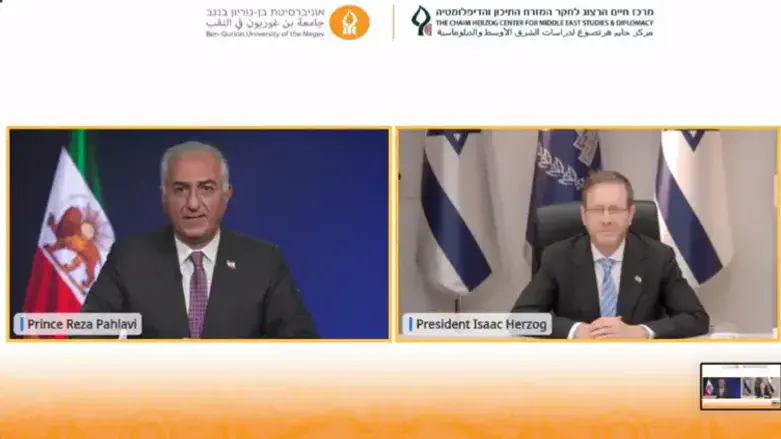
President Isaac Herzog and exiled Iranian Crown Prince Reza Pahlavi participated in a webinar hosted by the Chaim Herzog Center for Middle East Studies and Diplomacy at Ben-Gurion University of the Negev on Tuesday (November 17), discussing the Iranian regime, relations between the Israeli and Iranian peoples, and their hopes for a peaceful future between the two countries.
Addressing Pahlavi, Herzog praised his friendship with Israel and emphasized that Israel's conflict is with the Iranian regime rather than the Iranian people.
"Prince Reza Pahlavi, your friendship clearly shows that you fully understand that Israel can be a beacon to the entire region, and a great source of support for a partnership with the Iranian people."
"We always say, and stress time and again: our war is not with the Iranian people. Our war is with the regime that calls for our annihilation, that wants to eradicate us, and that extracts the resources of its nation, your people, to spread hate, havoc, and terror."
Herzog thanked Pahlavi for his message of solidarity with Israel on the third anniversary of the October 7 massacre and for his visit to the Auschwitz death camp in Poland.
"Your Royal Highness, I want to thank you for your recent message of solidarity and support for the people of Israel on the third anniversary of October 7th. I was also extremely moved to see you visit the Auschwitz death camp in Poland, expressing such deep feeling for what our nation endured in the Holocaust."
The President called for international cooperation against the Iranian regime and expressed hope that its removal would pave the way for renewed relations between the two nations.
"The Iranian regime continues to spread radicalization and instability around the world. I believe there should be a coalition of nations to fiercely combat the Iranian regime’s efforts around the world, and to bring hope, change, and peace to the region."
"I hope we will see a dream come true: relations of peace, prosperity, and friendship between Iran and Israel in the future, when this regime is removed, and we will see you, Your Royal Highness, coming back home."
Pahlavi, the son of Iran's last shah, highlighted the historical ties between the Iranian and Jewish peoples, describing their relationship as rooted in biblical history.
"Mr. President, my friends, you know that the bonds that tie our two great nations, Iran and Israel, together are biblical. They have shaped history. These ties have included great kings, prophets, and the rebuilding of temples to the Almighty Himself."
"To us Iranians, it is a source of inspiration that a people held captive and driven into exile can return home and build a great nation that serves not only its own people but also the world. We, too, have our share of leaders in academia, the sciences, and business."
Pahlavi warned that the Iranian regime's threats against Israel and Western countries must be taken seriously, arguing that allowing the regime to remain in power would pose an existential danger.
"When the Islamic regime chants ‘Death to America, death to Britain, death to Israel,’ it is not joking. It is not a political slogan. It is a marching order to its black-shirted thugs and its proxies. If this regime is allowed to survive, it will pursue nuclear weapons at any cost, and it will not hesitate to unleash a second, far greater Holocaust. The only way to deal with an existential threat is to eliminate it."
He also called for greater international support for Iranians opposing the regime, emphasizing the sacrifices made by those seeking freedom.
"What does unite Iranians' frustration is when their sacrifices for their own freedom, and for the peace of the world, are ignored or taken for granted. They are fighting on the front lines against this regime. Forty thousand of them gave their lives to defeat this regime. I know Israelis understand what it means to sacrifice in order to live free. So we ask that their sacrifice be honored with solidarity, and importantly, with support."