

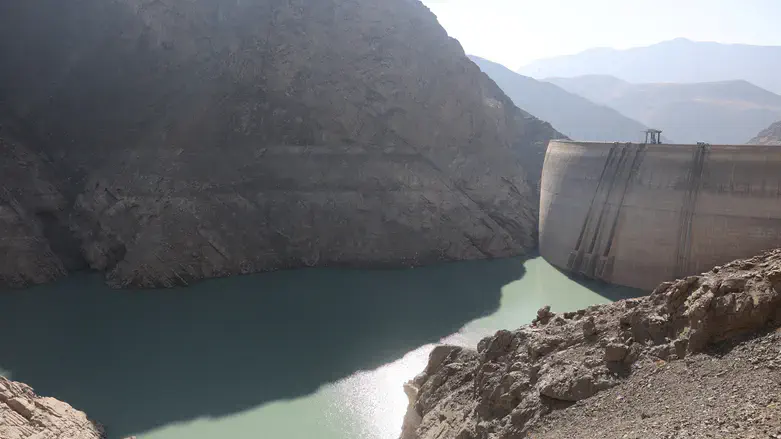
Iran's vast network of dams and water transfer projects may serve a previously undisclosed military purpose, according to an investigation published by The New York Times, which found that numerous Iranian missile facilities targeted in US and Israeli airstrikes were located near major water infrastructure projects.
The findings, detailed in the report, have raised questions about whether some of Iran's extensive investments in dams, pipelines, and tunnels were designed to provide essential resources to its underground missile program.
Nima Shokri, a water security specialist at Hamburg University of Technology in Germany, spent years investigating why Iran had constructed at least 533 dams, including in regions where their economic or agricultural justification was unclear.
Shokri examined maps of missile facilities struck during the war and discovered that the geographical distribution of the targets closely resembled the pattern of dams his team had documented.
The apparent connection has led several experts interviewed for the report to consider whether the projects were intended to ensure that Iran's military installations could operate independently of the national electricity and water networks.
Danny Citrinowicz, a former Iran analyst in Israeli military intelligence, told The New York Times that maintaining independent infrastructure would help protect the operational capabilities of Iranian missile bases during wartime.
According to Citrinowicz, providing military complexes with alternative sources of electricity and water could allow them to continue functioning even if the country's broader infrastructure were damaged.
However, the report emphasized that the relationship between Iran's civilian water projects and its military infrastructure remains unproven.
Farzin Nadimi, an Iranian military affairs expert at the Washington Institute, estimated that the country maintains at least 30 underground missile complexes. These facilities, known in Iran as "missile cities," contain extensive networks of fortified tunnels used to manufacture, store, and deploy ballistic missiles and drones.
The New York Times investigation also examined whether the location of sensitive military installations could explain the arrest of numerous Iranian wildlife conservationists in 2018.
At the time, the Islamic Revolutionary Guard Corps accused environmental researchers of conducting espionage under the cover of wildlife monitoring activities. Several conservationists were imprisoned for years, while Kavous Seyed-Emami, a founder of the Persian Wildlife Heritage Foundation, died in Iranian custody.
Morad Tahbaz, another founder of the organization who spent more than five years in prison, told the newspaper that interrogators were particularly interested in his team's activities in Hormozgan Province.
The region was subsequently targeted in US airstrikes on July 14, including an attack on the Tarom Protected Area, where the family of a local wildlife ranger was killed.
According to Nadimi, the area is located near a site where military analysts believe Iran established an underground missile facility.
The report also highlighted a major water transfer project connecting the Zagros Mountains to Yazd in central Iran.
Amir Aghakouchak, a water researcher at the University of California, Irvine, told The New York Times that he had previously questioned the rationale behind the massive project. Reports of a significant missile installation near Yazd following airstrikes in March led him to consider whether military requirements had influenced its development.
Nik Kowsar, an Iranian environmental analyst based in Washington, suggested in the report that the Revolutionary Guards may have regarded conservation workers operating near classified military installations as potential security risks, even when their activities were entirely environmental.
Nevertheless, the report noted that no definitive evidence has established that the detained conservationists encountered secret missile facilities or that Iran's dam construction program was deliberately coordinated with its missile network.
Iran's Foreign Ministry, Energy Ministry, and Revolutionary Guards did not respond to requests for comment from the newspaper.