
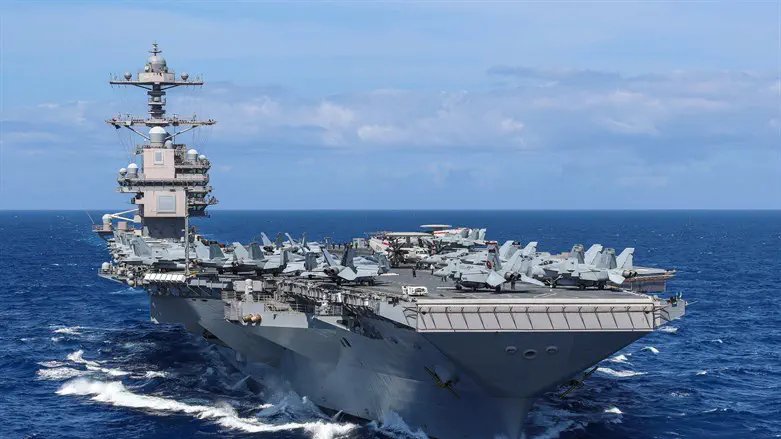
The US aircraft carrier Roosevelt is returning to the Middle East, joining two aircraft carriers already in the region. We spoke about the implications of this powerful military platform's arrival and its operational capabilities with Prof. Kobi Michael, a senior security researcher at the Misgav Institute for National Security and the Institute for National Security Studies.
An aircraft carrier, Prof. Michael says, "is the most important and largest combat platform available to the US military, or to militaries in general. It is a platform that can operate independently at sea for a very long time. We must remember that an aircraft carrier does not operate alone. It arrives with a fairly large fleet of warships and other specialized vessels that have firepower of their own, but it is the central platform that enables an air force of more than a hundred aircraft, mainly strike aircraft, to generate the firepower of an entire army."
"When we are talking about three aircraft carriers in the US Central Command's area of responsibility, with two hundred aerial refueling aircraft, F-35 squadrons and other fighter squadrons deployed across the region, alongside the Fifth Fleet's permanent presence in Bahrain and an additional force in Qatar, that amounts to very significant military power, which is not being assembled for no reason. This is not just about threatening Iran. The Americans do not think the Iranians are impressed by such a threat. It appears that the purpose of this concentration of forces is to enable President Trump to launch a very, very significant military operation once he decides that this is the right course of action", Prof. Michael assesses.
Prof. Michael also points to Iran's treatment of the US president as further evidence that a military decision is drawing closer. "Iran keeps humiliating the United States, whether through repeated bombings of tankers in the Strait of Hormuz or attacks on bases in the region, such as in Kuwait and Bahrain, and previously in Jordan. It also continues to harass the Gulf states, which are US allies that Washington is committed to defending, and this is driving a wedge between them and the United States as their disappointment with it grows. The Iranians are also threatening to target American bases on European soil and are operating terrorist cells on US soil, as we saw when the US treasury secretary and his family were rushed from their home to a military base over fears of an attack on him and his family."
"Iranian hubris, Iran's demands for progress in the negotiations, the stalled negotiations and the fact that they continue to focus their efforts on rebuilding their military capabilities-all of these, combined with the short time frame available to President Trump, will lead Trump to make a decision that puts him on the right side of history", Michael says. He finds it difficult to envision any tactic the US president could use to force the Iranians to accept his terms through negotiations alone.
Prof. Michael recalls that three aircraft carriers were already in the region together in April and could have been used to achieve a decisive outcome in the campaign against Iran. However, he says, "Trump's very serious mistake was that he did not finish the war during Operation Roaring Lion and stopped it after forty days. He could have achieved a decisive outcome earlier if he had acted to weaken or topple the Iranian government, or brought it to its knees so that it would come to the negotiating table defeated and accept American terms. Instead, President Trump unilaterally decided to stop the war after forty days, and in June 2025 brought them to sign a shameful and disgraceful agreement that amounted to complete capitulation to Iran. Fortunately for us, the Iranians, in their arrogance, did not honor this memorandum of understanding, thereby prompting Trump to decide to cancel it and threaten Iran's destruction, which did not actually happen apart from a few actions in response to Iranian moves."
The actions Trump did take, Michael says, "degraded Iranian radar capabilities, disrupting Iran's ability to strike tankers, yet they can still do so, as we have seen in recent days. With very troubling volatility, Trump jumps from negotiations with a 'wonderful government' to 'we will open the gates of hell on them,' and this happens within two-hour intervals... That is why I would not suggest taking this volatility too seriously. Perhaps this is a deception operation aimed at the Iranians."
Given Trump's shifting rhetoric, Prof. Kobi Michael suggests focusing on his actions rather than his statements, and therefore views the third aircraft carrier's arrival as evidence that a significant operation is approaching. "I assess that we are moving closer to a military campaign in Iran, and I hope it will be American-led and that we will not have to act alone, but we must prepare for that possibility as well. I also hope the planning will ensure that the achievements differ from those of the previous two campaigns, so that we do not find ourselves having to launch a fourth campaign."
Nevertheless, some believe the aircraft carrier is arriving only to replace one of the carriers already in the region that needs to rotate out, and that its arrival does not indicate an approaching military operation. Prof. Michael is not aware of evidence supporting that view, but believes that if this does prove to be the purpose of the Roosevelt's arrival, the conclusion would be that Trump has no serious intention of taking military action.
"It seems to me that President Trump is now at a point where he understands that if he does not finish the campaign, no one in the United States will finish the job, and this will be recorded as his historic failure in the annals of the United States and the world. That is not the legacy he will want to leave. I believe he recognizes a genuine danger to the region and the entire world, and that threat is reaching his own doorstep if the treasury secretary has to be evacuated to a military base out of concern for his family's safety. A superpower that accepts such a thing has failed, and I do not think the United States wants to be in that position."