
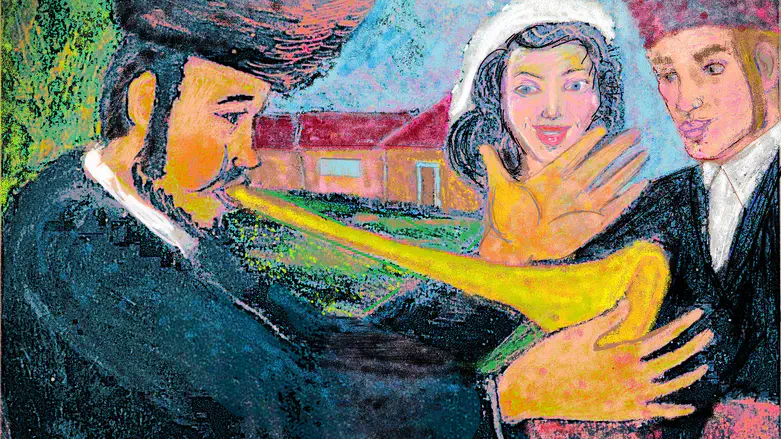
Randy Yisroel Settenbrino is a writer, artist and public intellectual, passionate advocate for Israel and Jewish-Christian solidarity, and the founder of the Historic Blue Moon Hotel, recognized by National Geographic as one of the 150 most unique projects in the Western Hemisphere. Founder of Ohr Chodosh L ‘Zion, a cultural and spiritual initiative dedicated to restoring Jewish identity, courage, and moral clarity through the fusion of art, history, and living faith. His newest release on Amazon Between the Altar and the Sanctuary: The Life, Faith, and Fire of Rabbi Meir Kahane.
The Bible is not a storybook. Every letter, word and turn of phrase carries a surface meaning and a hidden depth. Nachmanides, to whom my own family traces a genetic link, teaches that the deeds of the fathers are a sign for the children. The events of this past Shabbat's Torah portion are the blueprint of our exile and redemption.
Life is a series of tests: physical, economic, psychological and spiritual. Each patriarch faces famine and each faces a despot. These trials are needed to reach the level of development that produces offspring who can survive pervasive evil and still transmit genuine values. In nature, maturity brings the ability to fend off predators or camouflage oneself in order to reproduce.
The matriarchs Sarah, Rebecca and Rachel were all barren. The patriarchs run an obstacle course of confrontations and husband and wife alike petition G-d in prayer. Each matriarch came to a point in her own development and only then bore children. Each couple had children of different calibers, shaped by their own personal growth, and the same challenges persist for all of us today. Whether these paths were arranged so that gained capacities pass to a child through epigenetics, or upbringing and environment makes no difference, the pattern holds:
Isaac over Ishmael, Jacob alongside Esau and Joseph alongside his eleven brothers. Each barren mother’s long wait brought the son who would carry the mission forward. Joseph, whom tradition calls the Righteous, saved the world from famine without surrendering to the licentiousness of Pharaoh’s court. He carried his family into Egypt, and his bones accompanied their descendants out.
Isaac is the first of those long-awaited sons. The patriarch of discipline and restraint carries a name that means laughter. Isaac was given to a mother who laughed at the thought of bearing a child in her old age. The boy who would one day lie bound on an altar was named for joy and he is easy to underestimate. He is the quiet patriarch, a solitary figure without his father’s followers and allies. Yet Isaac is the survivor. He came down from the altar on Moriah and never grew bitter. He embodies the Stoic ideal of amor fati, the love of one’s fate. He did not fight the binding and he did not surrender to it as a helpless victim. He accepted his destiny with love.
Isaac’s image is written on the soul of every Jew who survived the killing fields of his era, carried on and rebuilt his family and his people to continue on the path of Zion.
This past week’s Torah portion, Genesis 25:19 through 28:9, opens with Isaac’s marriage to Rebecca. At forty, strengthened by his ordeal on Mount Moriah, he is matched with a woman of the same caliber of holiness as his mother. When Rebecca enters the family tent, the blessings that left it when Sarah died return.
Rebecca came from a family of operators. Her father Bethuel and her brother Laban were the capi di tutti i capi of their world. They plotted, they schemed and every deal was a scam. It is an odd alliance for a prophet, the son of a prophet. Yet the two families sprang from the same root. We are all created equal, until we decide whether self or selflessness matters most. Abraham chose G-d and G-d chose Abraham. Bethuel opted for power and money to sustain his comforts. Rebecca saw through materialism and chose to serve G-d by serving others.
When Abraham’s servant Eliezer arrives at the well to find a wife for Isaac, she draws water for a stranger and all his camels. It is by her kindness that she is recognized as Abraham’s kin. Yet only after twenty years of unheeded prayers does G-d answer and their ambition to build a holy family finally take root. The tradition tells us their prayer was oriented toward giving to each other. Isaac stood in one corner and Rebecca in another, and each prayed for the other. Rebecca pleaded that her husband, who had kept his father’s righteousness, merited a child. Isaac pleaded that his wife, raised among the wicked yet true to her virtue, deserved one. Isaac had to make his father’s faith his own. Rebecca had to find hers among thieves.
Rebecca conceives twins, each bearing a force that will shape the world: one driven by physical appetite to devour all he can grasp, the other by spiritual striving to rise above the snares and fluctuations of this world. The chaotic movement drives her to seek divine guidance on the meaning of the war raging within her As a woman of G-d she seeks meaning in her pain and is told that two nations are forming, completely at odds, and the elder will serve the younger.
The twins are born. Esau is a hairy red infant who becomes a man of the field: violent, lustful, impetuous. Jacob is smooth, civilized, sincere and drawn to study, working to ascend to the mission of his father and grandfather. Esau’s bloodlust eschews the higher-minded path. He wants action and revels in the fireworks of the forbidden. In his wantonness he abandons any hope of self-mastery. He knows the law will find him wanting.
In his contempt he trades his birthright, the firstborn’s right to carry the mission, for a bowl of lentils, reasoning, “I am going to die so of what use is it to me." It is a sentiment of nihilism that pervades all who are spiritually lost.
Isaac repeats his father’s cycle: a barren wife, famine and a king who covets his wife. Yet Isaac is a sabra who never leaves the Land of Israel. He “sowed in the land and received a hundred-fold." And he digs. Persistent in the face of Philistine opposition, he reopens his father’s wells, which the Philistines stopped up, and calls them by the names his father gave them. He relentlessly moves past every blockage until he strikes water that no one can contest, because G-d is with him.
He names that well Rehovot, for now the L-rd has made room for us to be fruitful in the land. It foreshadows the revitalizing of the land and the sustaining of life there despite hostile confrontations. The Sfas Emes, the Hasidic luminary, teaches that Rehovot came without a fight. It is the Sabbath, the place where the soul finally has room. Faith requires effort. Each generation must dig for itself, often in the very places our fathers found water. After October 7th it is clear to most that we are dealing with a barbarous Philistine, with whom peace requires as much resistance as prayer.
Why, then, does this man of discipline love Esau? Isaac loves Esau because he is everything Isaac is not. Isaac hopes Esau will use his fierce physical prowess to rid the world of chaos and bring order, to redeem the world so that the physical and the spiritual can be reconnected. As the Sfas Emes teaches, Isaac sees the spark of holiness in Esau, the angelic aspect, the perfection of his soul.
That perfection is lost on Esau himself. It will surface in his line: in the prophet Obadiah, in Onkelos, who translated the Torah into Aramaic, and in many of the sages of the Talmud. Isaac cannot envision how a gentle scholar will survive in a world that is ruthless and predatory. He fears that Jacob and his children will be pursued and their holy books burned, that they will remain chattel, powerless against their pursuers.
It is precisely Rebecca’s background that gives her the ability to see past physical prowess. When she looks at Esau she sees her father and her brother and she knows exactly how to handle him. She looks at Jacob and sees the best of both herself and her husband. When she overhears Isaac preparing to bless Esau, she acts to secure Jacob’s place. She urges a reluctant Jacob to take his brother’s place, with the instincts of a mafioso’s daughter. Prophecy reveals the destination. A mother’s insight finds the way. Jacob receives the blessing, and Esau is unexpectedly shattered.
The Italian side of me carries considerable emotion, and I acknowledge Esau’s cry of lost redemption. I recognize his angst, the powerless howl that shakes the earth and pierces Isaac deeply enough to draw another blessing from him. Yet I’m aware that Esau lives under the force of nature, unwilling to rise above it toward holiness. Here I think of my father, who made me understand that not everyone is fit for the priesthood.
Rebecca plays the game much like her brother Laban. She switches sons and he will switch daughters, giving Jacob Leah in place of Rachel. Rebecca does it to achieve G-d’s will, Laban to achieve his personal aims. Yet even Laban’s selfish ends ultimately serve G-d’s purpose. Rebecca’s crucible forms Jacob. She colludes with him to impersonate Esau and teaches him that sometimes he must wear his brother’s clothes to survive, as Jews did in Spain, in Mashhad and in Germany, living like Esau until they could be Jacob again. The experience teaches him to outmaneuver the shifty Laban and to put on the mantle of force when he confronts Esau.
At Gilead even Laban admits that the G-d of Jacob’s father warned him not to harm Jacob, and Jacob swears by the Fear of Isaac. The fear of Isaac was imparted by the piercing light of heaven, which dimmed his earthly vision but imbued him with heavenly awe as a pure sacrifice upon the altar.
That same awe of heaven carried righteous Gentiles who risked their own lives and those of their families to save Jews, among the most vicious nations and the most benign. They were determined to do the Father’s will on earth as it is in heaven.
Jacob carries both his father’s awe of heaven and his mother’s holy chutzpah. The awe anchors him in G-d’s will. The chutzpah gives him the audacity to act upon it, even against seemingly impossible odds. Together they carry him through his struggle with Esau’s angel by the river Jabbok and through his meeting with Esau himself on his return to the Holy Land. The patriarchs are hounded by schemers at every turn, yet with integrity and just enough of their opponents’ craft, they endure, overcome and prosper.
The Sfas Emes teaches that Abraham’s wells led from creation to the love of G-d and Isaac’s led to the awe of G-d.
That awe, the Fear of Isaac, will carry Jacob’s descendants through the dark labyrinth of Jewish history and give them the courage to believe and to rebuild a devastated nation after the Holocaust.
The Philistines are still filling the wells. And Isaac’s children are still digging, in Rehovot, in Beersheba and across the Negev. The water is still rising. And the laughter has returned to the hills of Judea.