

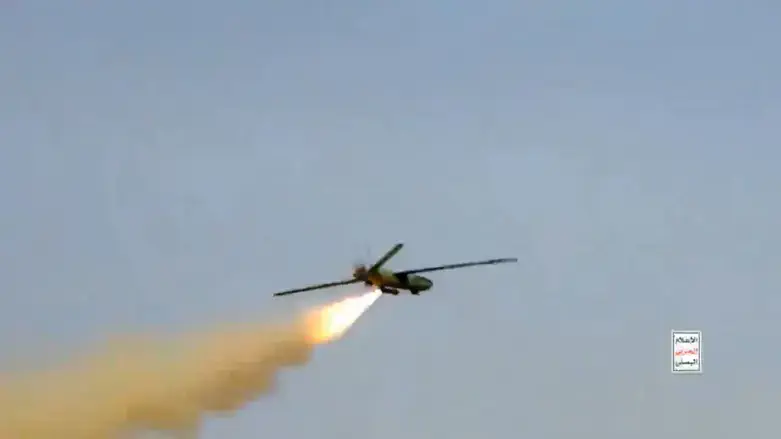
Iran sent drones toward Bahrain on Sunday for the second time in three days, with Bahraini authorities saying their defenses destroyed the incoming threats before they reached their targets.
The Islamic Revolutionary Guard Corps (IRGC) said six drones were deployed against an American air-defense radar installation at Bahrain’s al-Riffa air base. Bahrain, which hosts the US Fifth Fleet, issued an alert instructing residents to seek shelter.
Bahrain’s Foreign Ministry condemned the attacks and said Tehran would bear responsibility for their consequences.
The incident followed Friday’s attempted strike, which the IRGC claimed had hit an American early-warning radar facility. The US military rejected that account, saying its forces downed both Iranian attack drones and that nobody was hurt and no damage occurred.
Saudi Arabia’s Defense Ministry also announced Sunday that its air defenses had shot down two drones launched by the Houthis from Yemen after they entered airspace over the Mecca region in western Saudi Arabia. The ministry did not immediately identify their intended targets or report whether the attack caused damage.
The announcement followed several days of reported interceptions. Saudi authorities said they destroyed Houthi drones over the Mecca and southern regions on November 11, and intercepted two more heading toward the Riyadh and southern regions on November 14.
Reuters reported on November 12 that debris from two intercepted ballistic missiles fell at two locations in the Mecca region. The Houthis have repeatedly denied targeting the cities of Mecca and Medina, saying their attacks are directed at military and strategic facilities.
In a statement carried by Iranian state media on Sunday, the IRGC declared, “The Strait of Hormuz is closed," and threatened a stronger response to American military action.
Washington and Tehran remain at odds over access to the waterway. Iran has targeted vessels it considers to be operating without its authorization, while American forces have been protecting oil tankers carrying Gulf exports.
The IRGC also claimed Sunday that naval mines had struck two tankers in the strait, leaving them burning. Reuters said it could not independently confirm the claim.
Earlier in the week, American forces struck Qeshm Island after the IRGC fired at a US aircraft, US officials told CBS. The officials characterized the operation as defensive and limited in scope.
A preliminary June arrangement intended to end the conflict and restore passage through Hormuz unraveled after renewed Iranian attacks on shipping and the reinstatement of Washington’s blockade of Iranian ports.
President Donald Trump said this week that he was no longer pursuing an agreement with Tehran and directed Vice President JD Vance to concentrate on domestic politics. Reuters reported Saturday that Trump had indicated he could refrain from further strikes if Iran and the Houthis avoided new provocations, while keeping the blockade in place.
Meanwhile, Saudi-backed troops fighting the Iran-aligned Houthis in Yemen announced Sunday that they were leaving positions near Bab el-Mandeb and Dhubab Airport to strengthen defenses around Aden, the internationally recognized government’s temporary capital.
The Southern Armed Forces said the redeployment prioritized protecting Aden and surrounding governorates. Neither Saudi Arabia nor the Houthis immediately commented on the withdrawal.
According to Reuters, the retreat appeared to bring a six-week counteroffensive to a close. Government troops had recovered several positions near the strait but had been unable to fully dislodge the Houthis or recapture Mocha.
Yemeni military sources told Reuters that withdrawing units had moved to al-Suqyah, roughly 150 kilometers west of Aden, while continuing operations against nearby Houthi coastal positions.
Conditions have also deteriorated in besieged Taiz, where approximately half of the 300,000 people displaced by the latest fighting are sheltering. Relief supplies cannot reach the city, and civilians are unable to leave.
Iranian state media reported that Foreign Minister Abbas Araqchi would travel to Oman on Tuesday for discussions with his counterpart. Oman has served as a mediator in the crisis.