
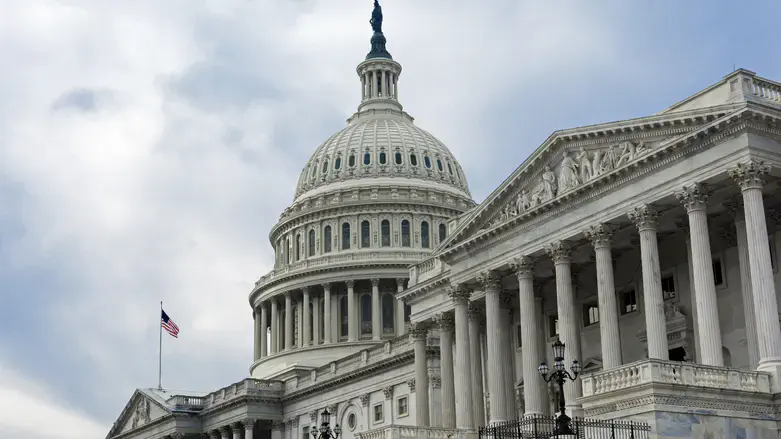
Dr. Kobi Barda, a senior researcher at the JPTI Institute, warns in the wake of the US midterm election results, "The first to suffer the hardest blow from the Democratic Party's gains in the United States will be the residents of Jewish communities in Judea and Samaria. This is going to be very painful".
In an interview with Arutz Sheva, he assessed that the apparent Democratic majority in Congress could lead to significant sanctions against the settlement enterprise, including measures targeting financial institutions in Israel. He warned that President Donald Trump would not necessarily be able or willing to prevent all of them.
Barda described the election results as an exceptionally sweeping victory for the Democratic Party. According to the figures and projections available to him at the time of the interview, he said, the Democrats' margin in the House of Representatives could reach about 100 seats, compared with the Republicans' five-seat advantage in the outgoing Congress. In the Senate, he estimated, the Democrats could secure 56 seats to the Republicans' 44.
He emphasized, "This is a victory of biblical proportions for the Democratic Party", noting that Democrats had also made what he described as exceptional gains in states considered Republican strongholds. As an example, he cited Kansas, where he said a Democratic senator had been elected for the first time in 94 years.
In his assessment, the main implication for Israel concerns the expected shift in Congress's approach to Israeli policy in Judea and Samaria.
Barda pointed to remarks by pro-Israel US Ambassador Mike Huckabee concerning "Jewish terrorism" in Judea and Samaria. He said that when even figures known for their strong support for Israel use such terms, Democratic members of Congress could view this as grounds for pursuing tougher measures.
He warned, "I am talking about individual sanctions, I am talking about regional sanctions, I am talking about sanctions covering entire areas".
He estimated that the shift could begin as early as January 3, when the new Congress takes office. He believes that even if Trump vetoes some measures, Israel could still be affected by other decisions.
The most severe scenario he outlined involves restrictions on Israel's banking system. Barda fears that Congress could pursue sanctions against banks and financial institutions that finance settlement-related activity, including construction and mortgages. He said, "In practice, this means bringing the settlement enterprise to a halt".
He said violent incidents involving rioters in Judea and Samaria in recent months had damaged Israel's international standing, including among those who had previously been sympathetic toward it. He believes that a new Israeli government presenting a shift in enforcement policy and taking practical steps on the ground could be given some time to demonstrate its intentions.
He clarified, "I cannot guarantee that such a thing would actually work", but assessed that without a policy change, the impact on the settlement enterprise could be immediate.
At the same time, he warned against relying exclusively on Trump to protect Israeli interests. He said a tendency was already emerging among the president's associates to place some of the blame for the Republican defeat on Israel and US involvement in the Middle East.
Barda referred to remarks he attributed to Vice President JD Vance following the elections. He claimed that Vance had listed four reasons for the Republicans' failure, all related to Israel, and had even called for a change in relations between the countries. He said the remarks had also received public support from Trump's son, adding, "This means that the pressure has begun to shift to Trump, who would find it convenient to blame Israel for the defeat. My assessment is that, as time goes on, we will see more and more statements from him, because this will help him distance himself from the failure".
Barda stressed that he could not determine whether Trump would actually reduce his commitment to Israel. However, he believes the political changes in Washington require Jerusalem to reassess its foreign policy and its relations with other countries.
Barda warned of the possible consequences of failing to change policy in light of the new balance of power in Washington, "If we cannot form a different government, one that presents a different face and tries to demonstrate a different approach to what is happening, the sanctions they are going to impose on us will be very severe".