

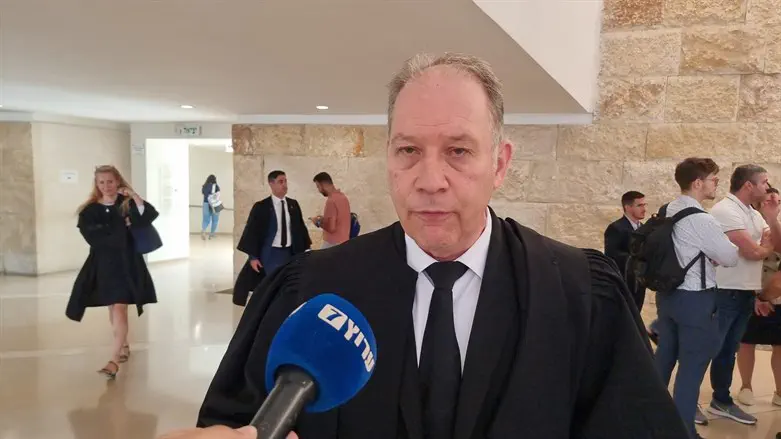
Likud legal adviser Attorney Ilan Bombach is preparing to challenge the results at several polling stations in Arab communities, alleging widespread election irregularities that may have affected the national outcome. In an interview with Arutz Sheva - Israel National News, Bombach detailed the evidence being gathered, criticized the handling of a related ISA investigation, and warned that the alleged misconduct could have shifted multiple Knesset seats.
Appeals can be submitted until Wednesday, 14 days after the election results were published, Bombach said. He claims that a growing body of evidence points to serious violations at polling stations in Arab communities, including the improper use of digital applications to mobilize voters.
"We will present a great deal of evidence, including affidavits from observers and citizens who witnessed the improper use of apps," Bombach said. "We remember the fierce battle in the Supreme Court over the Elector app, when the court ruled that it violated privacy. It turns out that Likud and other parties upheld the integrity of the elections and did not use apps, while digital applications and paper forms were used extensively throughout Arab communities. We have hundreds of testimonies about this."
He argued that the alleged practices constituted a serious violation of electoral equality, claiming that while some parties were prevented from mobilizing voters through such means, others were permitted to do so. He pointed to the sharp increase in voter turnout in Arab communities as a possible consequence.
Bombach said he was also collecting testimony concerning alleged vote-buying, multiple voting by individuals, threats against polling committee members, and people casting ballots on behalf of those accompanying them, including people with disabilities. However, he emphasized that the alleged use of voter-mobilization applications was central to the appeal because of its potential impact on the overall results.
He compared the allegations to the circumstances surrounding the annulment of the election for state comptroller, which was invalidated over concerns that the principle of ballot secrecy had been violated.
"We remember that the results of the election for state comptroller were invalidated because it was argued that the principle of ballot secrecy had been violated," he said. "Here, not only was ballot secrecy violated when people were photographed to prove they had voted as instructed, but the principle of equality was also violated when certain parties could not mobilize voters while others could."
Another major component of the case, Bombach said, is the ISA investigation into suspected foreign interference in the elections.
"We remember Justice Sohlberg's demand two weeks ago that the ISA investigate serious suspicions of grave violations of election integrity, involving hostile countries and foreign actors providing foreign funding totaling at least approximately 100 million shekels," he said.
Bombach accused Attorney General Gali Baharav-Miara of obstructing the investigation, despite what he described as a substantial evidentiary basis for examining the allegations.
He pointed to what he called a contradiction between Justice Noam Sohlberg's efforts to advance the investigation and the attorney general's alleged reluctance to cooperate with the ISA.
"On the one hand, Justice Sohlberg understands the importance of the matter and ordered that information be obtained quickly. On the other hand, the attorney general is putting obstacles in the way and making the investigations very difficult, despite a very clear evidentiary basis," Bombach said.
He cited the ISA's reported request to question members of the Arab factions in the Knesset, arguing that such questioning should be permitted. He specifically mentioned Hadash-Ta'al chairman Ayman Odeh and MK Ahmed Tibi, who reportedly visited Qatar shortly before the elections.
"Regarding Tibi, who was in Qatar a few days before the elections, would it not be appropriate to ask him what he was doing there?" he asked.
Bombach also challenged the attorney general's position that an investigation could not proceed without evidence establishing wrongdoing in advance.
"How can the attorney general establish a new rule that there can be no investigation without evidence? That is not correct. You do not investigate if there are no grounds for suspicion, and there are grounds for suspicion. Evidence is obtained through an investigation," he said.
He accused Baharav-Miara of preventing the questioning of Knesset members and arguing that their parliamentary aides were also protected by immunity. Bombach rejected that interpretation, noting that Knesset members and ministers had been summoned for questioning during the outgoing government's term.
"The more serious the suspicions, the more reasonable it is to allow the ISA to use more substantial tools to dispel uncertainty or substantiate the suspicions," he said. "You cannot tie the hands of the ISA when it wants to investigate the matter seriously."
Bombach further questioned what he described as the attorney general's heightened concern for the rights of suspects in this case, contrasting it with her handling of investigations involving Prime Minister Benjamin Netanyahu.
"I do not understand the attorney general's excessive concern for suspects' rights, which we did not see in the cases involving the prime minister, including in the treatment of people who were not suspects," he said. "There, we saw the use of spyware, improper methods and more, and we did not see such sensitivity. Here in particular, when the suspicions are serious, there must be a serious investigation, and the impression is that everything is being done to prevent one."
Bombach said he had formally asked Justice Sohlberg to instruct the attorney general to ensure that the allegations were investigated thoroughly and that she stop obstructing the ISA's work. He also requested access to the findings gathered so far, which he said could be crucial to preparing the election appeal.
He noted that a meeting was scheduled for Thursday involving Justice Sohlberg, the police commissioner and the head of the ISA, expressing hope that it would lead to the release of additional information.
"This is very significant for filing the appeal," he said.
Bombach also contacted the Privacy Protection Authority, which he said has independent authority to investigate the alleged misuse of digital applications and the photographing of voters. He requested information about its findings and any steps it had taken, but said he had yet to receive a response.
In addition, he requested access to body-camera footage recorded by election integrity supervisors at polling stations. Although filming is prohibited inside polling stations themselves, supervisors are equipped with body cameras to document their activities.
Bombach said Justice Sohlberg had indicated that the footage would initially be provided only to the police and other law enforcement authorities. However, he expects to seek access to the material as part of the appeal process.
Despite the difficulties, Bombach said he remained determined to pursue the case, criticizing what he characterized as an effort to dismiss the allegations before they had been properly investigated.
"Instead of going all out on the investigation and seeking to bring the truth to light, there is a sense that they are trying to say there is nothing to this and nothing to investigate," he said. "This is very puzzling conduct by the attorney general, even though Justice Sohlberg is speaking of serious suspicions and one would expect the matters to be examined seriously and thoroughly."
Addressing arguments that the alleged irregularities were not extensive enough to change the distribution of Knesset seats, Bombach acknowledged that the law requires election violations to have an impact on the results before corrective action can be taken.
However, he argued that such an impact need not amount to a shift of ten seats. Even irregularities affecting a smaller number of seats could warrant intervention, he said.
In this case, Bombach alleged that the suspected operation was extensive enough to have shifted multiple seats, describing it as a coordinated effort to manipulate election results in Arab communities.
"It is unacceptable to sweep such an affair under the rug rather than leave no stone unturned to find out exactly what happened there," he said.
"Public trust is not earned through empty, hollow statements that there is no concern about election integrity while, in practice, refusing to examine the matter. The attorney general's statements that this will have no effect and that nothing happened will not exempt her from examining and investigating the matter with every possible effort, as the law requires and as Justice Sohlberg ordered. His order cannot be violated."