
As I stood in my trench coat, my wrist in a cast, I wondered if I’d have to defend myself. As often happens with middle school boys, egos were flaring up. It felt like we had stepped on their turf. I remember thinking, “If he says anything about my Judaism, I’ll have to fight him." The ridiculous part was, in those days, unlike now as a rabbi, I wasn’t wearing any outward symbols of my religiosity-no kippah (skull cap), no tzitzit (tassels). As to be expected, my religion was never raised and neither were our fists. We parted ways, with nothing more than idle threats.
Growing up Jewish in the Philadelphia suburbs in the 90s never involved antisemitism. My alma mater, Cheltenham High School, was replete with students from all walks of life and most seemed to get along irrespective of their backgrounds. But being raised on “School Ties" and “Schindler’s List" antisemitism became a cornerstone of my identity. In retrospect, it seems silly to have built my Jewish life around the possibility of ill outcomes.
Little did I know that this would turn out to be preparation.
Things have changed. The safety and comfort Jews around the world once knew seem like a distant memory. Be it the anti-Israel protests throughout the West or the plethora of recently elected officials who voice their disdain for the one Jewish State-Jews feel alone and concerned that the past is repeating itself.
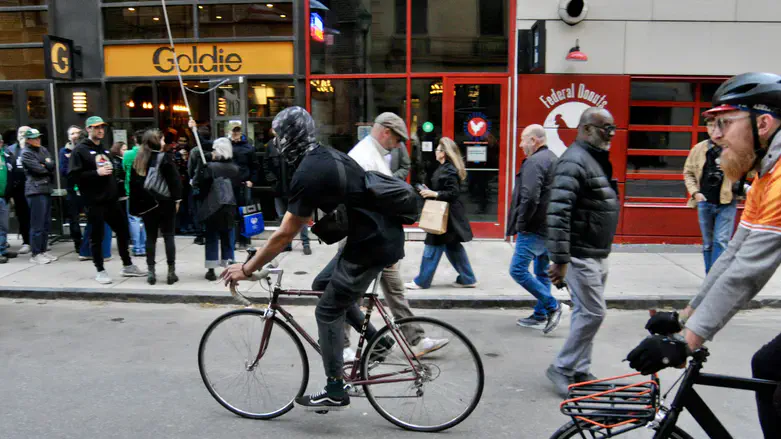
The most recent cause for concern is Philadelphia’s Boycott Ride to ban Jewish-owned businesses in Rittenhouse Square. The protest took place on the eve of the 88th anniversary of Kristallnacht, the night of broken glass, when the Nazis destroyed Jewish-owned businesses, marking the beginning of the Holocaust. Groups such as Philly Bike on Your Left and other anti-Israel groups intentionally targeted these stores, stating, “No Business for Zionists." But a number of these businesses have nothing to do with Israel and are just Jewish-owned.
Some might question what Jews in Philadelphia have to do with the plight of the Gazan civilians halfway around the world. Some might even question how this protest can be called antisemitic at all. Both inquiries are misguided. Israel’s defensive actions since Oct. 7 have just been the excuse for Jew hatred to resurface. It’s more convenient to hide behind the lies of “genocide" and “Israel purposefully targeting children."
But the lies are only protected by a thin veil. These freedom fighters who took to their bikes, have they ever protested the Caspian Grille? The Persian Grill or Persian Delights? The Iranian regime has committed some of the most violent atrocities on its own population over the last fifty years; the most recent was murdering 36,500 innocent civilians in one weekend for an attempted uprising against the totalitarian dictatorship. Not a single bicycle will head to these locations. By definition, holding Israel and the Jewish people to a unique standard that isn’t applied to any other nation is antisemitic.
These organizations are not interested in justice. Their goal is not to right the wrongs of the world. They are singularly obsessed with Israel’s actions and use them as a scapegoat to target Jewish vendors. Jewish strength and self-defense acts like gasoline on the fire of Jew hatred, enraging those who oppose us. But knowing what we face and who our enemies are has the same reaction in our community.
Philadelphians cracked the code that most other locations have yet to figure out. A large counterprotest drowned out those targeting the Jewish proprietors. The makeup of the local "food crawl" was composed of both interfaith leaders and community members alike. People could be heard yelling, “not in Philly!" at the masked Palestinian flag wavers.
As someone who has followed the anti-Israel movement’s activities over the past three years and their ability to intimidate those around them, Philadelphia made me proud. Today the Jewish community does not feel alone. While the fight is far from over, knowing there are those who stand together with us against discrimination, we feel the actual “brotherly love."