

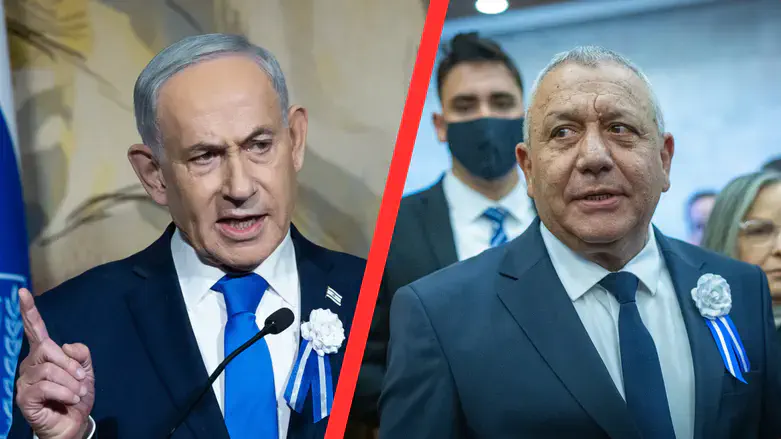
Yashar Party Chairman MK Gadi Eisenkot sent a letter to Prime Minister Benjamin Netanyahu on Wednesday, demanding he show restraint in making security and national decisions during an interim government, and avoid military maneuvers not required to deal with an immediate threat.
In the letter to Netanyahu, Eisenkot emphasized that the Prime Minister remains responsible for national security and the operations of the IDF and security forces, even though, according to Eisenkot, he no longer enjoys the confidence of the Knesset.
"I address you as the one who still holds the reins of power and is currently still in charge of Israel's security, the IDF, and the security forces. At this moment, as is well known, you are an interim prime minister who does not have the confidence of the Knesset. Only 46 Knesset members still support your continued tenure as prime minister," Eisenkot wrote.
Eisenkot tied his request to recent reports which he said raised concerns regarding the considerations influencing security decisions. "In this complex and sensitive political situation, possibly the most sensitive our country has known, you are obligated to show extra caution and responsibility when making security and national decisions, as well as to guide the heads of organizations regarding decisions that require the Prime Minister's consent."
According to Eisenkot, a distinction must be made between actions necessary to address an immediate threat and security operations that can be postponed until a new government is formed. "Deploying security forces in the absence of a direct and immediate threat that requires urgent action could have devastating consequences for Israeli democracy and public trust in government institutions."
"Therefore, I demand that you exercise national responsibility during this sensitive period. Show restraint and caution, and refrain from dangerous actions that can wait until a new government enjoying the confidence of the Knesset is sworn in. Do not undermine the public's trust in government institutions and the decision-making process," he added.
"You must not place the heads of the security establishment in a difficult constitutional dilemma or leave them uncertain about what is required of them and what the right course of action is. Allow them to fulfill the sacred duty entrusted to them without uncertainty," Eisenkot concluded his letter.
The Prime Minister's Office responded to the letter, rejecting Eisenkot's claims. "All decisions made by the government under the leadership of Prime Minister Netanyahu were based solely on security considerations and made in full coordination with the security establishment. They have led to unprecedented achievements for the State of Israel, and this will continue to be the case in the future. Instead of sowing fear and division, one must act responsibly."
The Prime Minister's Office called Eisenkot's letter an "irresponsible move that publicly discusses sensitive security matters. It is a transparent attempt to politicize issues concerning Israel's national security."
"Instead of trying to form a government with supporters of terrorism, Prime Minister Netanyahu once again calls on Gadi Eisenkot to join a government that fights terrorism," the Prime Minister's Office stated.
Eisenkot's retort to the PMO's response was quick to arrive. "If so, why did you refuse my request for an operational briefing through the customary official channels? Why are you trying to delay the convening of the Knesset Foreign Affairs and Defense Committee until next week?" he asked.
"I will not allow an oversight vacuum over a government that has lost the confidence of the Knesset. I will not allow even the slightest deviation from security considerations. I give you my word," Eisenkot pledged.
At the same time, Eisenkot asked the Attorney General to intervene to ensure that he receives regular security briefings from Prime Minister Netanyahu regarding the current threat landscape.
According to Eisenkot, the updates are necessary "to ensure effective oversight, maintain a proper national decision-making process, and safeguard security interests."