

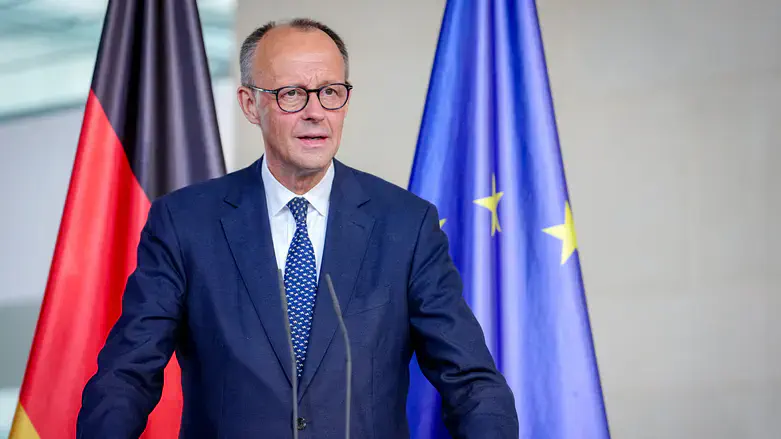
German Chancellor Friedrich Merz warned on Monday that Germany faces a historic test in its fight against antisemitism, declaring that the country's commitment to "Never Again" must be demonstrated through action.
Speaking at the Ohel Jakob Synagogue in Munich during a ceremony marking the 88th anniversary of Kristallnacht, the Nazi pogrom of November 9-10, 1938, Merz expressed concern over the growing visibility of antisemitism in Germany and across the world.
"Antisemitism is once again omnipresent," Merz said. "We see and hear it on our streets, in our cities, in the cities of our European neighbors and around the world, in parliaments, in associations, and in schools."
He warned that antisemitism is sometimes disguised as opposition to colonialism or criticism of Israel, and at other times justified through distortions of history.
"And that is why now is the moment of truth for the 'Never Again' that we pronounce so often and on so many occasions," the Chancellor declared.
Merz reaffirmed Germany's commitment to Israel, emphasizing that the Jewish state's existence is an essential component of Germany's historical responsibility following the Holocaust.
"We stand unwaveringly at Israel's side," he stated, explaining that the existence of a country where Jews are not a vulnerable minority, and where they can seek refuge from persecution, is part of Germany's historical obligation.
The Chancellor also referred to the Hamas massacre of October 7, 2023, describing the terrorist attacks on the Nova music festival and Israeli kibbutzim, where terrorists entered homes and bedrooms with the intention of murdering civilians.
"We support Israel in becoming secure again, both externally and internally," he said.
Addressing the extensive security measures surrounding Jewish institutions in Germany, Merz acknowledged that police protection remains necessary but described the situation as deeply troubling.
"A house of worship, a kindergarten with police officers standing in front of it, is probably safe. But at the same time, it is a horrifying sight," he said.
"High walls, bulletproof glass, armed security personnel in front of Jewish institutions. This is a constant reminder that normal, open, visible Jewish life in Germany is still not possible."
Merz said that although his government would continue strengthening security around Jewish institutions, such measures could only serve as temporary solutions to a deeper problem.
"The fight against antisemitism can only be won in people's minds," he said.
The Chancellor questioned whether German society had done enough to confront the underlying causes of antisemitism, acknowledging that he and others of his generation had believed greater progress had been made.
He also raised concerns about preserving the memory of the Holocaust as the generation of survivors and eyewitnesses passes away.
Germany's antisemitism monitoring organization RIAS recorded 8,725 antisemitic incidents in 2025, more than three times the number reported in 2022, averaging approximately 24 incidents per day.
During his speech, Merz paid tribute to Charlotte Knobloch, president of the Jewish Community of Munich and Upper Bavaria and a survivor of Kristallnacht, recalling her words at the opening of the Ohel Jakob Synagogue 20 years ago.
"We have built, we are staying, because we belong here," Knobloch had declared.
Merz praised the resilience of Munich's Jewish community, which continued rebuilding Jewish life despite the Holocaust and subsequent antisemitic attacks, including the 1970 arson attack on a Jewish retirement home, the 1972 Munich Olympics massacre, and the antisemitic attack of September 5, 2024.
"I am infinitely grateful, as a German, that Jewish women and men have once again established their homes here in our country and here in Munich after the Shoah," he said.
He noted that Munich has become an important center of Jewish life in Europe and pointed to the establishment of the Conference of European Rabbis' headquarters in the city in 2023, as well as the recent opening of a Jewish academy in Frankfurt.
Merz emphasized that Germany's historical responsibility extends beyond the government to every person living in the country, regardless of background or citizenship status.
"Historical responsibility means speaking out against antisemitism and confronting it wherever it appears," he said, calling on Germans to listen to Jewish communities, stand alongside victims of antisemitism, and maintain solidarity with Israel.
Concluding his address, the Chancellor expressed hope that the Ohel Jakob Synagogue, celebrating its 20th anniversary, would continue serving as a center of Jewish life for generations.
"May this Ohel Jakob become 200 years old and older," Merz said. "May it be a place for carefree Jewish life in our country."
"That is the country we want to be. If we all participate, it is the country we can be."