
Stephen M. Flatow is chair of the Religious Zionists of America-Mizrachi and the author of A Father’s Story: My Fight for Justice Against Iranian Terror. His daughter Alisa was murdered in an Iranian-sponsored Palestinian terrorist attack in 1995. He divides his time between Jerusalem and New Jersey.
Some people drove hours to Philadelphia on Sunday to buy breakfast. The eggs were not the point.
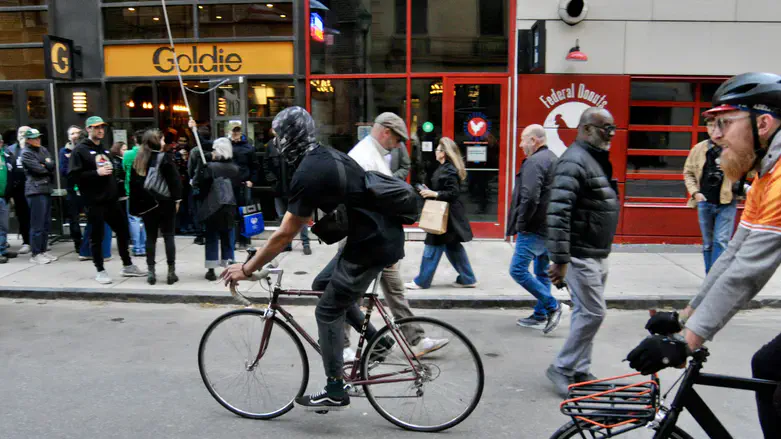
They came because Jewish-owned and Israeli-associated restaurants had been singled out for a bicycle protest whose promotional flyer demanded: “No business for Zionists! These Zionist establishments must go! Not in our city!"
Their answer was to show up, stand in line, and order lunch.
There is something wonderfully American about answering an effort to exclude your neighbors by becoming their customers. There is something deeply troubling about their needing that answer in the first place.
The November 8 “Boycott Ride" targeted six restaurants around Rittenhouse Square: Mac Mart, K’Far Cafe, Huda, Goldie, Dizengoff, and Schlesinger’s. The organizers insisted they opposed the owners’ support for Israel and rejected accusations of antisemitism. Their demand nevertheless made belonging in Philadelphia conditional on an acceptable position concerning the Jewish state.
Who appointed a bicycle collective to decide which Zionists may earn a living in an American city? Who invited anyone to decide other people's accepted opinions?
Many arrived in the now-familiar protest uniform: faces concealed, Palestinian Arab flags flying, and other people’s livelihoods on the agenda.
The response extended beyond Philadelphia. Reporting for Broad + Liberty, Jenny DeHuff interviewed Matt Sheldon, who drove from Manhattan to support the businesses. Schlesinger’s owner Allan Domb reported customers arriving from New York, Maryland, Delaware, Harrisburg, Westchester, and the Jersey Shore.
That matters. People recognized that a campaign against someone else’s Jewish storefront concerned them, too. They made solidarity a journey and a purchase.
But we should resist turning Sunday into an uncomplicated victory parade. Police reported three arrests and minor injuries to two officers, according to NBC10. Officers separated opposing groups; no surrounding property damage was reported. Conflicting crowd estimates also counsel against triumphal claims about who outnumbered whom. The restaurant lines were real. So was the need for protection.
As chair of the Religious Zionists of America-Mizrachi, I wrote to Philadelphia officials before the gathering. We asked for direct contact with affected owners, police liaisons, safe access, and protection before, during, and after the demonstration. Business owners needed to know whether they could safely open their doors.
City leaders deserve credit for responding publicly. Mayor Cherelle Parker condemned the targeting and directed police preparations. Council President Kenyatta Johnson rejected the campaign. District Attorney Larry Krasner attended a solidarity lunch at Dizengoff and publicly distinguished criticism of Israeli leaders from collective blame against Jews. Those actions mattered.
I am a religious Zionist whose politics generally lean right. A Democratic official who defends Jewish neighbors deserves acknowledgment. Our security is too important to reduce to a party loyalty test.
That principle becomes especially important after last week’s elections. Democrats won control of both chambers of Congress. Their victories confer responsibilities toward Jewish Americans, including confronting movements that seek to make Zionism a disqualification from ordinary civic life.
Philadelphia illustrated a division they must face. While Democratic officeholders condemned the campaign, the local Democratic Socialists of America defended the boycott and accused officials of conflating antisemitism with anti-Zionism.
For Jewish Americans, that argument has practical consequences. Can a restaurateur openly support Israel’s existence without facing demands that his business disappear? Must a Jewish shopkeeper submit to questioning about a foreign government before being accepted as a neighbor?
The organizers advertised their ride before Election Day. We cannot honestly claim that the election produced it. Nor does one Sunday establish a nationwide transformation. It does offer a concrete test for leaders taking power: Will they confront exclusion when it comes from people who otherwise share their political vocabulary?
The timing, immediately before the anniversary of Kristallnacht, understandably heightened the distress. Organizers denied choosing the date for that reason. We need not establish their intentions about the calendar to judge the exclusionary message printed on their flyer.
We should also be precise about history. Philadelphia in 2026 is not Germany in 1938. Police protected the community, public officials condemned the targeting, and customers came to support the restaurants. Those differences are reasons to defend American institutions and insist that they fulfill their responsibilities.
Perhaps a healthier chapter of American Jewish life can emerge from that combination: Jews refusing to retreat, neighbors showing up, and officials enforcing equal protection.
It will require sustained conduct long after the cameras leave and the restaurant lines shorten.
I welcome every customer who drove hours to Philadelphia. I welcome every official who spoke clearly and every officer who protected the public.
The standard remains simple: A Jewish American should be able to serve breakfast without first arranging its defense.
...