

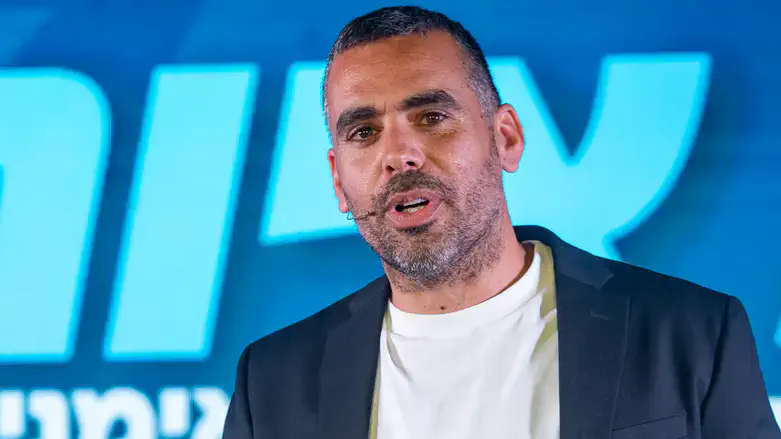
Right-wing figures are continuing to exert heavy pressure on Elyasaf Peretz, a bereaved brother and member of Gadi Eisenkot's Yashar party, in an effort to prevent the formation of a minority government that would rely on the support of Arab parties.
As part of their campaign, they are demanding that Peretz honor his commitments to forming a government made up exclusively of Zionist parties, advance a genuine conscription law, and work toward establishing a national unity government.
Peretz, however, is not yielding to the pressure and has expressed confidence in his party leader. Speaking to Arutz Sheva-Israel National News, he said: "I trust Gadi Eisenkot to make the best decisions for the people and State of Israel."
Meanwhile, the prospect of forming a 48-seat minority government that would rely on Arab lawmakers abstaining in a confidence vote now appears less likely, after Yisrael Beytenu chairman MK Avigdor Liberman imposed an outright veto on the proposal.
The alternative of forming a government with the support of haredi parties also faces significant obstacles. The outgoing opposition bloc would not have enough support with the cooperation of United Torah Judaism, which holds seven seats in the new Knesset. It would also need the support of Shas, which has six seats.
Despite years of campaigning against the haredi parties, Liberman is now not ruling out cooperation with them. In a statement released today, he said he was willing to consider compromises on the conscription issue but would not abandon his principles.
"Being willing to compromise does not mean giving up values and principles," Liberman wrote.
He went on to attack his critics, saying: "In recent days, I have watched a parade of folly by a series of commentators, agenda-driven journalists, bots, and people with preconceived notions, sometimes with an unmistakably racist undertone. No matter what I say, what I do, or what the truth is, they are always busy attributing malicious motives to me and inventing conspiracies."
Liberman argued that some of his critics would rather see a government relying on Arab parties than an attempt to reach agreements with the haredi parties.
"Those attacking me for trying to reach understandings with the haredi parties are among the same people who prefer to establish a government relying on Ra'am and the Joint List - parties whose members of Knesset openly identify with Hamas, describe it as a charitable organization, and accuse the State of Israel of genocide and crimes against humanity," he said.
He then made his position clear: "That will not happen. I will not lend a hand to forming such a government, which in my view would harm Israel's security and return Netanyahu to power. Given the current reality, in order to prevent another election and bring the Netanyahu era to an end, there is no choice but to make difficult decisions and determine which issues allow room for flexibility and agreement."
Nevertheless, he stressed: "Understanding does not mean abandoning principles, and dialogue does not mean erasing red lines."
Addressing the conscription issue, Liberman said his fundamental position remained unchanged, but the election results required a fresh examination of previously proposed arrangements.
"I still believe that the right model is a conscription law for everyone. At the same time, in light of the election results, we must examine ways to reach agreements, including on the basis of frameworks that were developed in the past."