Dr. Michael Krampner is a Jerusalem-based writer with a Ph.D. in Jewish history, and aa retired American trial lawyer whose writings and book reviews primarily focus on Jewish history, historical warfare, judicial reform, and geopolitical critique.
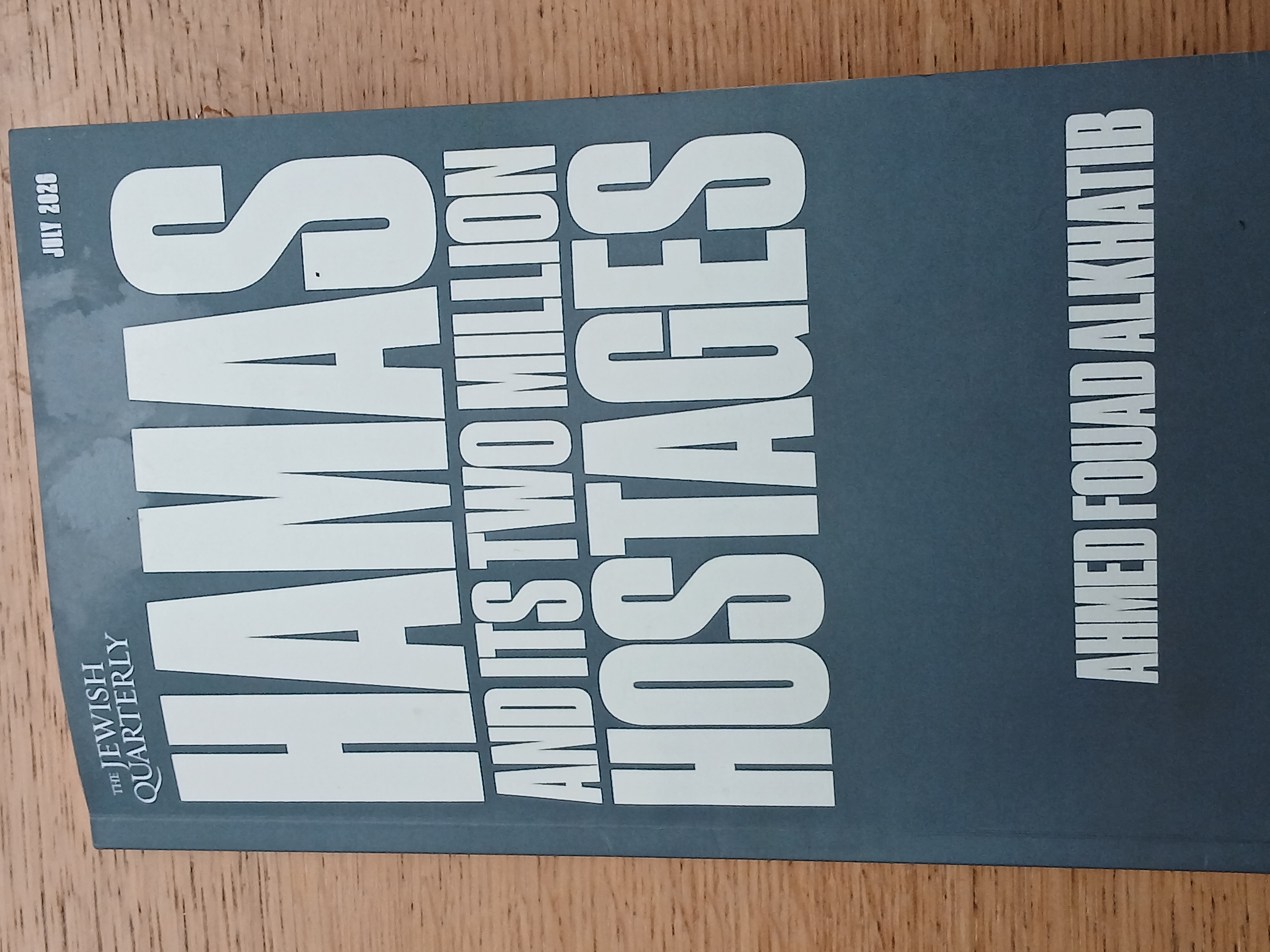
Ahmed Fouad Alkhatib’s little book, Hamas and Its Two Million Hostages, Jewish Quarterly Press, 2026 is an extended essay of only 86 pages published as a book, The author, born and raised in Gaza, and now an American citizen who is a senior fellow at The Atlantic Council in Washington, D.C. concludes that the people of Gaza are being held hostage by Hamas due to Hamas’ self-centered, theological-ideological hatred of Israel and Jews.
That theological and ideological hatred of Israel and Jews has been the source of much suffering for the Gazans, he says, decrying many of the so-called supporters of the ‘Palestinian Arab people’ as ignorant, malicious and ‘drunk on the worst possible combination of extremism, oversimplification and maximalism.’ Hamas, he says, ‘is a moral stain on the Palestinian Arab cause.’
Alkhatib holds that after October 7,2023 ‘a form of mass psychosis took hold of activists, academics, journalists, advocates, politicians and average individuals all blinded to Hamas’ criminality against both Gazans and Israelis.’ That spirit of mass psychosis is still common today even though, as Alkhatib points out, it hurts rather than helps Gazans in particular and ‘Palestinians’ more generally.
Before Hamas was established as a Muslim Brotherhood branch in Gaza in the 1970s and expanded in the 1980s Gaza was both freer and more secular than it became under Hamas rule.
But by the 1980s Hamas had developed a military wing and Hamas published their charter stating that their primary goal is the destruction of Israel and that only armed struggle, and never negotiation, would accomplish that goal. In the 1990s Hamas was engaged in open warfare with Israel.
Hamas was intent on preventing a ‘two state solution’ because it wanted a ‘one state solution.’ That state, of course, would be an Islamic state subject to Sharia law. Hamas’ big breaks came during the ‘Second Intifada’ when it developed its then signature techniques of sending suicide bombers into Israeli civilian spaces to murder Jews and stimulating retaliatory attacks by Israel.
Alkhatib’s father, a doctor, worked in Saudi Arabia for a while and while there Alkhatib was exposed to those aspects of Islam that were inherently antisemitic. When the family returned to Gaza in the late 1990s he attended UNRWA schools in Gaza which, he recognizes, are ‘an obstacle to peace because [UNRWA] perpetuates the unrealistic notion of a mass Palestinian right of return to Israel’s pre-1967 borders.’ Here Alkhatib is soft-selling Hamas’ and UNRWA’s doctrine, possibly unintentionally. Their real doctrine is that Arabs who have an ancestor who lived in Israel between 1946 and 1948, whether they owned any property in Israel or not, have a so-called ‘right’ to enter and control all of what is now Israel, not just within the 1967 borders, and to murder or expel every Jew in Israel.
Alkhatib does not dwell on the fact that UNRWA, besides teaching hatred of Jews and Israel in its schools and encouraging future generations of Jihadis also provides an income directly to many Hamas operatives and also provides family support to Hamas operatives by employing the wives and other family members of Hamas murderers, rapists and kidnappers.
In the 1990s, Hamas distinguished itself from the PA and Fatah by claiming the mantle of Islam and calling Fatah and the PA ‘secular.’ Hamas’ Islamism connected the Palestinian Arab cause to Islam worldwide. Moreover, Hamas imposed its version of Islam on Gaza. Alkhatib states ‘As with Islamists everywhere, those in Gaza went after women and tried to prevent them from wearing any clothing that was considered modern or secular such as pants and skirts and from showing hair or skin.’ To enforce their ideas of how women ought to dress and behave, Hamas operatives would go to the high-end neighborhoods in Gaza City and ‘throw highly acidic water used for toilet-cleaning in the women's faces.’
They used violence, torture and murder to bring Gazans under their control. Alkhatib reminds the reader that Hamas leader Yahyah Sinwar spent years in an Israeli prison not for murdering Israelis but for murdering Gazan Arabs.
‘The group’s [Hamas’s] liberation Jihadism involved rejecting any compromise, adopting antisemitic conspiracy theories and hostility towards Jews and Zionism, seeking the establishment of an Islamic state on the ruins of a destroyed Israel, gradually introducing restrictive Sharia inspired practices and celebrating violence and martyrdom as the ultimate forms of honour and valour.’
During the first intifada, in the 1990s, Hamas began to export its activities to Judea and Samaria and began digging tunnels. Hamas tried to wrestle control and leadership away from the Palestinian Authority (Fatah or the PLO) and aligned with another group, Palestinian Islamic Jihad which went right to terrorism whenever it could. Alkhatib reports that both Hamas and PIJ were ‘well integrated’ into Gazan society and that many of the leaders of these terror groups were educated professional men such as doctors and lawyers.
He asserts: ‘The suicide bombings in the latter part of the first intifada received widespread support among Palestinians in Gaza and beyond.’ Murder, suicide bombings and ‘martyrdom’ were also celebrated by many Islamic religious figures in Gaza. Hamas ridiculed and demeaned Arafat and the PLO, as if that murderous and blood-soaked organization was too tame and too benign because it discussed the possibility of peace with Israel.
Alkhatib is right in noting that Hamas’ violence against Jews and Israelis chipped away at Israelis’ belief in a peace process. It is difficult to make peace with people who announce that they want to kill you and say that they will not compromise about that.
The second intifada, begun in September 2000 was planned by Yasser Arafat to show that he was still a ‘revolutionary’ and could still be a leader of the anti-Israel Arabs. Arafat had just declined President Clinton’s proposal for a Palestinian Arab state that included Gaza, the majority of the 'West Bank' with East Jerusalem as its capital. He was angling for more status and power in the Arab world.
Meanwhile ‘Hamas directed protests from UNRWA schools….’ and urged students to participate in riots against the PA (Fatah) to get the PA’s Hamas prisoners released from PA prisons. Soon after, a proposal called the ‘Arab Peace Initiative’ was offered and Hamas’s response was its deadliest attack on Israeli civilians to that point, the 2002 ‘Passover massacre’ in which Hamas bombed a Passover Seder in a hotel in Netanya in which 30 Israeli civilians were killed and 140 wounded.
Hamas tried to create the illusion that it was a mighty military force that could compete with the Israeli Defense forces, but that was just another lie, Alkhatib shows. Hamas was most effective at killing unarmed Israeli civilians.
It was during this time, Alkhatib reports, that he was almost killed during an Israeli airstrike that was aimed at a Hamas leader who had many hideouts, one in his neighborhood. It was at this time also that his neighborhood mosque was taken over by Hamas. Soon after that, in 2004, Israel announced the Gaza disengagement plan removing all Israelis from Gaza. Hamas, of course, proclaimed it to be a great victory for themselves and it did win more Gazan, Palestinian and Arab support for Hamas.
Alkhatib came to the U.S. in 2005 on a study abroad program while in high school, shortly before Israel left Gaza. As a bright student and a capable English speaker, he had been encouraged to join Hamas and had refused despite his family being pressured by his teachers and other Hamas operatives who claimed he would lose his religion in the U.S.
Less than a year later Hamas won the parliamentary and municipal elections across the ‘Palestinian territories’ including Gaza. It had been a condition of participating in the elections that the participants renounce violence and agree to recognize Israel. Hamas, as usual, lied and as soon as it won announced it would continue down its original path of using violence and attempting to destroy Israel-no ‘two state solution.’ That was followed by a civil war between Hamas and Fatah, the Palestinian Authority.
In Gaza, Hamas was much better prepared than its victims. In that Arab versus Arab war ‘Hamas responded with ferocious violence against Fatah, the PLO and the PA, ….’ Hamas ‘threw people from rooftops, tortured many to death, firebombed buildings, assassinated dozens and finally, with the aim of taking over the Gaza Strip, launched a full-scale assault.’
In 2007, still a teenager, Alkhatib applied for political asylum in the U.S., which was granted because he had refused to join Hamas and the group with which he had come to the U.S. to learn was out of favor with Hamas. He did face some risk if he returned.
Alkhatib reports that Hamas has always used human shields and has never cared about the deaths of Gazans so long as those deaths serve Hamas’ propaganda and other purposes.
Even worse than the Arab world normalizing and celebrating Hamas, says Alkhatib, was that ‘[A] significant number of international NGOs, non-profits, journalists, activists, academics and think tanks overlooked Hamas’ crimes against Palestinian people and its detrimental impact on the Palestinian national project ‘to keep the focus on Israel.’’
The people of Gaza do not uniformly support Hamas, says Alkhatib. There have been protests and demonstrations in 2017, 2019, and in June and July of 2023. ‘The protests suggested that support for Hamas would further erode in the absence of any major distraction from such issues as unemployment, corrupt rule, and the group’s violent grip on power.’ By the summer of 2023 there was some talk of Qatar ending its funding of Hamas and it seemed that parts of the Moslem world were inching closer to Israel. Alkhatib suggests that the October 7 attack was timed to allow Hamas to increase its grip on the people of Gaza as well as to revive interest in the ‘Palestinian Arab cause’ in the Moslem world.
When Alkhatib first heard of the October 7 massacre, he understood that ‘a catastrophe had been unleashed,’ and that ‘Gaza as we knew it would cease to exist.’ He understood also that the massacre demonstrated a visceral level of Gazan hatred for Jews and Israelis. Alkhatib’s description of the massacre makes clear that he was and is horrified, not only by the massacre but by the sheer pleasure and joy that Palestinian Arabs and their supporters took in that event.
He is also horrified by the slogans such as ‘By any means necessary.’ that are used by Hamas supporters to justify the rape, kidnap and murder of Israelis. In fact, ‘Hamas was engaged in a sick form of human sacrifice that resulted in the unnecessary deaths of tens of thousands of Palestinians….’
Alkhatib does attempt to minimize the radicalization, the Nazification if you will, of the Gazans by saying that only a small number of Gazans actually participated in the Octobber 7 massacre. Not even all of Hamas’ estimated 50,000 soldier/operatives were there. And Alkhatib asserts, although without any evidence, that at least half the people of Gaza oppose Hamas ‘by virtue of being affiliated with Fatah and the Palestinian Authority’ which he seems to think is significantly different. He is correct that the PA’s means are different but their ultimate goal, the destruction of Israel, is the same.
Alkhatib also harshly criticizes the Israeli government which, he believes, not only botched the response to the Hamas massacre due to its own political and ideological issues but also committed war crimes in killing so many people including some of his relatives. He argues that the Israeli government played into the trap of allowing Hamas to present itslf and its regime as victims. He is also perceptive in stating that ‘Too often, it turned out, being pro-Palestine was just a way of being anti-Israel.’
The virtue of this book is that it presents a relatively honest account of both the author’s lived experience of Hamas and a history of that brutal criminal organization. The weakness of this book is that its author still believes in carving up the little state of Israel to make part of Israel into a ‘Palestinian State.’ Neither the PA in Ramallah nor Hamas in Gaza has shown any ability to provide honest, effective and peaceful government. He does not explain how he will overcome the Islamic ideological-theological obsession of destroying Israel or how the people of ‘Palestine’ will be deNazified to end their hundred year long war against the Jews of the Middle East.