


It says something about the game, but it says more about how adult players have changed the way they play. A hobby that once ate entire weekends now has to fit into one or two evenings, and the players who stayed have become very practical about it. Some focus on solo content, some keep a small group of old friends, and some pay for a WoW carry service to get through the most time-consuming parts so the hours they do have go to the content they enjoy. The common thread is that they treat their playtime as limited, because it is.
The players got older with the game
There is no official demographic data from Blizzard, but independent surveys give a rough picture. Researcher Nick Yee’s 2005 Daedalus Project survey put the average WoW player at about 28 years old. A 2020 survey of players carried out with Kennesaw State University found an average age of about 31, with respondents ranging from 18 into their 80s. Neither is a random sample, so treat both as a trend rather than a census.

Why people stay
Ask long-term players why they still play and the answers are rarely about the latest feature. A few reasons come up again and again.
Friendship is the big one. Many guilds have existed for ten or fifteen years. For players who moved cities or countries, a weekly raid night may be the most reliable way they have of spending time with old friends. The game is the excuse. The conversation in voice chat is the point.
Routine is another. A familiar game is restful in a way that a new one is not. You know the world, you know your character, and an hour in Azeroth after the children are asleep asks very little of you.
Then there is the continuity of the thing itself. Few entertainment products last twenty years. Players who were there for the early expansions feel some ownership over the story, and they want to see where it goes.
The time problem
The difficulty is that much of WoW was designed around players with a lot of free time. Endgame gear comes from raids and Mythic+ dungeons, and the rewards are spread across weekly lockouts. Progress at the top end is a long project. Miss two weeks because of a business trip or a sick child, and your group may have moved on without you.
For an adult player, the math looks something like this:
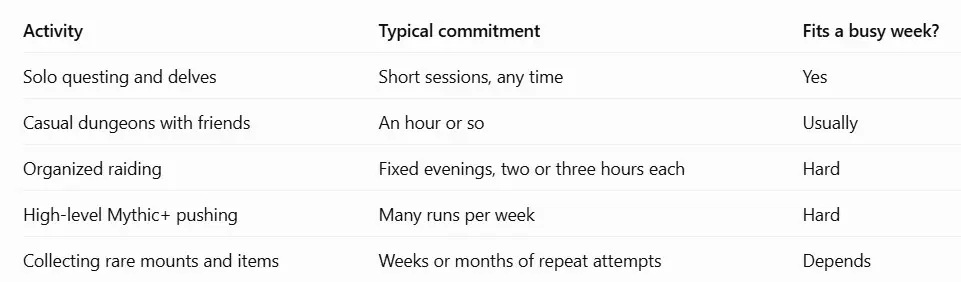
Blizzard has noticed. Recent expansions added more content that can be done alone or in short bursts, and more ways to catch up on gear if you miss a few weeks. But the most prestigious rewards still sit behind the hardest group content, and that is where adult players most often feel left out.
How adults adapt
Players with jobs and families have found their own ways around this, and most of them are sensible.
Some simply narrow their goals. They stop chasing every piece of gear and pick one thing per season, a mount or a raid they want to see. Others join guilds built around their schedule, ones that raid once a week at a fixed time and don’t expect more. These guilds have become common, and they often recruit openly for “adult" or “parent" players.
Another group pays for help. Carry services, where experienced players complete difficult content alongside the customer, have existed for most of the game’s life. For an adult with more money than free time, paying for a raid clear can feel no different from paying someone to clean the gutters. Players considering it should know that Blizzard’s rules on some forms of real-money trading are strict, so it is worth understanding how a service operates before paying. Opinions in the community are split, and they are likely to stay that way.
And many adult players lean into the social side and skip the competitive part altogether. They log in to talk, run a dungeon or two, and log out. For them the game is a meeting place more than a challenge.
A new option for nostalgic players
Blizzard is also aiming directly at older players. World of Warcraft: Forever, announced at BlizzCon in September 2026 with a release date of November 4, 2026, offers a version of the classic game with new zones and dungeons, included in the regular subscription. A lot of the interest comes from players who started in 2004 and want to revisit that feeling, ideally at a pace that suits a forty-year-old with a job.
It is too early to say how well Forever will fit busy adults, since levelling in the classic style is slow by design. But the fact that Blizzard built it at all shows how much the company now depends on players who grew up with the game.
A hobby that grew up
Twenty-two years is a long time for any game. World of Warcraft has survived it largely because its players brought it along through every stage of their lives, from dorm rooms to family homes.
The way they play has changed. Sessions are shorter. Goals are smaller. Some players spend money where they once spent weekends. What hasn’t changed is the reason they show up, which for most of them is the people they meet there.