

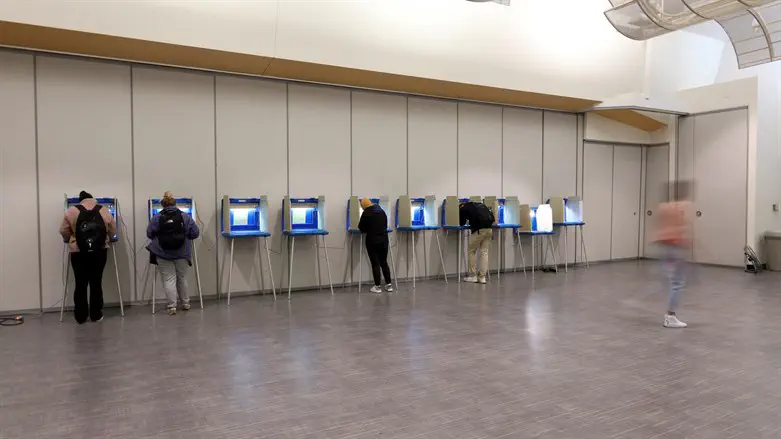
Polling stations began opening in the United States on Tuesday morning, as voters cast their ballots in elections widely viewed as a referendum on the first two years of President Donald Trump's second term.
More than 57 million Americans have already voted through early voting and mail-in ballots, with millions more expected to participate on Election Day.
All 435 seats in the US House of Representatives and 35 of the 100 Senate seats are being contested, alongside 36 governorships and numerous state and local elections.
The Republicans currently control both chambers of Congress, holding a narrow three-seat majority in the House and a 53-47 advantage in the Senate, including two independents who caucus with the Democrats.
Democrats need a net gain of at least three House seats and four Senate seats to secure majorities in both chambers. Opinion polls and election analysts have indicated that Democrats are favored to regain control of the House, while the battle for the Senate remains uncertain.
Although Trump's name does not appear on the ballot, the President has made the elections a central political test of his administration, urging Republican supporters to "pretend I'm on the ballot."
During a speech in Washington on Monday, Trump sharply criticized his political opponents, declaring: "The Democrat Party has nominated the most extreme and dangerous slate of candidates in American history."
The elections come amid growing concerns among American voters over the cost of living, energy prices, and the economic consequences of the war with Iran. Trump's approval ratings have remained near historic lows, with voters expressing dissatisfaction over rising expenses and the administration's handling of economic issues.
For Israel, the outcome carries significance beyond American domestic politics.
Congress plays a central role in approving federal spending, including military assistance to Israel, and in overseeing US foreign policy. A Democratic victory in either chamber could increase congressional scrutiny of the Trump administration's policies toward Israel, arms sales, and the ongoing confrontation with Iran.
A Democratic majority in the House would give the opposition greater authority to conduct investigations, summon administration officials, and challenge spending proposals. Control of the Senate would also provide Democrats with the ability to block senior administration and judicial appointments.
The elections are taking place against the backdrop of continuing tensions between Washington and Tehran, as Trump weighs the possibility of renewed military action while keeping the option of negotiations open.
Ruth Pines-Feldman, a research fellow at the Misgav Institute for National Security and Zionist Strategy and a doctoral candidate at Tel Aviv University, told Arutz Sheva-Israel National News that the results could significantly affect the President's political freedom of action.
According to Pines-Feldman, a Democratic takeover of Congress could make it more difficult for Trump to advance legislation, secure funding, and implement his administration's policies.
She also warned of growing divisions over Israel within American politics, particularly among Democrats, where progressive lawmakers have increasingly challenged military assistance and weapons sales to Israel.
Pines-Feldman raised the possibility that a Republican defeat could even accelerate an American decision to take military action against Iran.
She explained that the period between Election Day and the swearing-in of the new Congress on January 3, 2027, could provide Trump with an opportunity to act before a potentially less cooperative legislature takes office.
However, she emphasized that any decision would depend on strategic considerations and domestic political calculations, rather than election results alone.
One of the Senate races attracting particular attention is in Michigan, where progressive Democrat Abdul El-Sayed faces former Republican Representative Mike Rogers.
El-Sayed, who has criticized Israel, would become the first Muslim American elected to the Senate if victorious. His election would also represent a significant victory for the progressive wing of the Democratic Party ahead of the 2028 presidential election.
The Michigan race took an unexpected turn when Democratic Representative Haley Stevens, who narrowly lost the party's Senate primary to El-Sayed, endorsed Rogers.
Other closely watched Senate contests include Texas, where Republican Attorney General Ken Paxton faces Democrat James Talarico; Maine, where Republican Senator Susan Collins is seeking reelection against Democrat Troy Jackson; and Ohio, where former Democratic Senator Sherrod Brown is challenging Republican Senator Jon Husted.
In the House, competitive races in Pennsylvania, New York, California, Arizona, Iowa, and Texas could determine which party controls the chamber.
Beyond Congress, voters will decide on major statewide proposals involving abortion rights, redistricting, voter identification requirements, and taxation.
Polling stations open at different times across the country, beginning at 5 a.m. Eastern Time in Vermont, with the last states opening their polls several hours later.
The first polling stations are scheduled to close at 6 p.m. Eastern Time in parts of Indiana and Kentucky, corresponding to 1 a.m. Wednesday in Israel. Results will be reported throughout the night as additional states close their polls.
However, the final outcome may not be known immediately, particularly if control of either chamber depends on closely contested races requiring extended vote counting.
Whatever the results, Trump will remain President until January 2029. The central question is whether he will retain Republican control of Congress for the final two years of his presidency or face a Democratic majority capable of challenging his legislative priorities and increasing pressure over his policies toward Israel and Iran.