
Itzhak David GoldbergMD FACR is a Professor Emeritus at Albert Einstein College of Medicine
One touch of the Kotel’s ancient stones, and sixty years vanish, bringing back the tears, sacrifice, and triumph of a moment that changed Jewish history forever. I am carried back to that unforgettable Shabbat morning, June 10, 1967, when we, a group of young IDF soldiers, descended from the Mughrabi Gate into a narrow alley barely eleven feet wide, where some of the paratroopers who had liberated Jerusalem only three days earlier stood. Their faces still bore the exhaustion of battle and the grief of comrades who would never return, yet their eyes reflected a wonder beyond comprehension. As the familiar melodies of the Shabbat service rose between the ancient stones, tears of triumph mingled with tears of sorrow, and two thousand years of Jewish longing seemed suddenly to have become a living reality.
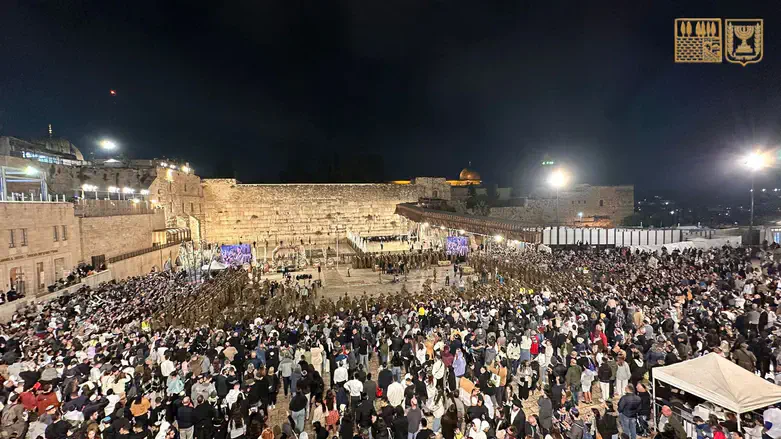
Nearly six decades later, the Kotel presented a profoundly different scene. The narrow alley had become an immense plaza overflowing with proud parents, grandparents, and families gathered to witness the swearing-in of young men and women of Israel’s Border Guard, Magav. As the recruits raised their voices in a thunderous declaration, “I swear!" (with the observant ones shouting "I declare!") their voices echoed across the ancient plaza, bridging generations of sacrifice, courage, and hope. In their faces I saw the faces of the paratroopers who had stood in prayer so many years earlier, as though one generation had reached across the decades to entrust the defense of Jerusalem to another.
In the opening pages of The Lonely Man of Faith, Rav Joseph B. Soloveitchik expresses his deep concern about the spiritual predicament of modern humanity and the danger of reducing the richness of human existence to what can be observed, measured, and explained. For the Rav, scientific knowledge provides an indispensable understanding of the physical world, but it cannot exhaust the meaning of human experience, because reality is encountered not only through the senses but also through memory and the intellectual, moral, and spiritual frameworks that shape our understanding of it.
This insight receives a more systematic philosophical expression in Halakhic Man, where the Rav describes the religious personality as one who approaches the physical world through a conceptual framework derived from Torah and Halakhah. Just as the scientist encounters nature equipped with mathematical principles, theoretical models, and the laws of physics, halakhic man approaches the same reality through the ideal categories of Jewish law.
When a scientist examines a spring, the inquiry concerns its chemical composition, the measurement of its flow, and the natural laws governing its waters; halakhic man encounters that same spring through the categories of ma'ayan and mikveh, asking whether its waters satisfy the requirements of ritual purification. The water remains physically unchanged, yet its significance is transformed by the conceptual framework through which it is understood, becoming not merely a natural phenomenon but a potential setting for the fulfillment of a religious obligation.
The significance of this distinction extends beyond the recognition that two individuals may interpret the same reality differently, for the concepts through which reality is understood can also shape the reality that human beings create. What begins as a difference in perception may become a difference in action, transforming a physical object into the setting of a religious practice, a particular place into a site of sacred obligation, or an ordinary human encounter into an expression of moral responsibility. In this sense, halakhic consciousness does not simply add a subjective interpretation to an otherwise complete physical description; it discloses a normative dimension of reality and seeks to give that dimension concrete expression in the world.
The scientist and halakhic man therefore do not inhabit different physical universes, but their distinct conceptual frameworks lead them to engage with the same universe in different ways, generating different questions, responsibilities, and possibilities for human action.
These philosophical insights took on a concrete meaning during this visit to the archaeological excavations below the Kotel. Beneath the plaza where young Israelis had just pledged to defend the Jewish state, the excavations revealed the imposing remains of an ancient bridge associated with the Hasmonean period, which once provided access to the Temple Mount.
The Hasmonean kingdom was the last period of independent Jewish sovereignty and was undone by division and civil war. A bridge built by a sovereign Jewish state, lying beneath the plaza where a new generation had just sworn to defend the modern one, is a reminder that sovereignty has been lost before.
Nearby lay the remains of a Roman-era bathhouse and a small auditorium, reminders of the empire whose armies destroyed Jerusalem. Yet beyond their architectural classification, these ruins adjacent to the holiest Jewish site awakened deeper questions concerning the fragility of civilizations and the extraordinary endurance of Jewish memory.
Above stood the living miracle of Jewish national renewal; beneath lay the silent remains of ancient Jerusalem, where the achievements of vanished generations had become fragments of stone.
The devastating teaching of our Sages that the Second Temple was destroyed because of sinat chinam, baseless hatred among Jews themselves, suddenly acquired an almost unbearable presence and reality. Bitter political struggles, increasing hostility between parties, and deepening polarization between religious and secular communities and between right and left have too often transformed legitimate disagreements into expressions of contempt and mutual distrust.
The question became even more painful against the memory of the young Israelis standing proudly above, men and women from different backgrounds and communities prepared to risk their lives defending a country whose citizens increasingly struggle to preserve the language of mutual respect.
An archaeologist could examine those stones, identify their architectural features, establish their historical chronology, and reconstruct the development of ancient Jerusalem, producing conclusions that might be entirely accurate, yet such explanations could never fully express what those remains meant to a generation that witnessed the liberation of Jerusalem.
Where the archaeologist saw the remains of ancient structures, Jewish memory revealed the warning of history; where the historian saw the achievements and decline of civilizations, the fragility of Jewish sovereignty became painfully apparent; and where an observer might have seen a military ceremony, the sacrifices of one generation seemed entrusted to the courage of another.
What began as a visit witnessing a new generation pledge itself to the defense of Israel became a far more demanding encounter with Jewish history. The recruits had pledged to defend the State of Israel. The stones beneath their feet asked something further: whether we, the generation privileged to inherit Jewish sovereignty, have the moral courage to defend it from ourselves.
In loving memory of my father, Yehuda Aryeh Goldberg, a Holocaust survivor and a man of extraordinary character and unwavering courage, who endured the unimaginable devastation of the Holocaust yet found the strength to rebuild his life, fought in Israel’s War of Independence, and raised a new generation, transforming profound suffering into an enduring legacy of faith, resilience, and hope.