

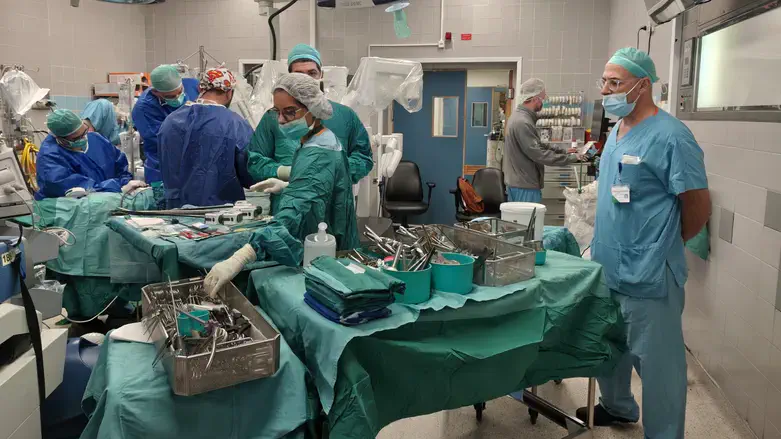
Doctors at Beilinson Medical Center has performed Israel's first robotic lung transplant, using tiny incisions instead of a full chest opening. The procedure is one of only around 20 of its kind performed worldwide and offers the potential for less pain, fewer complications and faster recovery.
The operation, performed last month using the da Vinci robotic system, marks a significant milestone in lung transplantation.
Unlike conventional surgery, which requires opening the chest and spreading the ribs apart, the robotic procedure was performed through several tiny incisions. Using the robot's arms, surgeons successfully connected the transplanted lung to the patient's blood vessels and airways while minimizing damage to the chest wall.
Traditional lung transplant surgery generally takes between eight and 10 hours and can involve severe postoperative pain. This can make it difficult for patients to breathe deeply and cough up lung secretions, increasing the risk of infections and prolonging recovery.
The robotic approach is designed to minimize damage to muscles, nerves and surrounding tissues, making it easier for patients to breathe and cough following surgery.
The operation was led by Dr. Yuri Peischowicz, head of Beilinson's Department of Thoracic Surgery, who described the achievement as a turning point.
"Robotic lung transplantation is a turning point for lung transplants in Israel," he said, noting that the technique makes it possible to perform the complex procedure with robotic precision and minimal incisions, rather than the extensive chest opening used for decades.
"We aspire to make robotic surgery without opening the chest the accepted standard for lung transplantation within five years," he added.
The world's first robotic lung transplant was performed in Spain around three years ago. Since then, only approximately 20 such procedures have been carried out worldwide, at a small number of medical centers.
Bringing the technique to Beilinson required extensive preparation, combining the hospital's experience in complex transplants with specialized training in robotic surgery.
Dozens of medical professionals participated in the operation, including surgeons, anesthesiologists, operating room nurses, pulmonologists, intensive care specialists and tissue-typing laboratory staff.
One of the main challenges was preparing for emergencies while the robotic arms were operating inside the chest cavity and limiting direct access to the patient.
Dr. Shai Fine, head of Beilinson's Anesthesiology and Operating Rooms Division, said the teams had to plan ventilation, monitoring and hemodynamic management in advance, as well as prepare for possible complications.
Preparations included a dedicated simulation exercise involving the entire operating room team. The patient was also connected to a heart-lung machine in advance to enable an immediate response if necessary.
The robotic transplant followed an earlier milestone at Beilinson. Approximately one month before the operation, surgeons performed a lung transplant using a minimally invasive approach without robotic assistance. That procedure involved just two small incisions instead of the extensive opening required in conventional surgery, providing the team with valuable experience ahead of the robotic operation.
Dr. Osnat Livneh-Straichman, head of Beilinson's Institute of Pulmonary Diseases and Allergy, said the achievement builds on the medical center's extensive experience.
"Thanks to extensive teamwork and more than 1,000 lung transplants performed at Beilinson Medical Center, we have accumulated the expertise, knowledge and experience that enable us to provide the most advanced treatment to suitable patients," she said.
One of the most encouraging results was the patient's recovery. According to the medical team, he recovered faster than expected and required almost no pain medication.
Dr. Dan Gorfil, head of Beilinson's Cardiothoracic Surgical Intensive Care Unit, said reducing postoperative pain was one of the main goals of adopting the robotic technique.
"The recovery of the patient who underwent robotic surgery exceeded all expectations. He required almost no pain medication, apart from paracetamol," he said.
The rapid recovery and minimal need for painkillers also enabled the hospital to shorten the patient's stay in intensive care and in the hospital overall.