
Rabbi Steven Burg is the International CEO of Aish, a global Jewish educational movement. He formerly served as Eastern Director of the Simon Wiesenthal Center, where he oversaw the Museum of Tolerance in New York City.
I know we have had elections and coalitions are on everyone's mind.
But I have not been able to stop thinking about Flydubai Flight 1073. Remember?
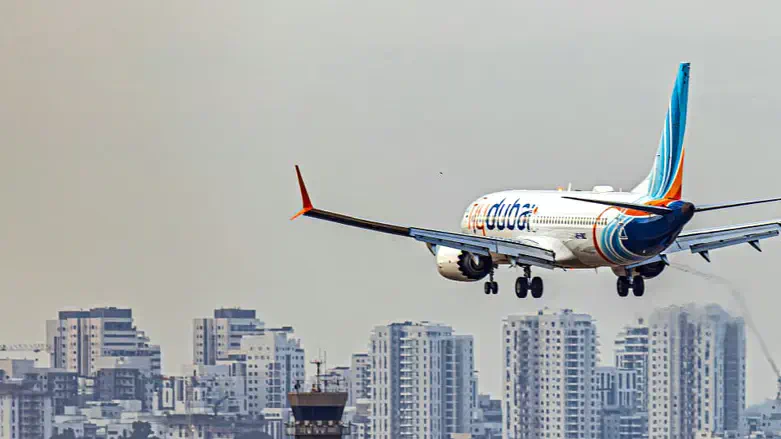
On the morning of Sept. 30, a Boeing 737 carrying 174 people left Dubai for Tel Aviv. Somewhere over the desert, the first officer attacked the captain, Smit Machchhar, and the plane went into a dive. Flight data shows it fell more than 14,000 feet in under 30 seconds. One passenger said it felt like hitting a massive air pocket while the whole cabin screamed.
A young Israeli woman named Miriam later described what she did in those seconds. She screamed "Shema Yisrael." She thought of her mother, who was waiting for her at Ben Gurion Airport, and told herself she could not die, because she was her mother's only daughter. Other passengers said the same words.
Shema Yisrael. Hear, O Israel, the Lord is our God, the Lord is One. For thousands of years, Jews facing death have reached for that sentence. It is what we hope will be on our lips at the very end.
That is the first Shema. There is a second one, and that is the one I keep coming back to.
We say the very same words every single morning and every single night. We say them on quiet Tuesdays, when nothing is falling out of the sky. That daily Shema is testimony. Twice a day, we declare that God is present in this world and involved in our lives. On Flight 1073, I believe 174 people watched that testimony come true.
Look at what happened. Captain Machchhar, a 38 year old father from India with 17 years of flying behind him, lay stabbed and bleeding on the cockpit floor. He felt the plane going down. He later told India's prime minister that he said to himself, "This is the last push, Smit," and reached for the door release. He got it open, the attacker shut it, and he opened it again.
Passengers poured in.
Yaniv Hayoun, a plumber, put the attacker in a chokehold, dragged him out of the cockpit and grabbed the controls, using what he had picked up from watching air disaster shows on television.
Dr. Shota Musaev, a dentist, helped restrain the attacker and then spent the rest of the flight keeping the captain alive with blankets, oxygen and whatever he could find.
Tzvika Manes and Assaf Rajuan were among the Israelis who held the attacker down and tied his hands with a headphone cord.
Two pilots who happened to be sitting in the cabin, scheduled to fly the return leg to Dubai, took the controls and brought the plane down safely in Tabuk, Saudi Arabia.
Now count what had to go right. A wounded captain found the strength to reach a door. Two pilots were on board at the exact moment they were needed. The dive was so violent that it damaged the rudder, and yet the plane held together and flew for another hour. A cabin full of ordinary people ran toward the danger. When I look at pictures of that tail, I find it very hard to see anything other than the Hand of God.
Some readers will hear that and worry I am taking something away from the heroes. I am taking nothing away from these heroes. What Captain Machchhar, Yaniv Hayoun, Dr. Musaev and the others did was extraordinary. They are heroes, plain and simple.
Judaism has always demanded action. The Talmud teaches that we may never rely on miracles. Since the beginning, our relationship with God has been a partnership. We work as hard as we possibly can and do everything within our power, and then God carries us the rest of the way. The people who rushed that cockpit did their part. Everything that lay beyond their reach is where I see Him.
Captain Machchhar seems to understand this too. He told Prime Minister Narendra Modi that in his darkest moments he repeated Hindu chants and held on to his faith that God would save them. A Hindu captain on the cockpit floor and a cabin of Jews crying out Shema, each praying in their own words in the very same minute. I find that incredibly moving.
This week we mark three years since October 7. I remember the days after the attack, when everyone here was beside themselves. People were terrified there were still terrorists loose in the country, and nobody knew what would come next. Then, slowly, through the courage of the IDF, the security services, and so many ordinary people, Israel pushed back its enemies on seven fronts.
Three years later, you can feel something in the air here in Israel. People are coming back to prayer, to Torah and to God.
That return sits right beside the loss. We will remember the people murdered on October 7, and the soldiers who fell defending us, for as long as we live. I often say that the strongest thing a Jew possesses is a broken heart. Our hearts are broken into pieces, and still we stand up and move forward. Both things are true at once.
Faith holds the same tension. We believe in God, we love God, and we feel close to Him. We also know that He expects us to act. If we think it is all up to us, we forget who carries us. If we think God will simply take care of everything, we forget what He asks of us. Judaism lives in the space between, where we give everything we have, and God takes us the rest of the way.
So there are two Shemas. One was screamed in terror inside a falling plane. The other is said quietly every morning, in kitchens and synagogues all over the world. The first begs God to save us. The second reminds us that He has been with us all along, waiting for us to do our part.
On Flight 1073, they both came together. The passengers and crew did their part in the dramatic save, and I believe God did His as well.
And elections are just another place where God is waiting for us to remember that He is One.