
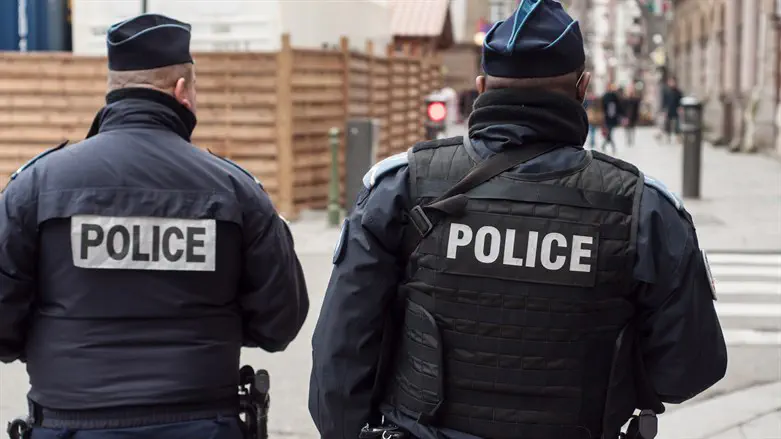
France is in chaos and the government imposed a curfew in certain areas, after Interior Minister Laurent Nuñez resigned: “In some cities we have lost control".
Pascal Bruckner speaks of a “silent coup d’état" in Le Figaro:
“What is striking is the good humor of the participants who shout ‘Wallah, Wallah!’. They are cheerful, they are the masters. Everywhere the same slogan on the walls and shop windows: ‘Bismillah the darkness’: the promise of a dark period of looting and violence, the consequence of a long series of abandonments that some of us have been denouncing for twenty years, from the tolerance of internal rot to the eruptions of violence in the banlieues explained by ‘racism.’ A silent coup d’état."
To understand the intensity and scale of what is happening one must not look at Paris, but at Marseille.
The population of Marseille is 886,040 inhabitants.
According to the authorities, about 30,000 residents of Marseille took part in the lootings on 17 October.
30,000 people are 3.4 percent of the total population of Marseille. Three inhabitants out of a hundred who took part in the devastation of their own city.
This is why Pierre-Henri Tavoillot, president of the Collège de philosophie at the Sorbonne, no longer hesitates to evoke the term “civil war."
And yet Emmanuel Macron, in his ridiculous address to the nation, blamed the “French."
The last time I was in Marseille two years ago, after a few hours I already felt the physical need to leave.
A city is not an aggregate of inhabitants. It is an order, fragile and continuously renegotiated, in which the majority recognizes certain rules as its own and enforces them. When a significant portion of the population-3 percent according to the authorities themselves-participates in organized looting, when the addresses of shops belonging to a specific community are known in advance, and when the damage is concentrated on those targets while others remain intact, we are not facing “disturbances," but an act of war that distinguishes between “us" and “them."
Let’s start then with this article from Algérie Matin. A little dialogue between friends, reported by the journalist. “How many Algerians are there in Marseille? 200,000. Marseille has 800,000 inhabitants; that means one inhabitant out of four is Algerian." No, there are not 200,000 but 300,000, says the journalist, before getting excited about the fact that one inhabitant out of three is “DZ" (the name given to Algeria on license plates).
And the rest of the Maghreb, Moroccans and Tunisians? The latter number 60,000. Who says so? Radio France. For Moroccans, the figure is 40,000. The total reaches 400,000, a figure that does not take into account the proliferation of illegals. But there are also the Comorians, right? From 50,000 to 80,000, not counting the Senegalese, Malians, etc.
Therefore, over 50 percent of the Marseille population is African.
The president of the Jewish community of Marseille, Zvi Ammar, has asked his co-religionists not to wear Jewish symbols. Too dangerous. The Jews of Marseille go to synagogue in groups of ten, for security. Many mothers, when they go to kosher shops, leave their children in the car with someone else. Parents have organized patrols around the schools. One synagogue has been bought by Muslims to turn it into a mosque.
In some neighborhoods of Marseille the insecurity is such that (from Le Figaro) postal services have been interrupted. Journalist Philippe Pujol writes that “there are more Kalashnikovs in Marseille than in Kabul."
Marseille illustrates what happens when a society stops defending the material and symbolic conditions of its own continuity. The city empties of meaning, street by street, and those who have lived there for generations no longer recognize it.
A group of tourists taking a boat trip on the Seine found themselves filming images of fires and devastations.
We are not even noticing that the European Titanic is sinking.