
Duvi Honig is Founder and Chief Executive Officer of the Orthodox Jewish Chamber Of Commerce
Really. You really can't make this stuff up.
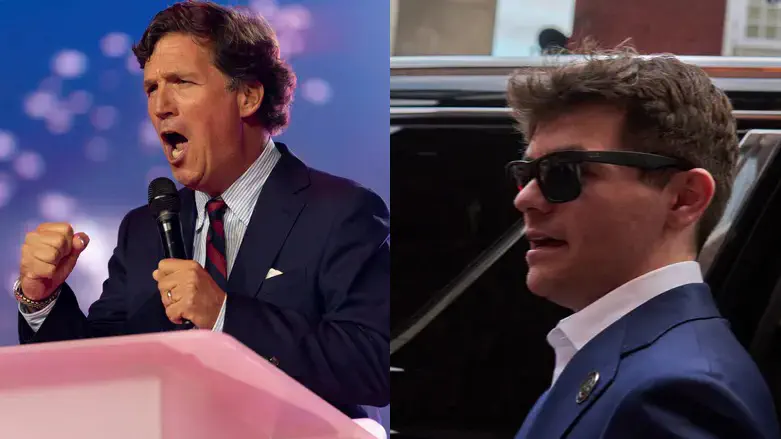
Nick Fuentes, a Holocaust denier who has spent years promoting antisemitism, is now accusing Tucker Carlson of being a Jew-hater. Yes, you read that correctly.
In a video circulating online, Fuentes calls Carlson a “true Jew hater," accuses him of “rabid antisemitism," and urges Vice President JD Vance to condemn him.
Is this Purim? Halloween? Some political comedy show? Are we supposed to believe that Fuentes, who has praised Hitler, suddenly discovered that antisemitism is wrong? Gimme a break.
To me, this smells less like ideology and more like money. Follow the money.
Outrage is now a business. Antisemitism attracts clicks, viewers, donors, subscribers and influence. A Washington Post investigation found that Fuentes collected nearly $900,000 in online donations over 15 months. That's real money flowing into an operation notorious for hateful rhetoric.
So here's my question: Did Carlson tap into Fuentes' financial lifeline? Did he attract donors or audiences that Fuentes once counted on? Did he cut into the very business that keeps Fuentes relevant? I have not seen evidence proving that it happened. But I would investigate the financial competition before accepting this sudden display of moral outrage at face value.
Whether Fuentes genuinely objects to Carlson’s antisemitism is beside the point. The spectacle of a Holocaust denier suddenly presenting himself as a defender of Jews and against antisemitism is almost laughable. To me, the real question is whether Carlson has begun cutting into Fuentes’ income. Is this about ideology, or is it about money?
But the third figure in this story makes it far more serious: JD Vance.
I keep looking at Vance's relationship with Carlson from every angle. Every time another controversy erupts, I wonder whether this will finally be the moment the vice president draws a line.
Carlson gives Holocaust denier Fuentes a platform. Perhaps now? Carlson faces accusations of amplifying antisemitic conspiracies. Perhaps now? Carlson attacks President Trump's military decisions involving Iran. Surely now?
On February 28, after American and Israeli strikes against Iran, Carlson called the decision “absolutely disgusting and evil," according to ABC News. His opposition to war is his right. Americans can oppose military action without supporting Iran's regime. But his words also fit a narrative useful to Tehran: that American action against Iran is illegitimate and driven by Israel.
Iranian media have carried Carlson's interviews and commentary. That does not prove he works for Iran or endorses its government. It does mean an American media personality's message can be amplified by a regime hostile to the United States.
And where is Vance? The vice president represents the United States of America. His obligation is to speak for American interests, not to protect a friendship with a powerful commentator. When the rhetoric of a close ally is useful to a hostile regime, the American people deserve a clear accounting of where their vice president stands.
At an August gathering of the Republican Jewish Coalition, Vance condemned Fuentes but declined to directly denounce Carlson. On September 3, he again defended the friendship. He said he would not throw friends under the bus because of political disagreements.
Friendship matters. Loyalty matters. But public office carries responsibilities greater than either.
Vance has condemned antisemitism and defended the American alliance with Israel. Those statements matter too. What troubles me is his repeated unwillingness to confront Carlson by name when asked about the controversies surrounding him.
What would it take? Another antisemitism controversy? Another attack on the president's foreign policy? Another occasion when Carlson's arguments are useful to America's adversaries? Is there any line he would not cross to preserve this friendship?
That persistence makes me wonder whether Carlson's influence over Vance is political, financial, or perhaps something the public doesn't know. Could Vance fear the political repercussions if Carlson turns on him? Could Carlson know something personally damaging? I have no evidence of compromising information, threats or blackmail, and questions cannot substitute for proof. But the strength of this alliance demands a better public explanation than simply “we're friends."
This isn't a demand that elected officials abandon every friend who disagrees with them. It is a demand for independent leadership. The vice president must be able to say clearly when a friend is wrong, especially on antisemitism, national security and America's interests.
The Fuentes-Carlson spectacle raises a question about money and influence. Investigate the donors and the incentives. But Vance’s decision to continue standing beside Carlson raises a separate, consequential question: who is the vice president serving when friendship collides with public duty?
The answer must be the American people. Not Tucker Carlson. Not an online audience. Not anyone's financial lifeline.