

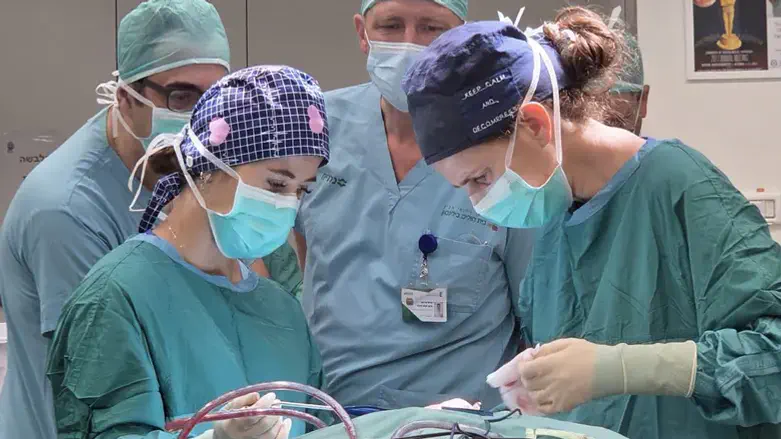
At Clalit-Beilinson Hospital, a 42-year-old woman has become the first patient in Israel to receive an innovative non-invasive epilepsy treatment that delivers electrical stimulation to the seizure focus without penetrating the brain. Israel is the first country outside Europe to use the technology_
For years, Olga Moisa lived in fear of her next epileptic seizure. Medication failed to bring her seizures under control, while surgery to remove the source of the seizures risked causing further functional impairment. Now, at 42, she has become the first patient in Israel to receive the EASEE brain stimulation system, an innovative technology designed to treat epilepsy without opening the skull or inserting an electrode into the brain.
The procedure was performed at Clalit-Beilinson Hospital by Dr. Idit Tamir, Director of the Functional Neurosurgery Unit. Developed in Germany by PRECISIS and represented in Israel by Medor, the EASEE system is implanted beneath the scalp and above the skull bone. A wire connects the device to a battery implanted in the chest, allowing it to deliver electrical stimulation to the identified seizure focus without direct contact with the brain.
The technology is already in use in several European countries. Israel is the first country outside Europe where the system has been implanted in a patient, marking a significant milestone in the expansion of treatment options for people living with epilepsy.
The system may offer an alternative for patients with focal epilepsy whose seizures do not respond adequately to medication and for whom surgical removal of the seizure focus is unsuitable or undesirable. Eligibility depends on identifying the precise source and location of the seizures, and each case must be evaluated individually.
"This is the first time we can treat patients with epilepsy without penetrating the brain or inserting an electrode into it, while potentially achieving a significant reduction in the number of seizures," says Dr. Tamir. "The technology has demonstrated results comparable to the improvements seen with invasive neurostimulation devices. In appropriately selected patients, it offers a genuine alternative to these treatments."
Approximately 100,000 people in Israel live with epilepsy, and around one-third do not achieve adequate seizure control with medication.
Epilepsy can cause seizures, altered awareness and involuntary movements. Depending on their severity and frequency, seizures can lead to falls, injuries and potentially life-threatening situations.
Moisa has lived with epilepsy since suffering a stroke in Ukraine approximately 15 years ago. According to her son, Sasha, the stroke was caused by bleeding associated with a congenital cerebral arteriovenous malformation, known as an AVM. Following the stroke, the right side of her body was left paralyzed, and she underwent extensive physiotherapy and rehabilitation. The seizures began alongside these lasting functional difficulties.
Moisa immigrated to Israel in 2022 following the outbreak of the war in Ukraine. For years, she was treated with medication, but the seizures continued.
"They told us there was nothing more they could do and that she would have to live with it for the rest of her life," her son recalls.
In 2024, after experiencing a series of seizures one after another, she sought treatment at Clalit-Beilinson Hospital.
"She called me while she was in a terrible state, crying and having a seizure. Then there was a second seizure in front of me, followed by a third, fourth and fifth. We took her to the emergency department, where she had several more seizures," Sasha says. Her medication dosage was increased, but the seizures persisted.
During her treatment at Clalit-Beilinson Hospital, Moisa was evaluated by Professor Felix Benninger, Director of the hospital’s Epilepsy Treatment Unit.
A video EEG examination helped identify the source of her seizures in a brain region associated with the functioning of the right side of her body. Because of the location, surgically removing the seizure focus could have caused additional functional impairment.
"Some patients do not respond to medication. We sometimes try one drug after another, but none succeeds in controlling the seizures," Professor Benninger explains.
For these patients, treatment options may include surgical removal of the seizure focus or implantation of a neurostimulation device. Surgery can provide substantial seizure control, but it is not suitable for everyone, particularly when the seizure focus is located near brain regions responsible for essential functions.
Another option is vagus nerve stimulation, which involves placing an electrode around a nerve in the neck and implanting a battery in the chest. This treatment may also be suitable for patients with generalized or multifocal epilepsy. However, some patients experience side effects, including hoarseness, speech difficulties and, in certain cases, a sensation of shortness of breath.
The EASEE system offers a different approach by delivering electrical stimulation to the seizure focus from outside the skull, without direct contact with the brain. According to Dr. Tamir, patients do not feel the electrical stimulation.
The treatment is primarily intended for patients with a single, clearly identified seizure focus in a location suitable for stimulation, including those for whom surgically removing the focus would pose a significant risk.
*Living Without Constant Fear of the Next Seizure*
Moisa underwent the implantation procedure on August 31. According to her son, she has not experienced a seizure in the days following the procedure. However, it is still too early to determine whether this improvement will be sustained over time.
"At the moment, the device is operating at a low stimulation level, allowing her body to gradually adjust to the stimulation. We still do not know what the outcome will be. We will only know in a few months," Sasha says.
The constant fear of another seizure, particularly one involving a loss of consciousness, had severely limited her daily life. "She was always anxious. Any sensation she experienced made her worry that a seizure was about to begin. She lived as though a warning light was constantly flashing before a malfunction," he explains.
Now, she is beginning to consider possibilities that once seemed out of reach, including traveling abroad. It is something she has wanted to do since 2024 but had been afraid to attempt because of her seizures.
The family does not yet know how much the device will reduce the frequency of her seizures or whether her medication can eventually be adjusted. The coming months will be crucial in assessing the treatment's effectiveness.
For Sasha, however, even a partial improvement would make a meaningful difference. "Even if there is something that can reduce the seizures by 50%, that is already better," he says.
The first implantation of the EASEE system in Israel at Clalit-Beilinson Hospital represents a new development in the treatment of focal epilepsy, particularly for patients whose seizures remain uncontrolled despite medication and who face significant risks from conventional brain surgery.
While the long-term outcome for the first Israeli patient remains to be established, the technology introduces another potential treatment option for carefully selected patients who have previously faced limited alternatives.