
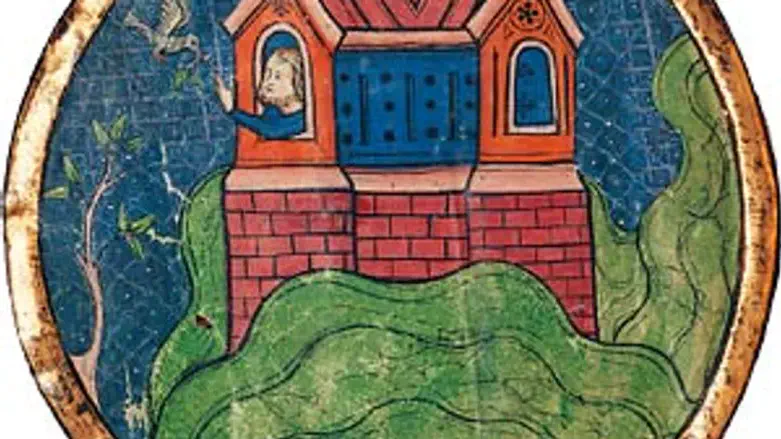
“Noah was a righteous man, perfect in his generations; Noah walked with God." - Genesis 6:9
Noah does not measure up to Abraham. So say the commentators, though the Torah itself calls Noah righteous. Abraham argued with G-d to save Sodom; Noah never called his neighbors to repentance.
Yet Noah is a man of G-d at a time when there is no example of decency in the world around him. What Noah had was his lineage, a direct chain of righteous forefathers reaching from Seth to Enoch, Methuselah, and his father Lamech. These men formed a patriarchal branch of dignity, a nobility of character passed from father to son in a corrupted world. Outside that chain, Noah and his sons had no peers and no community to lean on.
Anyone who has held to his values in a hostile workplace, a broken family, or a culture gone sour knows how much harder that is. Many people see the ugliness around them, feel disgusted by it, and still struggle to walk away. The Talmud teaches that once a person repeats a wrong, it begins to feel permitted. Familiarity may be the most dangerous retrograde force of all, because it works silently: it takes what once disgusted us, hardens it into habit, shapes it into identity, and gives it a dwelling in the place we live. Noah walked away every day.
No two people are identical; even identical twins have different fingerprints. Every person comes to this earth with his own mission. Abraham’s was to build a nation that would carry G-d’s word to the world. Noah’s, and Joseph’s after him, was to save the world itself. The Zohar teaches that Noah and Joseph shared one soul, and both bear the title tzaddik, the righteous one. Both guarded their purity in a world that had abandoned it: Noah in a generation steeped in licentiousness, Joseph in the house of Potiphar. And both came to save the world: Noah kept every living creature alive through the flood, and Joseph fed the world through famine.
Noah’s conduct in the generation of the Flood is remarkable not only for his refusal to succumb to the mores of his society, but for raising honorable children who were not infected by their peers, at a time when the pull of the culture can overpower the finest upbringing. Noah was a powerful father; the values he transmitted withstood 120 years of neighbors calling to his sons to join their generation. In a world where men took two wives, one for children and one for pleasure, and the powerful took whomever they chose, Noah and each of his sons took one wife.
The sages teach that there is no guardian against sexual temptation; no one is immune to its pull. That makes the restraint of Noah’s household all the more remarkable.
Noah is an introvert; he is not as proactive as Abraham in spreading the word. Given the pervasive violence and defective logic of a culture so corrupt it would rather see the world destroyed than change, Noah’s approach is wise and cautious. You do not reason with a mob. Noah’s household lives by a standard of decency far above the common people, because he knows G-d sees everything he does.
Building the ark is leadership by example, and each day’s labor is an act of open rebellion against a debauched society. One man and his family stand alone on the side of G-d, and the ark itself is their warning: every passerby can see that a flood is coming to end the lawlessness, and that there is still time to repent. The neighbors mocked him with the same contempt people of faith meet today, yet Noah lets the mockery pass and keeps his focus on G-d’s command.
Even when people want to change, they are creatures of habit, arrested by patterns and often addicted enough to disregard consequences. Psychology confirms what the sages knew: knowing better is rarely enough. What breaks the hold of habit is a goal, a focused target that rises above habit and circumstance. Viktor Frankl, who survived Auschwitz, often cited the line that one who has a why to live can bear almost any how. People seeking weight loss usually fail, unless they change their focus from losing weight to eating healthy. Once the goal becomes a way of life, every meal reinforces it, the same force that once held them back now carries them forward, and people who once felt hopeless about their weight become slim and healthy.
For an unfathomable 120 years, tradition tells us, Noah woke every morning to build the ark, a task that seemed Sisyphean to everyone watching. The rain did not come. Some mornings the outcome must have felt remote, the world unchanged. Still, he returned to the work. Noah was a human eternal flame, like the fire on the Temple altar that was never allowed to go out, and like the daily offering, one lamb at dawn and one at dusk, which holds the greatest principle: only through repetition do we transcend.
Noah’s genealogies reveal a remarkable fact: the patriarch is the finest teacher. A grandfather’s word, a father’s conduct, and a family’s customs held firm while the world outside dissolved. Rashi tells us the rains were held back seven days to mourn Methuselah, the last living link to the first generation. Only when that link was gone did the flood come. When the generations that knew G-d had passed, the world came undone, and only the one family that had kept the chain was saved. We are watching our own witnesses pass, and our world is coming undone in the same way.
Among the sins of Noah’s generation, the Torah names one twice: Hamas. Rashi reads it as robbery; the plain text reads it as violence. The midrash adds that they stole amounts too small for any court to prosecute, lawlessness dressed up as legality. In our day, Hamas has given the world both meanings of the word. Tens of billions from America, Europe, the United Nations, and the Gulf, and Soviet weapons before that, were turned into tunnels, rockets, and the private fortunes of its leaders, while generations were kept in refugee camps to preserve a grievance, and the land of the Bible was claimed as theirs.
The deeper sickness is in the West which funded it and excused it, and after the atrocities of October 7th, the murder of babies, families with children burned alive, beheadings, and the sexual mutilation of the dead, crowds applauded in the streets and celebrated on campuses.
The assault falls hardest on the chain itself. Schools socially transition children behind their parents’ backs. Lawmakers debate partial-birth abortion and whether an infant who survives an abortion deserves care, and the Gosnell trial showed what happens when the answer is no. Nuns who serve the dying poor were dragged through years of court battles over contraceptives, and a baker and a web designer had to fight to the Supreme Court for the right not to celebrate what their faith forbids.
The target is always the same: a family’s authority over its children, the sanctity of life, and the conscience a father hands down to his sons.
The midrash teaches that the generation of the Flood was not destroyed until they wrote marriage contracts for males and for animals. Even the nations who abandoned nearly every law of Noah, the Talmud adds, held this one line. The union of man and woman is the foundation of every society. Man and woman meet as opposites, and in that confluence each tempers and completes the other. The Torah calls woman “a helper corresponding to him" - Genesis 2:18, a counterpart whose difference brings balance to the human soul. Their union brings children into the world, binds two families into one, and carries values from one generation to the next.
A civilization can survive a great deal; it cannot survive moral equivalency, the insistence that every arrangement is equal and every distinction is cruelty. When a society erases the line between man and beast, it has forgotten what a human being is. The Torah tells us that in Noah’s day even the animals corrupted their ways, as if the disorder of mankind had spilled into nature itself. Man was created in the image of G-d. A culture that can no longer tell the difference between a person and an animal is sick. The generation of the Flood fell when the whole society agreed that nothing was sacred, and that what mattered most was to make people feel good without asking them to think.
When the rain finally came, Rashi tells us, the people vowed to stop Noah from entering the ark and to smash it. So G-d brought him in at midday, in full view of the mob, as if to say: let anyone who can stop him come and try. The quiet man of G-d who never preached ended his 120 years with the boldest act of all.
Like Noah, we need not win the argument with the crowd. We can build: our families, our schools, our houses of worship, our own conduct, one consistent day at a time, and when the moment comes, we stand in full view.
Noah stepped off the ark as the patriarch of all mankind. Every human being alive is a child of Noah, and the seven laws given to his family became the moral inheritance of the nations. Civilization was rebuilt the way it had been preserved: through a father, his sons, and their wives, one household at a time.
The ark begins long before the rain.