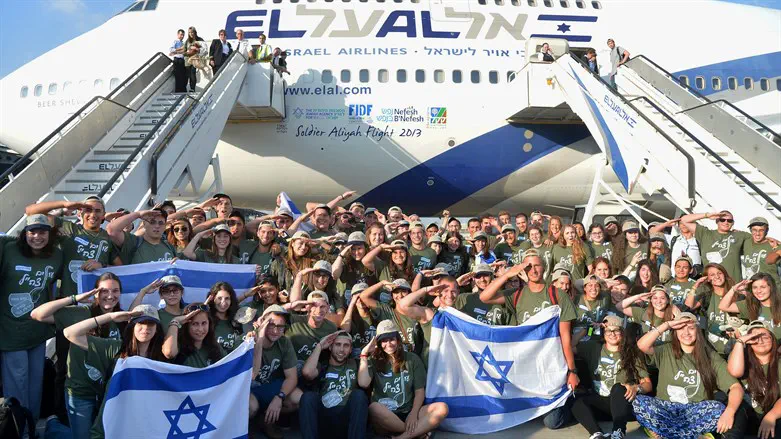
Rabbi Shalom Rosner is the Rav of Kehillat Nofei Hashemesh and an internationally-renowned maggid shiur. His community is one of 42 celebrating Shabbat Aliyah this week. Find your nearest participating community at https://yiisrael.com/aliyah/
As an Oleh myself, and as the Rabbi of Nofei Hashemesh, a community made up predominantly of Olim families, I frequently think about those who have decided to make Eretz Yisrael their home.
When it comes to the physical move to Israel, there are steps to take, forms to complete, bags to pack, flights to take, homes to find, and so much more.
But long before the physical move, there is the decision to move to Israel. And with all the knowledge we may have about what living in Israel entails, this decision still involves a leap of faith, or what we might prefer to describe as a spirit of “Na’aseh V’Nishma." In the context of Aliyah, this means: “We’ll make Aliyah now, and we’ll understand all that it entails once we arrive."
Perhaps it may sound impulsive to make Aliyah and only afterward fully understand its implications. But from my experience, as well as that of many in my community, it is clear that Aliyah involves tapping into the pulse of Eretz Yisrael and, as a result, hearing the call of our soul to return to our homeland in the spirit of “Na’aseh V’Nishma."
In his recently published Hegyonei HaParasha, Rabbi Yitzchak Mirsky shares a beautiful insight from Rabbi Yitzchak Yedidya Frankel z"l, who previously served as Chief Rabbi of Tel Aviv, and was also the father-in-law of former Chief Rabbi of Israel, Rabbi Yisrael Meir Lau.
Rabbi Frankel notes that when the Torah was offered to the Jewish nation, they proclaimed “Na’aseh V’Nishma." In contrast, when the Torah was offered to the non-Jewish nations, they first asked, “What is in the Torah?", while then explaining that they could only decide whether or not to accept the Torah once they knew its pros and cons.
Perhaps this response sounds strange and lacking in faith. Yet, when we consider how the Jewish nation approached entering the Land of Israel, we see that they, too, initially did so conditionally, as evident in their insistence on sending spies into the land, as if they were saying: “What is in Israel? We can only decide whether or not to make Israel our homeland once we know the pros and cons of living there."
What this means is that the way in which the Jewish nation responded to the prospect of moving to Israel was the same as the way in which the non-Jewish nations responded to the offer of accepting the Torah.
This brings us to Aliyah, because the tikkun, meaning “spiritual repair," for the damage caused by the insistence on sending the spies, and by the subsequent negative reports of 10 of the 12 spies, is to respond to the opportunity to move to Israel with the words “Na’aseh V’Nishma"!
This is what every oleh or olah has done when moving to Israel! They have embraced the spirit of “Na’aseh V’Nishma" with respect to Eretz Yisrael and, as a result, they have achieved a tikkun of the sin of the meraglim!
With all this in mind, I am delighted to support Young Israel in Israel’s “Shabbat Aliyah" initiative, taking place on Shabbat Parshat Lech Lecha, which is the ideal week to celebrate the olim in our community, to give them chizuk for the faith they have shown and the choice they have made, and to emphasize that Aliyah is not a one-step process. Instead, we continue to make Aliyah even after we have made Aliyah, and this is something we wish for one another!
Note: 42 communities around Israel will mark “Shabbat Aliyah" on Shabbat Parshat Lech Lecha, organized by Young Israel of Israel and the Mizrachi-Young Israel Shuls Network. The idea is to recognize the journeys of Olim from all over the world, honor their contributions, and affirm the role they play in the life of their Kehilla.