

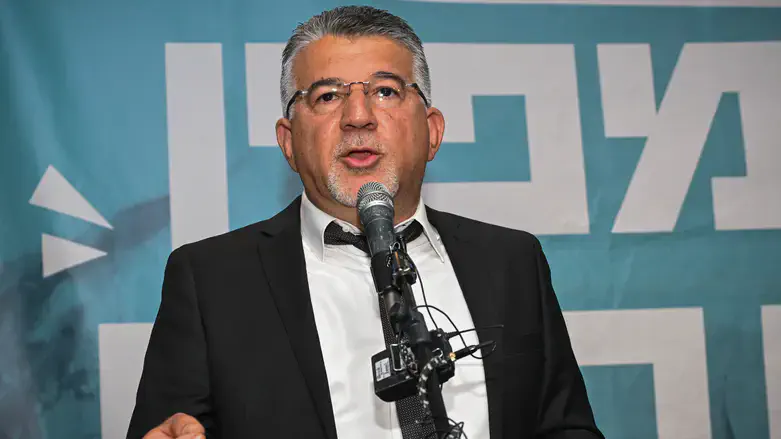
Hadash Party and Joint List chairman Prof. Yousef Jabareen has declared four central demands from the heads of the anti-Netanyahu bloc parties as a condition for negotiating support for an alternative government after the elections.
Among the demands: a plan to combat crime in the Arab sector, the development of Arab communities, a plan for young people, and a diplomatic horizon for establishing a Palestinian state within the 1967 borders.
In an interview with Radio 103FM, Jabareen made clear that the Joint List will not commit to recommending any candidates for Prime Minister or to support the next government without negotiating its demands.
"We said that we would be prepared to negotiate based on our demands. Whoever wants to collaborate with us will find that he must discuss the issues we raise. There are four main points," Jabareen stated.
He started by presenting his demand to combat Arab crime, defining it as the first issue on the Joint List's agenda. "You have the issue of crime and violence. This is a central issue at the top of our preferences. We demand a comprehensive, funded, and realistic plan to fight the criminal organizations," he stated.
The second demand regards the development of Arab localities. "There is the issue of developing Arab communities and meeting their needs, including developing jurisdictional areas, reconstruction projects, and stopping the demolition of homes," he explained.
He then laid out his third demand, focusing on Arab youth, who, according to him, make up half of the Arab population. Jabareen demanded welfare and education programs for the young generation.
Discussing the Arab youth, Jabareen addressed the issue of national service and made clear that the Joint List would oppose any attempt to impose an arrangement on the issue. "It is unclear what is meant when they say national service. We will not accept any coercion from the authorities into an arrangement related to national service.
According to Jabareen, any change will need to be accepted by the Arab public, the High Follow-Up Committee for Arab citizens of Israel, and local authority leaders, while focusing on community activities and volunteering.
After his first three demands, Jabareen moved on to his list's diplomatic demand, calling on the parties who wish to replace Netanyahu to commit to advancing the creation of a Palestinian state.
"We also have a diplomatic plan which we say most clearly, and unfortunately, I don't see the other parties addressing this. Our diplomatic plan is the creation of a Palestinian state within the 67' borders. The creation of a Palestinian state alongside the State of Israel, which, of course, would live in peace with it," he declared.
Jabareen added: “Anyone who wants to replace Netanyahu’s government of wars and blood must also offer a diplomatic horizon in the direction of recognizing the Palestinian people’s right to self-determination, opening negotiations. It is time to offer hope to the Israeli public."
“That is our demand, and that is the only hope through which there will be peace. We will seek to change direction on the diplomatic front," he stressed.
After outlining the demands, Jabareen addressed the leaders of the opposition parties and made clear that even if the establishment of a Palestinian state is not immediately possible, he expects them to present a change in diplomatic direction. “I’m not naive enough to say that a Palestinian state will be established tomorrow, the day after the elections," he said.
He later referred to Netanyahu’s Bar-Ilan speech, in which Netanyahu had previously expressed support in principle for a Palestinian state, and argued that anyone seeking to present an alternative to Netanyahu cannot ignore the issue.
“If Netanyahu spoke about it [in the Bar-Ilan speech], then today, anyone who seeks to create an alternative to Netanyahu, advance peace, create hope, and speaks about reform and an alternative, I don’t see how that can happen any other way," he said.
Later in the interview, Jabareen addressed the Joint List’s preparations for the elections and efforts to increase voter turnout in Arab society. “The truth is that at this stage, our main focus is working with the Arab public to increase voter turnout. That is our main mission today," he said.
According to him, the party believes turnout will be higher than in the previous elections, potentially giving the Joint List a double-digit number of seats, even if that is not yet reflected in the polls.
Toward the end of the interview, Jabareen clarified that any decision on whom to recommend to the President or whether to support a government would be made only after the elections, based on the results and subsequent negotiations. “There is no automatic support. We are not offering a blank check to anyone, certainly not to the opposition leadership," he stated.
Finance Minister Bezalel Smotrich responded: “Just two days after announcing his intention to provide a safety net for an Eisenkot government, the chairman of the Joint List is exposing his dangerous plan to establish a terrorist state in the heart of the State of Israel. Lieberman will ask him to keep quiet, Eisenkot will issue denials, but the fact that this is what the State of Israel will look like if the left comes to power cannot be hidden."