

At a time when the gap between the religious community and those who do not observe Torah and mitzvos seems to be widening, it is worth returning to an important lesson from this week’s parshah. How can we remain true to our commitment to Torah and mitzvos while at the same time drawing closer to fellow Jews whose way of life differs from our own? How can we protect what is precious to us without pushing our brothers and sisters even further away?
The difference between Noach and Avraham Avinu sheds important light on this question.
The Torah describes Noach as an “ish tzaddik, tamim hayah bedorosav" - “a righteous man, perfect in his generations" (Bereishis 6:9). In the midst of a corrupt generation, Noach remained true to his principles and faithfully carried out Hashem’s command to build the teivah. Chazal discuss the significance of the words bedorosav, “in his generations," and whether Noach’s righteousness should be assessed in relation to his own generation or compared with the standards of other generations (Rashi, Bereishis 6:9).
We should not assume that Noach was indifferent to the welfare of others; the Torah does not say that. Yet when we turn to Avraham Avinu, the Torah teaches us another important lesson in avodas Hashem: the responsibility to care actively for others and to go out of our way to reach them.
When Avraham saw three men standing nearby, he did not wait for them to approach him. He ran towards them, invited them in and hurried to arrange a meal for them (Bereishis 18:1-8). Avraham’s tent became an enduring symbol of hachnasas orchim, welcoming guests with warmth, generosity and genuine concern for their needs.
Avraham’s concern did not end with those who came to his door. When he learned of the impending destruction of Sedom, he stood in tefillah and pleaded for its inhabitants. He turned to Hashem and asked whether the righteous would be destroyed together with the wicked (Bereishis 18:23-32). Hashem Himself testifies that Avraham will instruct his descendants after him “to do tzedakah and mishpat" - righteousness and justice (Bereishis 18:19).
Avraham’s greatness lay not only in remaining true to his own path, but also in accepting responsibility for others. He went out to meet them, welcomed them warmly and sought their welfare, all without compromising his absolute devotion to Hashem.
There is an important lesson here for the reality in which we live today in Eretz Yisrael.
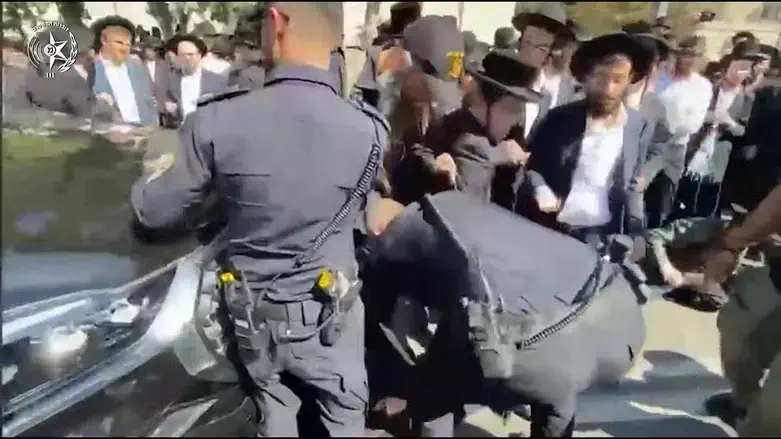
For those committed to a life of Torah and mitzvos, Shabbos observance, chinuch al taharas hakodesh, the ability to live according to halachah and the continued existence of the Torah world are not political slogans. They are foundations upon which our lives are built. When these values are threatened, we have a responsibility to raise our voices and, at times, to take to the streets in protest.
Yet we must also ask ourselves an uncomfortable question:
Does the way we act always bring us closer to achieving what we seek?
When thousands take to the streets and major roads are blocked, the consequences can be far more serious than inconvenience. Time is precious, and depriving people of it without their consent is no small matter. It can amount to gezel zman - the wrongful taking of another person’s time. People may be prevented from getting to work, losing valuable hours and income, reaching medical appointments, attending a simchah, returning home after a long day or collecting their children.
More seriously, a blocked road can delay someone who urgently needs medical attention, prevent an ambulance from reaching a patient in time, or hold up someone whose life depends on immediate care. For the individual caught in such circumstances, the consequences may be severe and, in some cases, irreversible.
Those affected may have no connection whatsoever to the issue being protested. They may share our concerns, disagree with us or have no opinion on the matter at all. Yet they are made to bear the burden of a struggle they did not choose. The frustration and anger this creates are understandable. Worse still, when people repeatedly experience Torah-observant Jews through the disruption and distress caused by such demonstrations, they may come to associate our community not with the Torah values we seek to uphold, but with the hardship imposed upon them.
There is a further point that we must consider. When we demonstrate in the name of Torah observance, we must be especially careful that our actions do not undermine the very Torah we seek to uphold. If a demonstration results in widespread bitul Torah, this cannot simply be overlooked. Torah is kept alive through learning it, living by its teachings and demonstrating their truth through our conduct and middos.
We must ask ourselves whether a protest that brings about widespread bitul Torah, while also disrupting the lives of so many others, truly advances the cause for which we have taken to the streets. We cannot assume that every action taken in the name of Torah necessarily strengthens Torah. It may, in fact, have the opposite effect. We cannot claim to be defending the honour of Torah while ignoring the importance of Torah learning itself.
A protest may command attention, but if its cost is borne by innocent people and it comes at the expense of Torah learning, we must seriously consider both the human consequences and the damage it may do to the very cause we wish to advance.
A protest can make people hear us, but that does not mean they understand us. At times, the very means we employ to defend the values of Torah may deepen the distance between those values and the people we hope to reach.
Chazal teach us in Maseches Yevamos (65b):
“Just as it is a mitzvah to say something that will be heard, so too is it a mitzvah not to say something that will not be heard."
This is not an instruction to remain silent when the Torah world is in danger, nor does it mean that every protest is wrong. Rather, it calls upon us to consider carefully how best to achieve the purpose for which we are acting. Our goal is not merely to express our protest, but to protect Torah and help others understand why we stand where we do.
This is where the lesson of Avraham Avinu becomes especially relevant.
Alongside public protest, we must make a serious and sustained effort to reach our fellow Jews personally. We should go into neighbourhoods where there is little contact between religiously observant Jews and those who do not observe Torah and mitzvos. We should arrange meetings and conversations, invite people into our homes and institutions, and create opportunities for them to ask questions openly and receive honest, patient answers.
We should explain what Shabbos means to us, why chinuch al taharas hakodesh stands at the centre of our lives, and why our commitment to halachah does not mean rejecting other Jews. At the same time, we must be prepared to listen to the concerns of those who see things differently, without assuming that every disagreement stems from hostility.
Even when we encounter harsh attacks on the Torah world, we must be careful not to allow our anger to blind us to the reality beyond the dispute. Many of our fellow Jews who do not observe Torah and mitzvos have never had the opportunity to experience the sweetness of Shabbos in a Torah home, to appreciate the depth of a life shaped by Torah, or to become familiar with the meaning of mitzvos at close quarters. For some, Judaism is known primarily through what they have heard about it, sometimes through negative stereotypes and public confrontations. There are those who grew up far removed from the Torah world, without ever being given a genuine opportunity to discover it from within.
The halachic concept of tinok shenishba reminds us of the importance of considering the circumstances in which a person grew up and the opportunities he or she had to learn about Torah and mitzvos. This does not mean that everyone who does not observe Torah and mitzvos necessarily falls within that halachic category, nor does it justify attacks on the Torah world. It does, however, remind us to distinguish between rejecting views that we cannot accept and the way we relate to the person who holds them.
Precisely because Torah is so precious to us, we have a responsibility not only to defend it against attacks, but also to give more of our fellow Jews the opportunity to discover it for themselves. It is not enough to tell them what we believe is wrong. We must give them the opportunity to see what is beautiful, profound and life-giving about a life of Torah and mitzvos. Sometimes, a personal encounter, an invitation to a Shabbos meal around a warm Jewish table, or an honest conversation with a ben Torah can open a door that years of confrontation have failed to open.
This work must not be left to a handful of individuals, nor should it be undertaken only when a crisis erupts. It requires thought, perseverance and the involvement of rabbanim, mechanchim, community leaders and ordinary members of the community. We must build personal relationships before disagreements turn into confrontations, and we must continue to maintain those relationships even when differences of opinion remain.
Such efforts will not resolve every dispute. There will also be occasions when there is no alternative to firm public protest. But a Jew who has shared our Shabbos table, met our families and spoken honestly with us has had an opportunity to see our lives from within. He or she may not agree with every position we take, but it will be harder to judge an entire community solely on the basis of a blocked road or a public confrontation.
In Maseches Sotah (14a), Chazal teach that we must follow in the ways of Hashem: just as He clothes the naked, visits the sick and comforts mourners, so too must we follow His ways. The demands of Torah are expressed not only in the things we oppose, but also in the deeds we perform for the benefit of others.
This does not replace the need to stand firmly by the principles of halachah. It is part of that very same responsibility. If we want our fellow Jews to understand the beauty of a Torah life and the demands it entails, we must show them through our conduct, our middos, our concern for others and our willingness to step beyond the familiar boundaries of our own community.
It is easier to mobilise thousands for a demonstration than to build hundreds of personal relationships. A protest may attract immediate attention, while building relationships requires patience and a long-term investment. Yet such relationships can achieve something that even the largest demonstration cannot.
Noach teaches us the importance of remaining true to our principles even when the world around us loses its moral direction. Avraham Avinu teaches us how to combine that commitment with an active concern for others. His tent was open, and he himself ran towards those who came near.
We cannot determine whether others will accept our position. We can, however, choose how we present it and how much effort we are willing to make to reach them.
Our challenge is to defend our way of life with conviction and determination while building bridges to our fellow Jews. Sometimes this requires public protest. At other times, a quieter act is called for, one that is no less important: stepping beyond our familiar surroundings, meeting other Jews and opening our doors to them.
Sometimes, the most effective way to defend our way of life is not to block a road, but to open a door.