

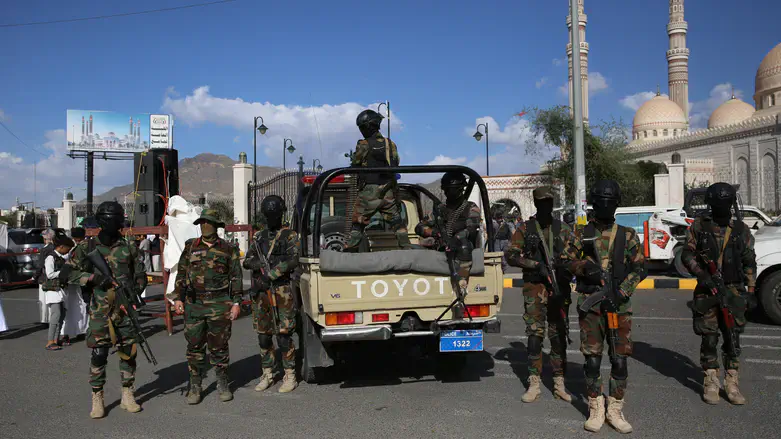
The escalating conflict between Saudi Arabia and Yemen's Iran-backed Houthi terrorists intensified on Friday, with Saudi authorities confirming that three people were killed in attacks on Riyadh's King Khalid International Airport, while Saudi-backed Yemeni government forces announced significant territorial gains near the strategic Bab el-Mandeb Strait.
Thursday's attacks on the Saudi capital's airport also wounded several people and damaged a Saudia Airlines aircraft, forcing numerous airlines to suspend flights to Riyadh. The Saudi General Authority of Civil Aviation said the airport was struck twice, with one attack targeting airport infrastructure and the other hitting a passenger aircraft.
The authority confirmed that the three fatalities were Saudi citizens, while several Saudi nationals and foreign residents sustained injuries ranging from minor to serious. Saudia Airlines said one of those killed was an employee of the company.
Emergency services responded to both incidents, and the wounded were transported to hospitals. Saudi aviation authorities announced on Friday that normal operations had resumed at the airport, although numerous international flights remained canceled or delayed.
Separately, Saudi Civil Defense reported that debris from an intercepted Houthi ballistic missile struck a kindergarten and a medical clinic complex in Riyadh on Thursday, causing property damage.
The Saudi-led coalition also announced that it had intercepted two ballistic missiles launched toward Riyadh and destroyed another missile targeting Khamis Mushait in southern Saudi Arabia.
Meanwhile, Saudi airstrikes continued against Houthi military positions across Yemen as part of Operation Dawn of Yemen, targeting locations in the northern province of Saada, the capital Sanaa, and other areas.
Military sources told Al Arabiya and Al Hadath that warplanes carried out strikes in the Kitaf and Al-Buq districts of Saada, considered the Houthis' principal stronghold. Additional attacks targeted positions in Sanaa, while explosions were reported in Amran province.
The latest strikes followed an extensive aerial campaign on Thursday against Houthi military camps, troop concentrations, and reinforcements in the provinces of Al Bayda, Ibb, Marib, and Hodeidah. Houthi forces heading toward the battlefronts in Taiz were also targeted.
The Saudi-led coalition said it had destroyed three Houthi missile-launching platforms and warned that attacks on civilians would be met with a forceful response.
In a separate development, Yemeni government forces announced Friday that they had secured control of the Bab el-Mandeb Strait and Mayyun Island, following operations against Houthi forces along Yemen's western coastline.
The announcement came as fighters from the Southern Giants Brigades engaged Houthi forces in the Dhubab area, capturing several terrorists who had been holding fortified positions.
Video: Captured Houthi terrorists
According to military sources cited by Al Arabiya, government forces attacked a Houthi military installation in Dhubab after surrounding the position and issuing a three-day ultimatum. The Southern Giants Brigades subsequently released photographs and videos showing captured Houthi fighters.
Saudi Arabia's ambassador to Yemen also announced Friday that the Bab el-Mandeb area had been cleared of Houthi forces. However, Reuters reported that it could not independently verify the claim, noting that Houthi forces continued to hold positions in nearby Mocha, while fighting persisted in surrounding mountainous areas.
The strait, which connects the Red Sea with the Gulf of Aden and the Arabian Sea, is a vital route for international shipping and energy supplies. Control of Mayyun Island, situated at the entrance to the strait, is considered strategically significant for securing maritime traffic.
Yemeni military sources reported that the Houthis attempted to reinforce their besieged fighters in Dhubab by sending additional troops by sea on Thursday evening. The group also intensified missile and drone attacks toward Bab el-Mandeb overnight, while clashes continued in the surrounding area.
Elsewhere, Houthi forces have advanced in mountainous districts around Taiz, cutting off a major road serving the city, which is home to more than half a million residents and thousands of pro-government fighters.
The Yemeni Armed Forces announced Thursday that they had carried out 1,729 precision strikes against Houthi military targets across multiple fronts during the ongoing offensive.
Military spokesman Colonel Majed al-Nazili claimed that the operations had neutralized 1,370 Houthi fighters and destroyed or disabled approximately 300 military vehicles and pieces of equipment.
According to the spokesman, the strikes targeted observation posts, command facilities, weapons storage sites, supply routes, and military reinforcements.
As the fighting continued inside Yemen, the Houthis renewed their threats against civilian aviation over Saudi Arabia.
On Friday, the group declared Saudi airspace a military operational zone for its missile forces, warning aircraft against flying over the kingdom, with the exception of airspace above the Muslim holy cities of Mecca and Medina.
The European Union Aviation Safety Agency expanded its warning against flights over Saudi Arabia following the attacks on Riyadh airport. Aviation risk monitoring organization OPSGROUP also advised airlines to avoid Saudi airspace.
The US Embassy in the United Arab Emirates urged American citizens to exercise heightened caution, citing Houthi attacks against civilian targets in Saudi Arabia and the possibility of further escalation.
Saudi Arabia has meanwhile sought military assistance from Pakistan and Turkey, its partners in a mutual defense agreement, as it attempts to counter Houthi missile attacks and support government forces fighting to reverse the group's territorial gains in Yemen.
The renewed conflict comes amid the wider regional war that began with US and Israeli strikes on Iran on February 28. Houthi attacks on Red Sea shipping and the Bab el-Mandeb Strait have added pressure to international energy supplies, already affected by Iran's partial blockade of the Strait of Hormuz.
The escalation also comes just days before Riyadh is scheduled to host the WPC Energy Congress, bringing together energy ministers, government representatives, and senior oil industry executives beginning Sunday.
Despite the attacks, organizers were still promoting the event on Friday. Italian Energy Minister Gilberto Pichetto Fratin announced that he would participate remotely rather than attend in person, without specifying the reason for his decision.