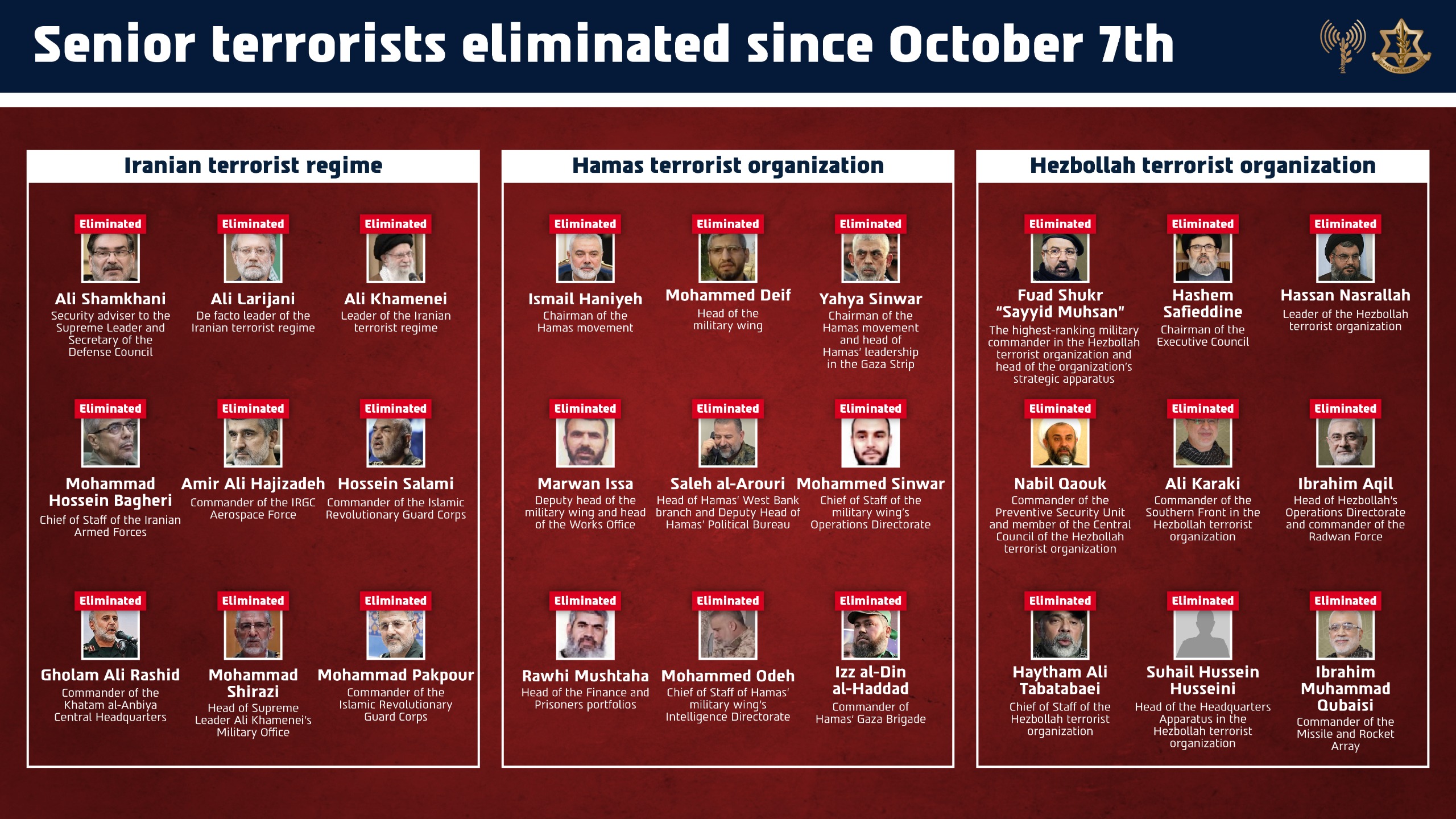

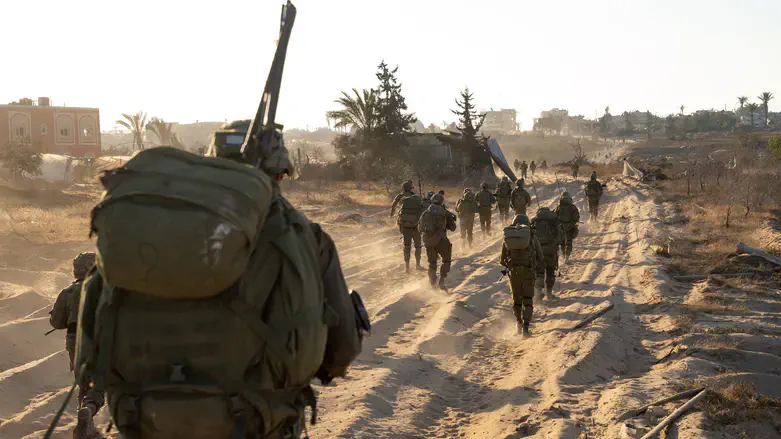
The IDF has struck approximately 100,000 terrorist targets across multiple arenas since the outbreak of the war, while carrying out sweeping changes to its intelligence, border defense, force deployment and reserve systems as part of lessons learned from the October 7 massacre, according to data released by the military.
The figures, covering three years of IDF activity, show that approximately 65,000 targets were struck in Gaza, about 28,000 in Lebanon and Syria, approximately 4,500 in Iran and around 80 in Yemen. During the same period, Israel faced approximately 10,200 projectiles launched from Gaza, 20,000 from Lebanon, 1,200 from Iran, 50 from Syria and 90 from Yemen.
The IDF said 970 personnel have fallen in operational circumstances since the beginning of the war. More than 70% of soldiers wounded during the war have returned to service.
In Judea and Samaria, security forces located and confiscated more than 3,800 weapons and apprehended approximately 45,000 wanted individuals for questioning. Those detained included weapons traffickers, people possessing weapons, suspects planning imminent attacks, individuals involved in terrorist activity, stone and Molotov cocktail throwers, terrorist operatives and facilitators. More than 46 million shekels intended to finance terrorism were also confiscated.
Intelligence overhaul after October 7
Alongside the operational figures, the IDF detailed extensive reforms implemented across its branches, commands, corps and directorates following investigations and lessons learned from October 7.
The Intelligence Directorate has placed providing warning of war, hostile activity and threats to Israel and its citizens at the top of its priorities, defining it as the Directorate's central responsibility. It also adopted four guiding values: responsibility, professionalism, humility and truth.
Over the past two years, the Directorate has updated its warning concept, validated existing warning models and developed new ones, strengthened warning operations rooms across all arenas, developed advanced training programs and established a multi-arena, multidisciplinary warning operations room designed to create a unified intelligence picture connected to developments in the field.
The military said the intelligence culture is also being changed to place the possibility of surprise and uncertainty at the center of daily thinking. Personnel are being encouraged to question assumptions, debate assessments and identify information that contradicts expectations. The updated warning concept places greater weight on changes in an enemy's level of readiness and less on assessments of its intentions or apparent "reassuring signs."
Intelligence collection is being broadened to combine technological capabilities with intelligence gathered from the field, while professional training now includes greater emphasis on the limitations of intelligence and on understanding cultural and religious differences between Israel and its enemies. Dedicated training in Islamic studies and intelligence research has been established, with outside academics and intelligence experts involved in the Islamic studies program.
New oversight bodies have also been established or expanded, including the Foundational Intelligence Department, the Doctrine and Training Department and the Control Department, while a new school trains intelligence commanders from team-leader level through lieutenant colonel. The Intelligence Directorate is also establishing a Data Division to centralize and process information and make greater use of computing infrastructure, data and artificial intelligence.
Gaza border defenses rebuilt
In Southern Command, the IDF said that during the war it eliminated four heads of Hamas military branches, 17 brigade commanders, approximately 60 battalion commanders and around 300 company commanders, in cooperation with the Air Force, Intelligence Directorate and Operations Directorate.
The defense system for Gaza border communities has undergone major changes. Fences, security roads, protected positions, gates, lighting, radars and observation systems have been upgraded. Community defense units and civilian security coordinators received additional weapons, protective equipment, communications systems and drones, while the encrypted "Netz" local defense application was introduced.
Armored ambulances have been deployed in communities maintaining regional readiness, and the "Magen 46" program increased training from two exercises annually to eight complex exercises. Each community now has a dedicated defense file, and brigade-level regional defense command-and-control centers have been established.
Approximately 40 military posts have been established on commanding terrain based on anticipated Hamas attack routes, while dozens of kilometers of routes were prepared to improve operational mobility. The Gaza border barrier was also reinforced with advanced above- and below-ground capabilities following the investigation into its breaching on October 7.
Hundreds of terrorist sites, launch pits, weapons storage facilities and other infrastructure have been dismantled. The IDF has also refined systematic drilling to locate underground infrastructure, carrying out more than 4,000 drillings since the ceasefire last October, while destroying underground infrastructure along the Yellow Line, including tunnels in Beit Hanoun and the "Dror Lavan" tunnel.
Air Force multiplies forces on alert
The Israeli Air Force has revised its preparations for a large-scale surprise war across multiple arenas. The number of forces kept at readiness has increased by as much as fourfold compared with the eve of the war, and by as much as sixfold in certain arrays. Authority delegated to field echelons has also been expanded, while command-and-control and operational-picture-building capabilities have been strengthened.
Cooperation with ground forces and regional commands has been expanded through the new Cooperation and Borders Group, while preplanned target banks and fire plans have been developed for all of Israel's borders. Squadron 190, the "Magic Touch" attack-helicopter squadron, was relocated to Ramat David Airbase to shorten response times in border sectors.
Hundreds of radars and other systems have been deployed or expanded to detect drones and other near-ground threats. Dedicated defense battalions have been established to protect Air Force bases, along with the "Arad" Unit in Wing 7, composed of female combat soldiers tasked with providing intervention teams against ground and aerial threats and collecting intelligence to defend strategic assets.
The Air Force also established a dedicated directorate, headed by a reserve brigadier general who participated in the October 7 inquiry, to oversee implementation of the investigation's lessons in work plans, exercises, training and force-building.
IDF more than doubles readiness frameworks
At the General Staff level, the Operations Directorate has increased exercises focusing on defense and surprise multi-arena scenarios and drafted a new order changing the principles governing defense and the response to a large-scale surprise attack.
The number of readiness frameworks and force reserves across all sectors has more than doubled, encompassing air, ground and naval forces. Commanders in the field have also been granted broader authority, particularly regarding the employment of fire during a surprise attack.
Northern Command, meanwhile, has adopted a concept dubbed "The IDF in Front of Civilians," under which forces deploy forward to prevent threats from developing close to Israeli communities.
The 91st and 36th Divisions carried out extensive activity along the first line in southern Lebanon to create a security area and prevent terrorist organizations from reestablishing themselves. Following the fall of the Assad regime, troops from the 210th "Bashan" Division entered Syrian territory within approximately 12 hours and established a forward security area containing ten military posts.
Defense units in northern communities have tripled in size and received drones and additional observation, combat and communications equipment. The "Pere" and "Dvora" rapid-response units were also established, staffed by combat soldiers who live in the Golan Heights, Galilee, valleys and communities along the confrontation line.
New defenses in Judea and Samaria and along eastern border
Central Command is implementing a "Community as a Fortress" program to reinforce observation, collection, weapons and other security components in communities, while changing the deployment of troops and military posts in Judea and Samaria. The IDF also decided to convert all military camps into military posts as a lesson from the attack on the Nahal Oz base.
Operational plans have been tested through exercises and "red teams" intended to challenge assumptions. Following the establishment of terrorist organizations in Jenin, Tulkarm and Nur Shams, Operation Iron Wall was launched to dismantle terrorist infrastructure and prevent its reestablishment. Israeli forces continue to maintain an operational presence in those areas.
The IDF has also established the 96th "Gilad" Division to confront threats from Israel's east. The "Water Line" military posts along the eastern border were restored, the Dead Sea command-and-control center was established to defend hotels, industrial facilities and residents, and female mobility combat soldiers were trained on "Jaguar" vehicles as a mobile reserve force.
Five David Brigades were also established and trained as territorial rapid-response forces intended to provide an armed and readily available response to rapidly developing incidents along Israel's borders.
Ground Forces expand
The Ground Forces have redefined community classifications and force standards under the "Meshiv Haruach" program, with every community receiving new weapons and conducting training under a common combat doctrine.
A new Intelligence Collection Branch was established at the National Center for Ground Training, while training for visual intelligence interpreters has been strengthened. The border-defense concept itself has been changed to place communities and residents at its center, with greater defensive depth, security areas and IDF forces positioned forward to identify and thwart threats before they reach civilians.
The Ground Forces have also expanded their structure with the establishment of the Hasmonean Brigade, 96th Division, David Brigades, 607th Battalion, 38th Division, robotics companies, 11th Battalion and 935th Battalion. New technologies include remotely operated armored fighting vehicles, while new training facilities have been designed to recreate battlefield conditions, including a "Lebanon" training facility and urban warfare facilities.
The Combat Engineering Corps has meanwhile expanded the remote operation of engineering platforms, established Battalion 607 and increased the use of technology in underground warfare.
Home Front Command and logistics
The Home Front Command said it has improved warning and civil-defense capabilities, including adjusting the amount of time civilians have to seek protection according to the threat and location. Its ability to deploy forces rapidly across several arenas has also been strengthened, with new formations including a district in the Besor region, the Ya'ara Headquarters, Atzmon Battalion, a mobility unit, Ari Battalion and a National Home Front Training Center.
Joint exercises with local authorities, Magen David Adom, Israel Fire and Rescue Services and Israel Police have expanded. Hundreds of public shelters have been renovated and thousands of protective structures deployed nationwide, while protection projects have been accelerated in northern communities and educational, healthcare and welfare institutions.
Communications infrastructure has been reinforced to maintain operations even if infrastructure is damaged, including redundant communications cores, an alternate command headquarters and satellite capabilities for cellular coverage. The Home Front Command has also developed responses to emerging threats including cluster-munition and hazardous-material incidents.
The Technology and Logistics Directorate has adapted the combat service support system to operate alongside combat troops under extreme conditions. A School for Combat Service Support was established at Training Base 6, while the "Acceleration" program is intended to speed troops' return to operational readiness through changes to emergency storage, maintenance and equipment preparation.
Navy adopts layered coastal defense
The Israeli Navy has reorganized maritime security and defense areas to create multiple defensive layers, improved detection and communications systems and deployed reinforced forces at response points near combat zones.
Patrol vessels have been integrated more closely with ground forces, including through advanced command-and-control systems aboard Dvora-class and other vessels. The Navy has also established the "Netz" forward combat-intelligence unit to rapidly identify threats and close operational cycles against them.
New naval platforms include the "Saifan," an interception platform operated by the Snapir Unit and equipped with a precision-fire system, and the "Shaldag Mark V," which provides improved observation and fire capabilities as well as greater endurance and operational range.
Reserve forces expanded by 36%
The changes have also transformed the IDF reserve system. Since the war began, the reserve force has grown by approximately 36%, with new frameworks including the Hashomer Brigade, David Brigades as part of the establishment of the Gilad Division, the 38th Division, armored formations, intelligence collection units, community defense forces, air-defense frameworks, policing and detention units and Home Front Command formations.
In August 2024, approximately 22,000 personnel who had previously been released from service were returned to the reserves. During three personnel-utilization events comprising eight General Staff-level days in 2025, 14,016 reservists were assigned to active units on the day they were interviewed, with another 1,655 assigned later. Four additional utilization days in 2026 resulted in 7,575 reservists being assigned immediately and another 484 later. Four more such days are planned for December, when thousands more personnel are expected to be assigned to combat and combat-support roles.
The number of personnel assigned to reserve units immediately after completing mandatory service has increased by approximately 38%. Combat formations are serving an average of approximately 80 to 100 reserve days this year, compared with a planned annual average of approximately 55 days, due to changing operational needs.
At the same time, support for reservists and their families has expanded through grants, an assistance fund, emotional and couples counseling, tuition subsidies, vacation vouchers, housing benefits, student assistance, a digital wallet and other benefits.
The "Service Circle" program was also developed to provide continuous assistance before, during and after operational deployments, covering individual and family needs, resilience and welfare while strengthening the connection between reservists, their commanders and their units.
The IDF said it will continue expanding its personnel base and maximizing available manpower to meet its operational missions, while working to reduce the burden on reservists and strengthen support for them and their families.