

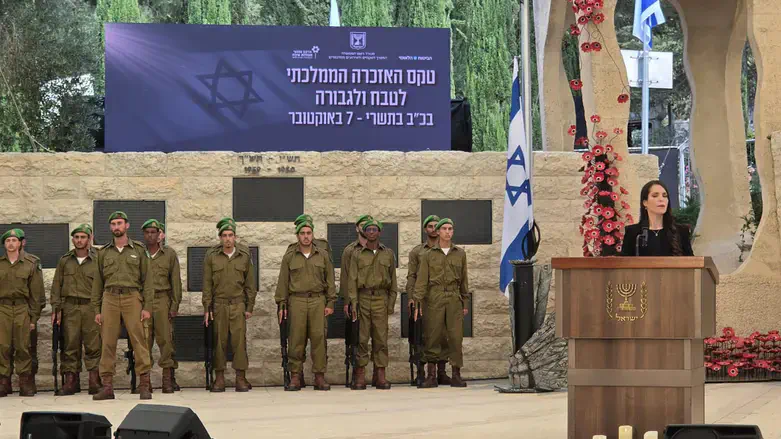
Rabbi Yosef Zini of Ashdod, father of Shin Bet chief David Zini, has issued a strongly worded letter three years after the Simchat Torah massacre, criticizing the government's decision to establish a national day of remembrance for the October 7 events.
Writing under the title “A Faithful Perspective - For Your Miracles and Wonders," Rabbi Zini responded to an educator who asked how he should address the memorial day with his students.
“In my humble opinion, as believing Jews, there is no value whatsoever in this unfortunate decision," Rabbi Zini wrote, offering several reasons for his position.
He first criticized the way the decision was made, arguing that establishing a day of mourning should have been done in consultation with Israel's rabbinic leadership. “They did not consult with the leading rabbis of the generation, headed by the Chief Rabbinate of Israel, which is certainly the supreme authority regarding the establishment of days of celebration-or, God forbid, days of mourning," he wrote.
Rabbi Zini also objected to the date chosen, noting that it falls on a day when Tachanun is not recited and which, in his view, cannot be transformed into a day of mourning.
He then turned to what he described as a need to balance remembrance of the disaster with gratitude for the miracles and salvation experienced by the Jewish people since Simchat Torah 5784. “Unfortunately, we have not seen the authorities seeking to establish days of thanksgiving for all the millions of miracles we have been privileged to experience, especially over the past three years," he wrote.
Rabbi Zini further argued that the decision was driven by “pressure from unequivocally faithless circles" on the government.
To illustrate his approach to mourning and remembrance, he invoked the Jewish holiday of Hanukkah. The Maccabean victory, he noted, came at the cost of thousands of lives, yet Jewish sages did not establish a separate day of mourning for those who fell. “Not because of disregard for the holy victims, may God avenge their blood, but because we remember them at every opportunity," he wrote.
He similarly pointed to Israel's wars, noting that despite the many casualties, successive governments did not establish a separate national day of mourning for each conflict. At the same time, he praised the IDF's memorial ceremonies at military cemeteries as “the most proper conduct."
Rabbi Zini also argued that Jewish history contains so many tragedies that establishing a separate memorial day for each would leave little room on the calendar. “If our people had established memorial days for our many tragedies throughout history, apart from the days of mourning for the destruction of our Temple, we would not have enough days in the year," he wrote.
Toward the end of the letter, Rabbi Zini stressed that his position does not diminish the pain over the events of Simchat Torah 5784. “We all mourn our various tragedies, including Simchat Torah 5784," he wrote. But he added that the Jewish people traditionally focus on how they overcame their failures and tragedies: “We are not a self-destructive people!!"
“We will leave this trait to dying - or dead - Europe," he added.
Returning to the educator's original question, Rabbi Zini called on him to emphasize faith, hope and anticipation of redemption when speaking to his students.
“Explain to your students, to the best of your ability, what is said in all our prayers: ‘And You, in Your great mercy, will desire us and favor us, and our eyes will behold Your return to Zion in mercy,’" he wrote.
“This will bring assured and eternal comfort to all the holy victims of Simchat Torah 5784, may God avenge their blood," Rabbi Zini concluded, signing off with a declaration: “Fortunate are you, Israel, who lives!"