

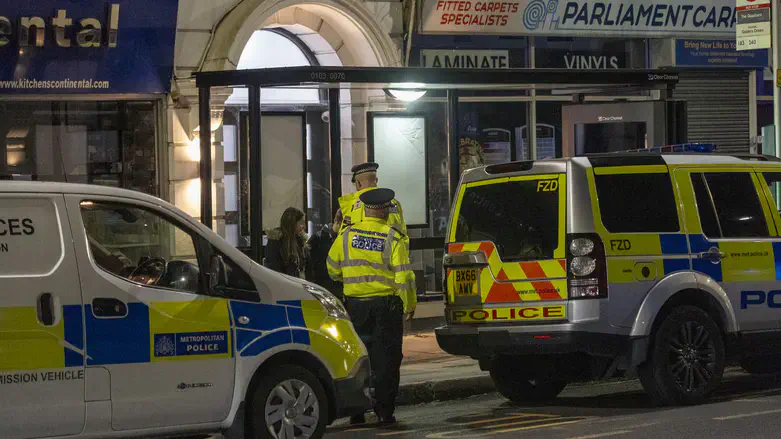
The Metropolitan Police said it is preparing for a busy week of public order events in London, including a planned pro-Palestinian student march on October 7 and a larger pro-Palestinian demonstration three days later, as the city marks the third anniversary of the October 7 massacre.
At a media briefing at New Scotland Yard, James Harman, Deputy Assistant Commissioner for Met Operations, said hundreds of officers will be deployed across a number of protests and other events during the coming week. He said the combined impact of the events, at what he described as a “really sensitive time," creates a risk of communities feeling unsafe and unsupported.
“Where we need to we will take a robust approach - imposing strict conditions where the intelligence indicates there is a risk of serious disorder, serious disruption or that others would be threatened and intimidated - and take a zero-tolerance approach to criminality of any kind, including hate crime," Harman said.
On Wednesday, October 7, a group calling itself the University of London Coalition is expected to march from King’s College London in the Strand to University College London in Holborn, beginning at midday. The group has demanded an end to what it describes as a “genocide in Gaza."
Harman said the date carries particular significance for many Londoners. “For many in our city, this will be a day of mourning, a day of reflection, and we are aware of a number of vigil events being planned," he said.
He said serious concerns had been raised about the impact of the march on students and staff, particularly Jewish students and staff, as well as about the route and the date of the demonstration. The Met has attempted to identify and contact the student organizers and has asked them to hold the event on a different day.
“I am also saying today to anyone who is intending to join the march - please reflect on the impact and distress it will cause on this very significant day, and exercise your right to protest on a different date," Harman said.
The Met said that if the protest goes ahead, police will have no choice but to police it, and that the policing plan will take account of the impact on the community of holding the protest on October 7. Police have also written to the four universities attended by the students, asking for their help and leadership.
Harman stressed that the police do not have a general legal power to ban protests or marches. “The police cannot give permission for protests or marches to go ahead, nor do we have any power in law to refuse permission," he said. “We can only impose conditions on organisers, under the Public Order Act, to prevent serious disruption or serious disorder, or disruption to the life of the community."
He said the Public Order Act allows police to seek a ban from the Home Secretary only where officers believe the risk of disorder is so serious that it cannot be managed through conditions imposed as part of a wider policing plan. “That is a very high bar and that is very rarely used," he said, adding that the power applies only to marches and not to static assemblies.
The Met made the same point in a post on X responding to calls to “just ban it." The force wrote: “We can't ban protests & can only ask the Home Sec to do so if the risk of serious disorder is so high that it can’t be managed by conditions. That's not the case here."
In a graphic published with the post, the Met said police can impose conditions on a march under Section 12 of the Public Order Act where necessary to prevent serious disorder or serious disruption to the life of the community. Such conditions can include routes, timings and start or finish points. The graphic states that police themselves do not have the power to ban a march, but can apply to the Home Secretary under Section 13 if the risk of disorder is so serious that conditions alone cannot deal with it.
The graphic also distinguishes marches from static assemblies. It says police can impose conditions on an assembly under Section 14, including conditions on time, place and duration, but that neither the police nor the Home Secretary has a power in law to ban a static assembly.
Harman said police will use their full powers on October 7 to impose and enforce appropriate conditions, including on the route and timing of the march. Anyone who breaches the conditions, or encourages others to do so, can be arrested, he said. He added that the Met will take a “zero-tolerance approach" to hate crime and other offending.
On Saturday, October 10, police expect up to 10,000 people to attend the Palestine Coalition’s national call-out. The march is expected to form up at noon near Northumberland Avenue on the Embankment, proceed via Westminster Bridge, the South Bank, Waterloo Bridge and the Strand, and end with a rally on Whitehall. Police also anticipate a counter-protest by Stop the Hate and others.
The Met said several hundred officers are expected to be involved in policing the October 10 demonstration. Harman said strict conditions will be imposed on the timing and route, and that the police presence will be significant in order to minimize disruption and deal swiftly with crime or disorder.
According to Harman, there have been 35 large protests organized by groups that make up the Palestine Coalition since October 2023. He said most participants attend peacefully and lawfully, while a small minority have been arrested across the protests for racially and religiously aggravated public order offenses, stirring up racial hatred and supporting terrorist organizations.
More than 600 officers are expected to be involved in policing the various protests and events during the coming week, including specialist units. Harman said the 35 large Palestine Coalition protests since October 2023, together with other protests related to the conflict, have cost the Met £26.6 million to police, rising to £90 million when opportunity costs are included.
The London events come amid a wider wave of demonstrations around the third anniversary of the October 7 massacre. The Ministry of Diaspora Affairs and Combating Antisemitism said on Monday that, as of October 4, it had identified 262 pro-Palestinian protest and solidarity events across 37 countries between October 1 and October 14.
According to the Ministry’s National Situation Room, Britain has 19 identified events. The United States leads with 45, followed by Spain with 40, Australia with 21 and Italy with 16. Germany and Canada each have 14, France has 10 and the Netherlands has eight.
The report said October 10 and 11 are expected to see particularly intense protest activity, with 121 events between them, including 96 on October 10. Another 75 events have been identified for October 7 itself. The Ministry classified 87 of the 262 identified events as presenting a medium or high risk and listed London among a number of risk focal points.
The Ministry also said 45 events are expected to take place near an Israeli embassy, consulate or other property associated with Israel, with 30 located within 2.5 kilometers of such a property. It assessed that concentrating many events over the weekend is intended, among other things, to maximize participation and public and media exposure.
Harman said the coming week is unusual because of the variety of events and protests and the sensitivity of their timing. “As always, we will police without fear or favour. We will facilitate people’s right to lawful protest," he said. “But I end with a warning: if anyone thinks they can commit crime, intimidate our communities or stir up hatred towards others, they should think again as they will be dealt with swiftly and decisively."