
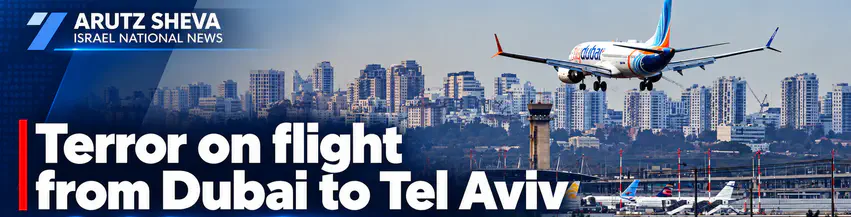


Political commentator Amit Segal sharply criticized the Ministry of Transportation on Monday morning over alleged failures in securing foreign flights, focusing on the ministry’s failure to use the National Passenger Profiling Center.
“The Transportation Ministry’s failure is glaring in one central area: a National Passenger Profiling Center was established," Segal wrote.
He said that every relevant government ministry was required to authorize employees to access the center’s data and conduct searches based on its needs.
As an example, he cited the Health Ministry’s ability to identify passengers arriving from countries experiencing outbreaks of epidemics, as well as the Transportation Ministry’s ability to identify pilots arriving from hostile countries.
Segal noted that the database has already demonstrated its capabilities and helped, among other things, locate the Israeli women who went missing in Vienna.
However, he claimed that “the Transportation Ministry never bothered to authorize employees, never submitted a single query, and did not even bother to pay its share of the database."
“If it was decided that pilots from hostile countries are not allowed in, how are you going to identify them if you didn’t bother to do your basic part and actually check? It’s a real scandal," he added.
Segal’s comments come amid a series of reports in recent days raising questions about the Transportation Ministry’s conduct and the way it has exercised its responsibility for the security of foreign aviation.
One of the central findings concerns the database Segal referred to. The National Passenger Profiling Center Law allows authorized bodies to receive information about passengers and crew members on international flights. Ynet reported that the Transportation Ministry is among the bodies permitted to use the information as part of its duties, but that since the database was established, it has never requested to exercise that access.
The system’s information may, among other things, make it possible to identify the citizenship of crew members and flag cases requiring additional checks. At the same time, it was revealed that details about flight crews may only reach the system shortly before the aircraft doors close and sometimes even after takeoff, meaning that the information-transfer mechanism itself is now also under review.
The issue came into sharper focus after it was revealed that, over the years, crew members holding citizenship from countries that do not maintain diplomatic relations with Israel had arrived at Ben Gurion Airport. Only following the attempted attack on a flydubai flight were guidelines to airlines tightened, with a decision that crew members who are citizens of countries without diplomatic relations with Israel would not be assigned to flights to Israel.
The reports also revealed that the gaps had been known for some time. An internal National Security Council document revealed by Galei Tzahal stated that the Transportation Ministry was not carrying out the responsibility assigned to it under decisions made in the field. The issue also appeared in a confidential State Comptroller’s report and in discussions involving the Transportation Ministry, the National Security Council, the Shin Bet and the Mossad.
Within the Transportation Ministry itself, professional officials warned that they did not have the capabilities required to assume the broader security responsibility. Nevertheless, the responsibility remained with the ministry, while no alternative mechanism was established to close the gap between information held by state agencies and the checks actually required.
It was also revealed that the Transportation Ministry’s Security, Emergency and Cyber Division, which is responsible for extensive security duties in the air, maritime and land sectors, operates with limited staffing. According to data published by Ynet, the division currently has about 10 permanent full-time employees, after staff members left and positions remained unfilled.
The Transportation Ministry rejected the allegations against it, arguing that it is not an intelligence agency and does not have the tools to independently conduct intelligence background checks on passengers and crew members. The ministry also said that some reports were conflating responsibility for foreign flights with responsibility for charter flights.
Following the series of reports, Prime Minister Benjamin Netanyahu instructed National Security Council head Shmuel Ben-Ezra on Sunday evening to appoint an examiner to conduct a comprehensive review of all aspects of security for foreign civilian aviation to Israel.