
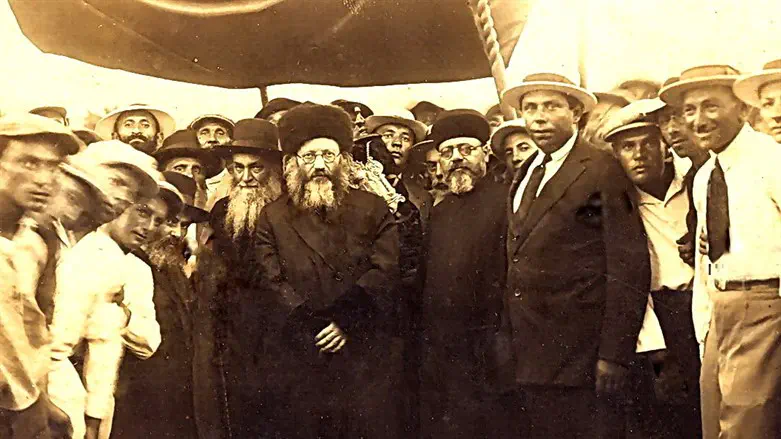
The celebrated first Chief Rabbi of pre-state Israel, Rav Avraham Yitzchak HaCohen Kook (1865-1935) is recognized as being among the most important Jewish thinkers of all time. His writings reflect the mystic's search for underlying unity in all aspects of life and the world, and his unique personality similarly united a rare combination of talents and gifts.He was the undisputed leader of Religious Zionism, defining the Jewish People and the Land of Israel as entities with specific commandments in the Torah of Israel, a construct known as Torat Eretz Yisrael.
Rav Kook was a prominent rabbinical authority and active public leader, but at the same time a deeply religious mystic. He was both Talmudic scholar and poet, original thinker and saintly tzaddik.
Thoughts for the renewed reading of the Torah, starting from Parashat Bereishit:
At the end of the last of the Five Books of the Torah, it says:
God came from Sinai... He brought them a Law of fire from His right hand." (Deut. 33:2)
Why is the Torah called Eish-Dat, a “Law of fire"? And what does it mean that the Torah came from God’s “right hand"?
God’s ‘Right Hand’
The right hand is ordinarily the stronger arm. The metaphor of God using His “right hand" to transmit the Torah indicates that the true power and foundation of the universe lie, not in the physical world, but in its spiritual side.
The relative importance of the world’s spiritual reality may appear counterintuitive, but it can be better understood by considering, by way of analogy, the relative strength of human intellect and spirit compared with brute physical force. The Torah is rooted in the more powerful realm of the spiritual - God’s ‘right hand.’
The Clarity of Moses’ Prophecy
Furthermore, these poetic metaphors of aish-dat and God’s “right hand" convey the unique clarity of Moses’ prophecy. Moses’ prophetic visions were more precise and purer than those of any other prophet. The Sages wrote that Moses saw through an aspaklariame'ierah, a ‘clear lens.’ What does this mean?
Prophecy is ordinarily attained through a combination of two faculties: the intellect and imagination. Prophets need images and parables in order to grasp and then transmit their prophetic messages.
Moses’ prophecy, on the other hand, was based solely on intellect. His prophecy was perceived through a ‘clear lens,’ without the murky vision of the imagination (Guide to the Perplexed, II:36). For this reason, the Torah of Moses is called Eish-Dat, a ‘Law of fire.’ His prophecy came from pure intellect, like a blazing fire that purges and removes all impurities.
When Ezekiel described his prophetic experience, he said, "God’s hand was upon me" (37:1). Unlike Moses, Ezekiel did not speak of the right hand. In fact, he specifically meant the left hand. Ezekiel utilized his powers of imagination - the weaker, less distinct ‘left side’ - in order to grasp his prophetic vision.
The Torah of Moses, on the other hand, was based on the more powerful right side. It flowed solely from the strength and clarity of Moses’ cognitive powers. His unique Torah was thus a “Law of fire from his right hand."
(Adapted from EinEyah vol. II, pp. 347, 335)