
Robert Scott Kellner, the grandson of Friedrich Kellner, served in the U.S. Navy from 1958 to 1964 and is a member of the American Legion. A retired English professor, he taught at the University of Massachusetts and Texas A&M University. He is the editor and translator of My Opposition: The Diary of Friedrich Kellner -- A German against the Third Reich, Cambridge University Press, 2018.
Three thousand years of Jewish history offer a warning about the dangers of political division.
Despite ongoing existential threats from every direction, Israel’s throng of political parties battle intensively against each other for the power of the prime minister’s office, at stake in the October 27, 2026, elections.
The scene strikes a familiar chord in anyone familiar with the capricious advance of civilization: a nation under siege, its people bitterly divided over who should lead, while the enemy primes its weapons and waits.
History offers no shortage of cautionary tales-ancient Greece, Carthage, the Roman Empire--but none is more instructive than the one written in the soil of the Land of Israel itself.
Three thousand years ago, Solomon’s prosperous Kingdom of Israel split in two because of a violent striving for political power after his death. Prophets warned the two new kingdoms of the dangers of disunity, but they waged war against each other.
The consequences were catastrophic. Assyrians conquered Samaria, resulting in the Ten Lost Tribes of Israel. Nebuchadnezzar destroyed Jerusalem, razed Solomon’s Temple, and exiled many to Babylon.
The highly cultured Greek city-states also suffered acrimonious politics. Contesting each other and ignoring warnings by Demosthenes, they fell prey to the ambitious king of Macedon, whose son, Alexander, had his own lust for conquest.
The Seleucid dynasty, created by one of Alexander’s generals, spread Greek rule along the Mediterranean’s eastern coast. There, rebellious Jews, the Maccabees, fought for freedom and eventually established the Hasmonean Kingdom. As brothers blindly fought over succession to that crown, the expanding Roman Republic absorbed the kingdom, which became the last independent Jewish state for the next 2,000 years.
Bereft of a concentrated voice and a protective army, the scattered Jews became the scapegoat for every wily ruler in the world. And antisemitism became the go-to crutch and shield for anyone with unresolved problems who needed to shift the blame on others.
In 1948, after six million Jews were murdered by German Nazis, their European accomplices, and Arab volunteers, Israel was reborn. Jews were able to argue with each other once more over how to rule themselves.
But that came at a great price. The Muslim world attacked the nascent state with overwhelming odds and murderous intent and continued their attacks for decades, aided by their communist allies, Cuba, North Korea, and the Soviet Union.
Israel won, but it was always a roll of the dice, as seen in the Hamas terrorism of October 7, 2023.
That savage shock silenced the quarrels long enough for Israel to eliminate the leaders of Hamas and Hezbollah and, with U.S. help, to crush the Iranian leadership.
But the weakened Hamas and Hezbollah still exist, and Iran tweaks the nose of America. With the endless wealth of the Arab oil nations and covert help from communist nations, the terrorists have portrayed themselves as victims. Their constant presence on social media has increased antisemitism beyond anything Joseph Goebbels might have imagined.
The Hamas savage monsters are now the good guys-beloved even by lesbians and gays.
There has never been a greater need for a united Israel, for Israelis (to temporarily, at least) put on hold their typical furor over ideological and political differences. They know how to rally together. They just did so on Flydubai flight 1073. Political leaders who denounce each other in parliament may have children serving in the same military units under fire on the front lines.
And during special commemorations, they regularly recall the terrible fate of Jews that followed the fall of King Solomon’s United Kingdom and the destruction of their holy temples.
The deeper question is not whether Israelis should disagree. The question is whether enough Israelis, on left and right, secular and religious, continue to believe that they share a common fate. If the state falls, everyone loses. Everyone.
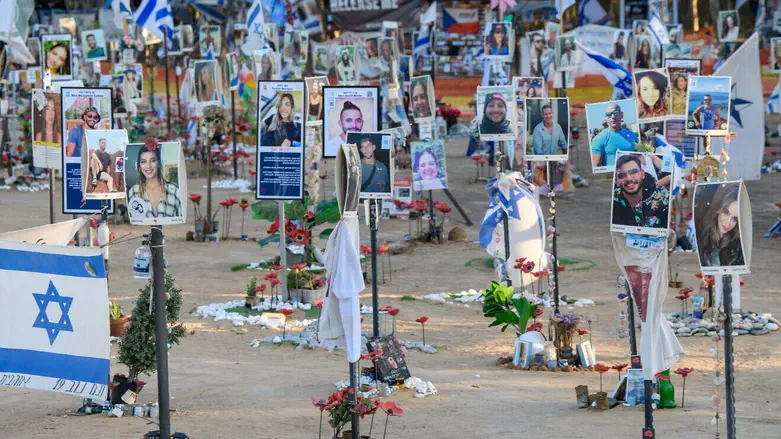
All will share the same fate that is encapsulated in the image of idealistic young peace lovers gathered at Israel’s Supernova Sukkot Festival for “friends, love and infinite freedom," there to sway and dance to music.
Some of the revelers at that festival and many of the residents of the Gaza envelope communities no doubt prided themselves on championing the “Palestinian cause" and a two-state solution, with naive imaginings of how they need only spread wide their arms for Hamas to embrace them.
That is, until the Palestinian Hamas appeared from every direction, including heaven, with machine guns, hand grenades, and knives. How many youngsters and kibbutz members screamed, “Wait, wait, don't hurt me, I support you," as the murderers themselves screamed “Allahu Akbar" and methodically killed each one, hundreds of them, and then displayed corpses and captives to the thrilled and cheering crowds lining the streets of Gaza?
The ballot box is a democracy's most sacred instrument. But democracy, as history shows, is also a nation's most dangerous vulnerability when the alternative to thoughtful and peaceful debate is annihilation. The choice is between a democracy whose leaders unite their parties and the people against a common threat and one that fractures into warring factions while the enemy watches, waits, and strikes.
The ancient Israeli prophets, Greek orators and Roman senators all spoke the same warning. Will it ever be heeded?