
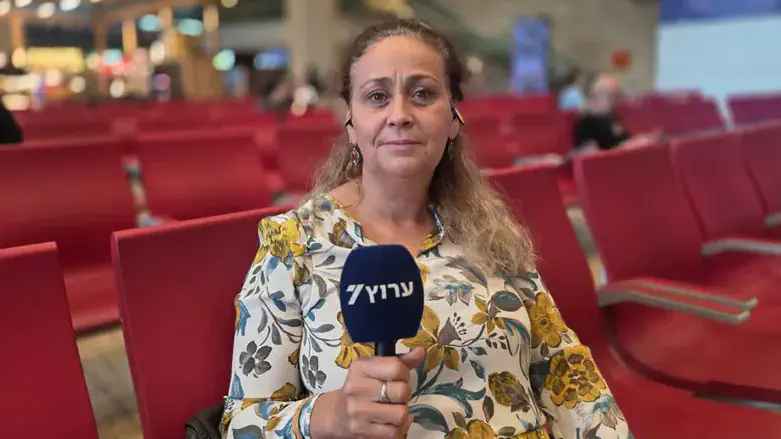
Yasmin Abukasis stood in Ben Gurion Airport with two of her children, signs and balloons in hand. Nearly a year has passed since she saw her daughter, who was scheduled to land in Israel after 11 months abroad to attend the memorial service for her brother. However, instead of the family reunion she had been waiting for, Abukasis received a phone call that she still struggles to process, even after recounting it time and again.
"She tells me, 'Hi Mom, everything okay? I'm in Saudi Arabia.' I told her, 'What? Saudi Arabia?'" Abukasis recounts. "And then she starts to tell me about the horror, which I've already repeated several times and I still don't understand."
Until that conversation, she had no idea what was happening. Abukasis says she looked at the arrival board and did not understand why it did not say that the flight from Dubai had landed. A woman whom she met there told her that she had heard about "an argument between flight attendants," but Abukasis still did not understand the gravity of the situation. Only once her daughter called did the situation become clearer.
According to the account her daughter gave her, while seated in the front section of the plane, one of the passengers walked with her young daughter toward the restroom near the cockpit. There, she said, she noticed that the cockpit door was open and heard a struggle taking place inside. When she approached, she said she saw two pilots fighting, with one holding a pocketknife and stabbing the other.
“She saw two pilots fighting each other, one holding a pocketknife and stabbing the other, with blood spilling everywhere," Abukasis said, recounting what she had heard from her daughter. According to her, the passenger returned to the cabin shouting for help, and within a short time a sharp change was felt in the flight.
“The plane starts descending very rapidly and shaking from side to side," Abukasis said. “The passengers realize that this is it, they’re crashing, and they still don’t understand what is happening."
According to her, several Israeli passengers ran toward the cockpit, fought with the man who, she said, had attacked the other pilot, overpowered him, and tied his hands using whatever was available. Abukasis stressed that the information she had at that stage was partial, and that she did not know for certain the condition of the man who was subdued. She said the other pilot was seriously injured, and that a dentist and a nurse who were aboard the plane stepped in to treat him.
But even after the attacker was subdued, the fear in the cabin did not disappear. According to the account she received from her daughter, the plane continued losing altitude and shaking, while the passengers did not know whether the danger had passed.
“They didn’t know where the next danger would come from," she said, describing the passengers’ feelings. “Are we crashing, or is someone now going to come out and spray us? That was the passengers’ experience."
According to Abukasis, at some point two additional pilots who were among the passengers entered the cockpit and managed to gain control of the aircraft. She said she did not know what their role was or why they were on the flight, and emphasized that the details were still not entirely clear to her.
For her daughter, she said, those were minutes in which the possibility that she would not leave the plane alive felt very real. She was alone on the flight, held the hand of the passenger sitting beside her, and prayed.
“She screams ‘Shema Yisrael,’ and she says, ‘Daddy, I’m not ready to die, my mother is waiting for me. She can’t lose another child,’" Abukasis said. “She recites verses from Psalms, and she says, ‘No, there’s no way, it will be okay, we’re going to survive.’"
For Abukasis, that sentence carries especially painful meaning. Her daughter was on her way to Israel to attend the memorial for her brother, who was killed on October 7. Now, after 11 months away from Israel, her mother was waiting for her at Ben Gurion Airport and once again found herself facing the horrific possibility of losing a child.
“I’m waiting for her, and suddenly some terrorist, in the guise of a pilot, does what he does," she said, while clarifying that this was her understanding of the incident at the time she spoke. “I’m still in the middle of the event. Of course, it takes me back to October 7, back to that very difficult trauma. Unfortunately, back then we didn’t have a miracle, and today, thank G-d, there is a miracle."
Abukasis did not hide the intensity of the shock. “Being alive has become a privilege," she said. Alongside the fear and pain, she repeatedly emphasized her gratitude that this time the story ended differently for her family: “I am truly giving thanks to G-d, truly with a psalm of thanksgiving, that my daughter survived this incident."
But as the hours passed at Ben Gurion Airport, the anxiety was joined by a deep sense of disappointment. She claimed that for many hours she received no official contact from any state authority, no organized update, and no assistance, even though her daughter and other Israeli passengers were in Saudi Arabia following the incident.
“It disappointed me greatly," she said. “I’ve been sitting here since nine in the morning. At around ten-something, I got a phone call from her. No official has come to me to update me, calm me down, or ask what is happening."
Abukasis said she understood the sensitivity involved in the fact that the plane was in Saudi Arabia, but from her perspective, those very circumstances only heightened her expectation of an official response. “Where are all our people? Where is the Foreign Ministry? Where are all the authorities that deal with these things?" she asked. “How are we sitting here until 2:45, me and my two children, and I haven’t heard a single official statement from anyone? Nothing."
She said she herself contacted Yad Labanim in an effort to mobilize officials who could help. “It is truly sad. It is sad that this is how citizens of the State of Israel are treated," she said.
At the end of hours of uncertainty, after waiting with signs and balloons, receiving the phone call from Saudi Arabia, and hearing the difficult accounts from her daughter, Abukasis ultimately asked for one simple thing: to see her walk through the gates at Ben Gurion Airport.
She was still waiting for the hug. “Absolutely," she said. “And then, with G-d’s help, I’ll be calm."